Business · General Contracting
Construction Contract Fundamentals
Part of Contractor License, Start to Finish · step 11 of 21 · next: Contract Types: Fixed, Cost-Plus, T&M, GMP
In learning paths: Contractor License, Start to Finish
A construction contract is the written record of a deal: who does what work, for how much money, by when, and who carries which risks. Everything else in contract administration, change orders, claims, disputes, hangs off this document. If you cannot say what your contract obligates you to do, you are managing the project on hope.
This lesson teaches contract mechanics as business practice. It is not legal advice, and contract law varies by state: when real money is on the line, a construction attorney licensed in your state reads the document before you sign it.
Why it matters on the job
The contract is the only version of the deal that survives a dispute. The handshake, the phone call, the “we always do it this way” understanding: none of it binds anyone once memories diverge. Contractors lose money not because they build badly but because they agreed, in writing, to terms they never read: unlimited scope language, payment tied to conditions they cannot control, schedules with teeth they did not price.
What makes an agreement a contract
Courts generally look for a few core ingredients before they will enforce a deal:
- Offer and acceptance. One party proposes terms, the other accepts them. Your bid is typically an offer; the owner’s signed acceptance closes the loop. A counteroffer, changing the price or terms, kills the original offer and starts a new one.
- Consideration. Each side gives something of value: you give the work, the owner gives the money. A promise with nothing exchanged is usually not enforceable.
- Capacity and legal purpose. The parties must be legally able to contract, and the work must be lawful. In most licensing states, an unlicensed contractor may be unable to enforce the contract at all, which means building the job and having no legal right to be paid for it.
Oral contracts can be binding in many situations, but proving their terms is a coin toss. Many states also require certain construction agreements, home improvement contracts especially, to be in writing with specific content. Treat “get it in writing” as an absolute rule of business, whatever the legal minimum is.
The contract is a stack of documents
On anything beyond a small job, “the contract” is not one paper. It is a defined set:
- The agreement: the signed form naming the parties, the price, the time.
- General and supplementary conditions: the rules of engagement, payment procedure, changes, disputes, termination.
- Drawings and specifications: what you are actually building.
- Addenda and exhibits: everything issued before signing that modifies the above.
These documents can conflict, and good contracts include an order of precedence clause saying which document wins. Know your stack and know the precedence: a note buried in the specifications can override what the drawing shows, or the reverse, depending on the clause.
Worked example: reading the deal before you price it
You are bidding a $180,000 tenant improvement. The proposed contract says payment is due 45 days after the owner approves each invoice, retainage is 10 percent, and the schedule carries $500 per day in liquidated damages after the completion date. Before you sign, price those terms. Carrying $90,000 of average outstanding billings for an extra month has a real financing cost. Retainage means $18,000 of your money arrives at the end, not along the way. Ten days of slip costs $5,000. None of these numbers appears in your estimate unless you put them there. The contract is part of the cost of the work.
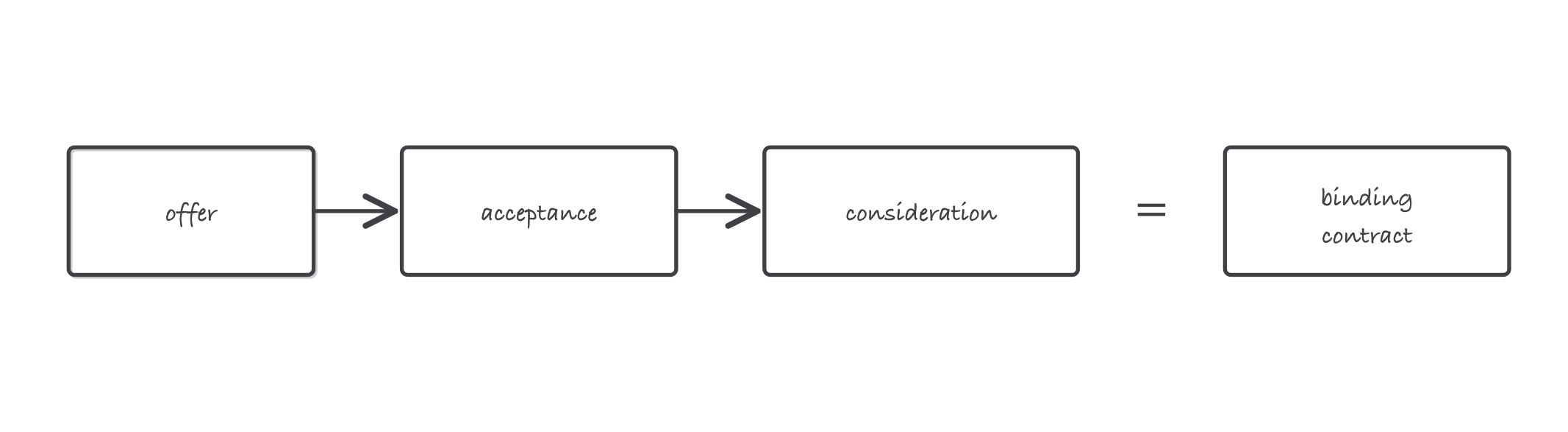
Offer, acceptance and consideration: the ingredients courts look for before a deal binds
Where it bites
- Signing the other side’s paper unread. Owner-drafted and GC-drafted contracts allocate risk away from the drafter. Every clause you did not read is a clause someone wrote for their benefit, not yours.
- Starting work before signatures. Work performed under a draft contract is work performed under terms nobody has agreed to. If the relationship sours in week two, you have no document to stand on.
- Assuming the proposal equals the contract. If the signed agreement does not attach or reference your proposal, your exclusions and clarifications may not exist legally.
- Ignoring the order of precedence. Bidding from the drawings alone when the specifications carry a harsher requirement, and the specs take precedence, is a priced-in loss.
Exam relevance
State business and law exams test contract formation directly: what constitutes offer, acceptance and consideration, when a contract must be written, and the consequences of contracting without a license. Expect questions on the document stack and on which terms control when documents conflict. The exam treats the contract as the center of contractor business management, and so should you.