Qualifications · General Contracting
The Business and Law Exam
Part of Contractor License, Start to Finish · step 2 of 21 · next: License Classifications and Monetary Limits
In learning paths: Contractor License, Start to Finish
Assumes you know: How Contractor Licensing Actually Works
The business and law exam is the half of contractor licensing that trade skill cannot carry you through. Nearly every licensing state requires it, the content is remarkably consistent nationwide, and it fails experienced builders every week, because it tests the office, not the jobsite.
*Learn the Trades is a free study resource. We are not a licensing body, an authorized training provider, or an exam administrator. Reading this page does not award any card, license, or certification. Always verify requirements with the issuing authority linked in the sources.*What it covers
The syllabus across states maps closely to the NASCLA Contractors Guide to Business, Law and Project Management, the reference many states designate. Its three parts are effectively the exam outline:
- Starting the business, entity types and their consequences, licensing law, insurance kinds and minimums, bonds, basic marketing and planning.
- Running the business, estimating, contracts and changes, scheduling, project management, safety obligations (OSHA duties as an employer), environmental responsibilities.
- The people and the money, payroll and employment law, employee versus subcontractor classification, taxes, financial statements, cash management, and lien law with its unforgiving deadlines.
Every one of those areas is a lesson in this Business section: the exam is, in effect, a test over this curriculum.
How to prepare
- Get your state’s candidate bulletin: it names the exact reference books, whether the exam is open-book, and the weighting.
- If open-book: buy the actual designated editions, tab them, and practice retrieval: the exam is a navigation race, like the trade exams.
- Focus study where builders are weakest: lien deadlines, employment classification, and insurance types are the classic point-losers.
- Treat the practice as free consulting: everything the exam makes you learn is something your first year in business will test again, for real money.
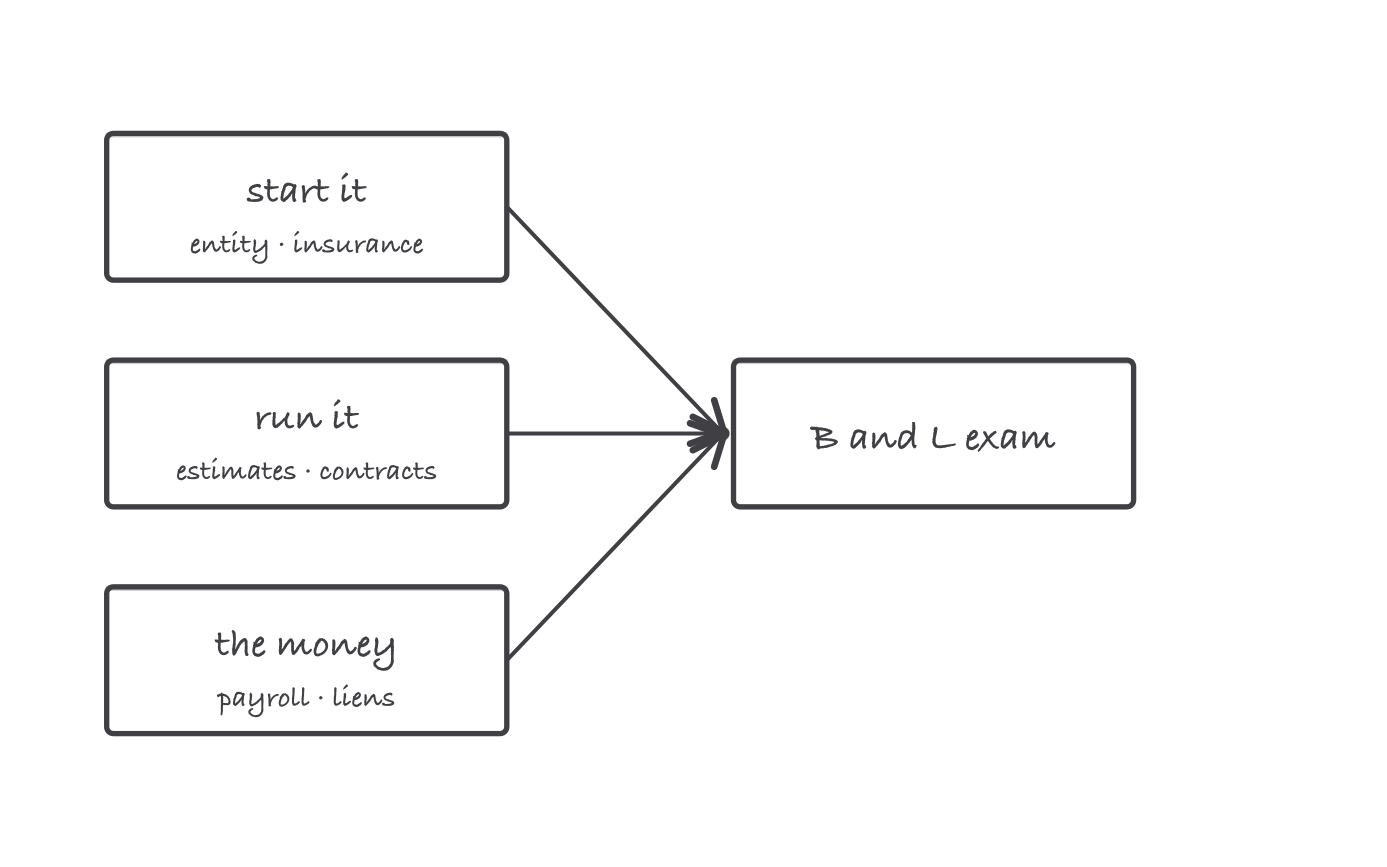
The exam is the office side of contracting, in three parts
Where it bites
- Field veterans underestimate it precisely because they are veterans: the exam contains almost nothing you learned on the tools.
- Designated reference editions change; studying an outdated edition means page-number answers that no longer line up.
Sources
- NASCLA, Contractors Guide to Business, Law and Project Management (the widely designated reference)
Verified requirements
| Where | Expires | Renewal | Continuing education |
|---|---|---|---|
| California | Yes | 2 years (CSLB: 'Active licenses expire every two years.' Inactive licences expire every four years.) | Confirm with issuer |
| Florida | Confirm with issuer | Confirm with issuer | Confirm with issuer |
| Arizona | Confirm with issuer | Confirm with issuer | Confirm with issuer |
Information comes from issuing-authority sources. Confirm current rules, fees and eligibility with the authority before acting.