Business · General Contracting
Delays, Claims and Notice Requirements
Assumes you know: Change Orders
A delay claim is a request for more time, more money, or both, made under the contract because something outside your control pushed the work. Whether you get anything depends on two questions asked in order: what caused the delay, and did you give notice the way the contract requires? Strong causes die on weak notice every day.
This is contract mechanics as business practice, not legal advice. Claims law and notice enforcement vary by state and by contract form; on a claim worth real money, involve a construction attorney early.
Why it matters on the job
Time is the most expensive thing on a project. A delayed job carries extended supervision, extended general conditions, idle equipment and pushed-back revenue, and may be accruing liquidated damages on top. The contractor who understands delay categories and notice discipline recovers time and money; the one who “stays positive and catches up” donates both.
The three kinds of delay
Sort every delay into one of three boxes:
- Excusable and compensable: caused by the owner or their side, design errors, late owner decisions, restricted access, owner-directed changes. You are entitled to time and money.
- Excusable, not compensable: caused by neither party, unusually severe weather, area-wide strikes, acts of God. You are typically entitled to time but not money: the schedule moves, each side eats its own costs. Note the standard is weather beyond what is normal for the season and location; ordinary winter is in your bid.
- Non-excusable: caused by you or your subs. No time, no money, and if there are liquidated damages, they may be running.
Two complications matter. Concurrent delay: when an owner delay and a contractor delay overlap, many contracts and courts award time but not money for the overlap. The critical path test: a delay generally matters only if it delays the project’s completion, not just one activity. An activity sitting on float can slip without moving the end date, and claims built on non-critical slippage go nowhere.
Notice: the clock inside the contract
Nearly every contract requires written notice of a delay or claim within a stated period after the event begins, and many say that missing the window waives the claim. The periods are often short, and courts in many states enforce them. Read your clause, diary the number, and build the habit: when something smells like a delay, notice goes out now, in writing, to the named recipient, in the form the contract specifies. Notice is not aggression; it is the procedure both parties signed. A professional notice letter states the event, the date it began, the expected impact, and reserves your rights while details develop.
Worked example: sorting one event
On day 40, the owner’s redesign of the storefront stops exterior framing for 8 working days. Framing is on the critical path. Category: owner-caused, so excusable and compensable. Same week, your drywall sub loses a crew for 3 days on an interior area holding 10 days of float. That slippage moves nothing and claims nothing. Your notice letter, sent within the contract’s window, claims 8 days of time plus extended general conditions: site supervision and trailer costs at your daily rate, say $850 per day × 8 days = $6,800. The claim is documented from daily logs showing the stop date, the crews affected and the restart.
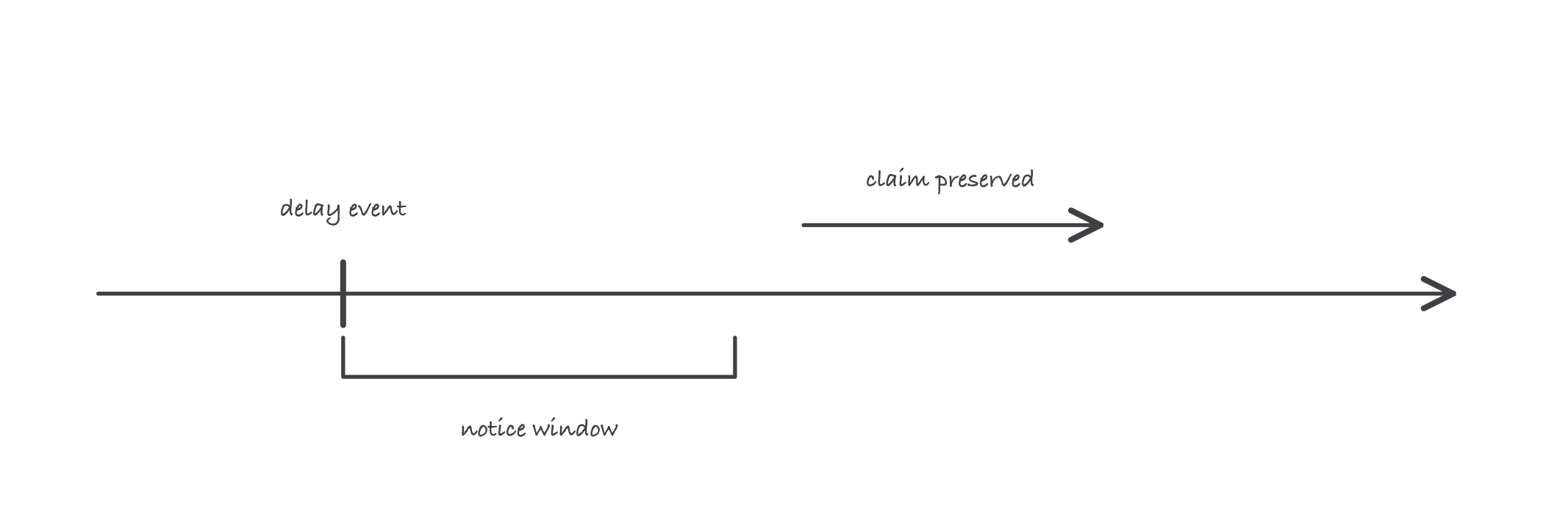
The claim is born when the event happens and dies when the notice window closes without a letter
Where it bites
- Late notice. The most common claim killer in construction. The field waits to see if the delay “works itself out,” and the window closes. Send notice early; withdrawing a claim that resolved costs nothing.
- Claiming non-critical delay. If the activity had float, the end date did not move and neither does money. Know your critical path before you write the letter.
- No contemporaneous records. A claim assembled at closeout from memory loses to daily logs written the week it happened. The delay you cannot document is a delay you cannot price.
- Accepting time without money, silently. Signing a time extension that says nothing about cost can waive the cost. Reserve rights in writing when the money is not yet agreed.
Exam relevance
Business and law exams test delay classification and notice mechanics: which delays earn time, which earn money, what concurrent delay does, and what happens when contractual notice requirements are ignored. Scenario questions hand you a cause and a missed deadline; the tested answer is usually that the paperwork, not the weather, decided the outcome.