Business · General Contracting
Material and Equipment Costing
Assumes you know: Quantity Takeoff
The number that belongs in your estimate is not the quoted price of material: it is the delivered cost, with waste, tax and freight on top. Equipment works the same way: the rental rate is the start of the cost, not the end of it.
Why it matters on the job
Material and equipment feel like the safe part of an estimate because a supplier hands you a number in writing. But the quote is for material sitting on their shelf. Getting it to your site, cut to fit with offcuts in the dumpster, taxed by the state and delivered on a truck adds real percentage points, and a bid that ignores them gives away margin the estimate claimed to have.
Material: from quote to delivered cost
Four adjustments turn a quote into an estimating number:
- Waste. Cuts, breakage, lap and theft. The factor depends on the material and the shape of the work: sheet goods and lumber typically carry more waste than bagged or bulk goods, and complicated layouts carry more than simple ones. Use factors from your own job history where you have it.
- Sales tax. Applied at your actual local rate on taxable materials. Never skip it because the quote did.
- Freight and handling. Delivery charges, fuel surcharges, and your own labor to unload and move it twice.
- Escalation. A quote valid for 30 days does not protect a bid the owner holds for 90. Either get the supplier to hold pricing in writing, or carry an allowance and say so in your qualifications.
Worked example: a lumber package
- Supplier quote: $10,000.
- Waste at 5 percent: $10,000 × 0.05 = $500. Subtotal $10,500.
- Sales tax at 8 percent (illustrative; use your local rate): $10,500 × 0.08 = $840.
- Freight: $250.
Delivered cost: $10,500 + $840 + $250 = $11,590. That is 15.9 percent above the quote. Carry $10,000 and the missing $1,590 comes out of profit.
Equipment: own the whole week, not the dig
Rental houses price by the day, week and month, and the week is usually the unit that matters. A mini excavator at $1,800 per week with $350 delivery and pickup, burning 5 gallons of diesel per working day at $4.20 per gallon:
- Job needs 8 working days, which spans 2 rental weeks: 2 × $1,800 = $3,600.
- Delivery and pickup: $350.
- Fuel: 8 days × 5 gal × $4.20 = $168.
Equipment cost: $3,600 + $350 + $168 = $4,118. Note the trap in step one: 8 working days is not 1.6 weeks of rent. You pay for the calendar the machine sits on your site, including the days it waits on weather and inspections.
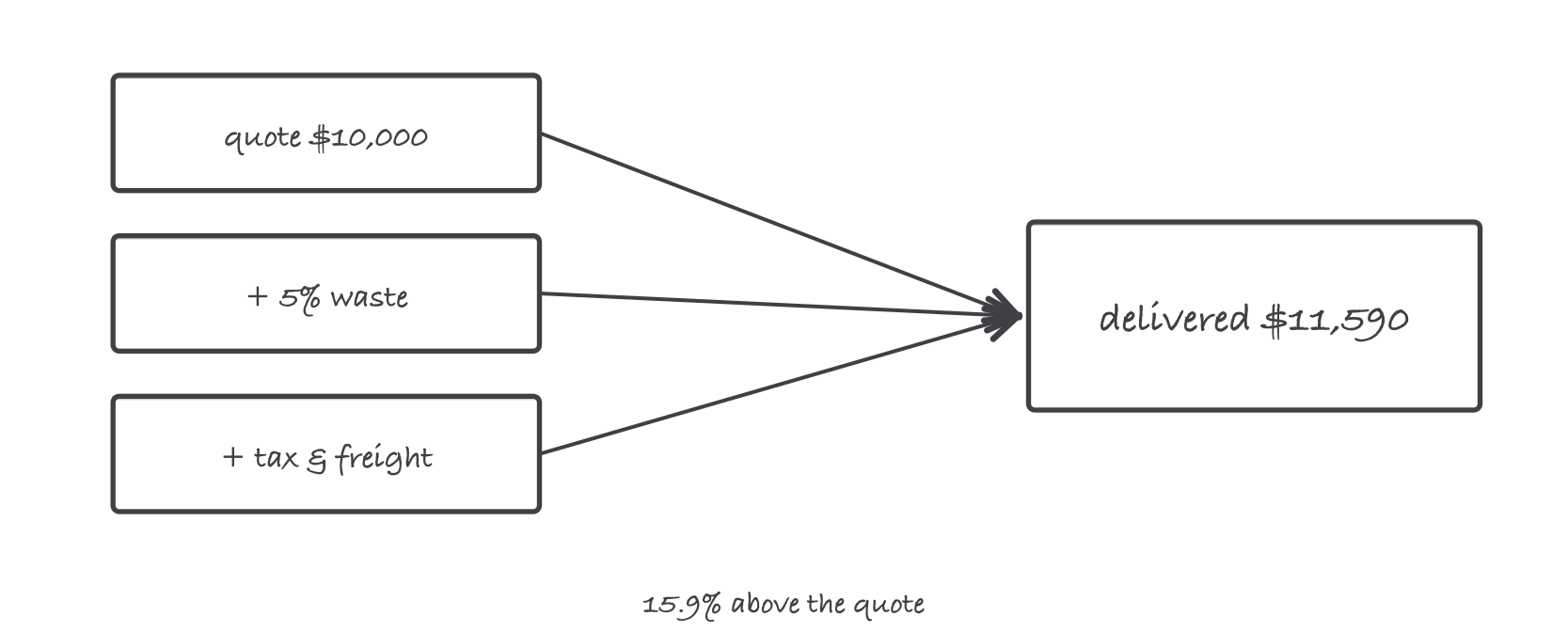
The estimating number is the delivered cost, almost 16 percent above the quote in this example
Where it bites
- Quote expiry. The supplier’s 30-day price against the owner’s 90-day bid hold is a gap someone pays for. Make it not be you: written price protection or a stated escalation qualification.
- Unit mismatch. You took off square feet, the supplier quoted per square yard or per thousand. Reconcile units before multiplying, every time.
- Rented equipment on standby. The machine bills while it waits. Schedule slips are equipment cost increases, which is one more reason general conditions and schedule belong in the same conversation.
- “Delivered” that is not. FOB the supplier’s yard means the freight is yours. Read the quote’s terms line, not just its number.