Business · General Contracting
Estimating Mistakes That Kill Contractors
Assumes you know: Overhead, Markup and Margin
The expensive estimating mistakes are boring ones. Not exotic misjudgments: something left out, a unit confused, a number copied wrong, a scope gap between subs. Every one of them is invisible in the winning bid and permanent in the contract.
Why it matters on the job
An estimating error has a cruel asymmetry. Estimate high and you lose the bid, which costs you the estimating time. Estimate low and you win the job, which costs you the whole error, because the missing money comes out of profit at 100 cents on the dollar. The market systematically awards you your own mistakes.
The classic failures
- Omission. The single biggest killer: an entire item never priced. Final cleaning, hoisting, dumpsters, testing, permits, temporary protection. The fix is a standard checklist, usually organized by CSI division, walked line by line on every bid so “did I price this” never depends on memory.
- Unit errors. Square feet priced as square yards, cubic feet as cubic yards, per-thousand prices applied per-hundred. The arithmetic looks clean, which is why reviews miss it. Sanity-check magnitudes: 1,620 sq ft of carpet is 180 sq yd; if your carpet line implies nine times the money, or one ninth, the units are lying.
- Transfer errors. The takeoff said 21 sheets; the summary says 12 because of a typo. Every hand-off between documents is a chance to drop digits. Recompute totals once, cold, before bid day.
- Wage-only labor. Pricing labor at $28.00 instead of the $46.32 loaded rate from the labor costing lesson understates every labor line by roughly 40 percent.
- Hero production rates. Pricing at the speed of your best crew on their best day. Estimate from your job-cost records, which average in the rain and the bad days.
- Sub scope gaps. Two subs, each excluding the same item, each assuming the other has it. Scope-check quotes against your checklist, not against each other.
Worked example: what one omission does
Your bid: $250,000, carrying $20,000 of planned profit (8 percent of price). You forgot final cleaning and dumpsters: $8,000.
- The price cannot change: the contract is signed at $250,000.
- The $8,000 is real work that must be done and paid for.
- Profit: $20,000 − $8,000 = $12,000.
A 3.2 percent estimating miss ($8,000 on $250,000) destroyed 40 percent of the profit ($8,000 of $20,000). That leverage, small miss against the price but huge against the profit, is why estimating discipline is profit discipline.
The defenses
- A checklist you never skip, updated every time a new mistake teaches you a line.
- A second person reviews every bid: fresh eyes, recomputed totals, units challenged.
- Order-of-magnitude checks: dollars per square foot against your own history for that building type. A bid 20 percent below your usual range is not a triumph; it is a search warrant.
- Job costing after the win, so estimate and reality confront each other and next year’s numbers improve.
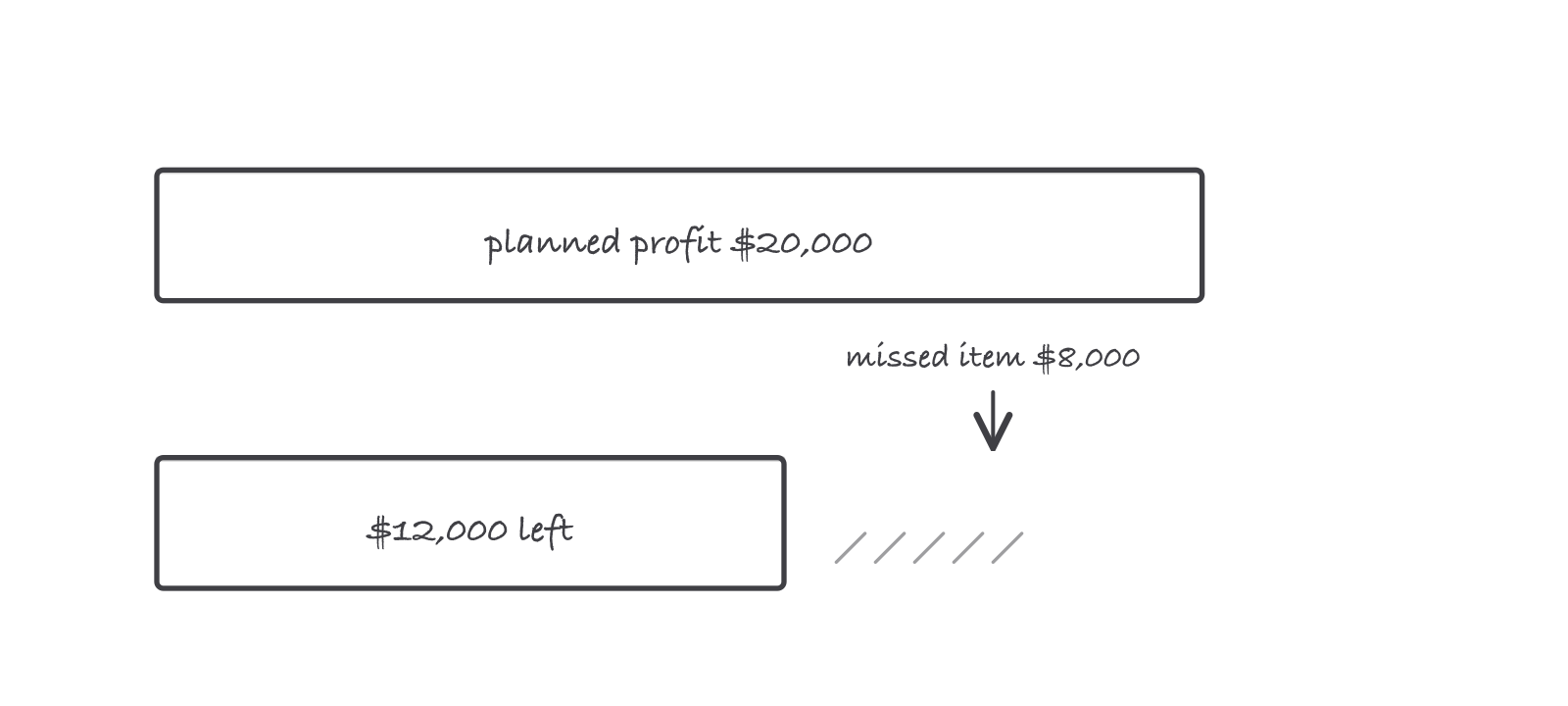
The price is locked, so a missed item is paid entirely out of the profit slice
Where it bites
- The confident lowball. Being far below every other bidder feels like winning. Before you sign, treat a big spread as evidence of your own error and re-walk the estimate.
- Reviewing your own work. You will re-read your assumption, not your arithmetic. The person who made the estimate is the person least able to find its holes.
- Fixing errors with hope. “We will make it up in the field” is not a plan; production rates do not improve because you need them to.
- Not writing the lesson down. An estimating mistake you pay for twice is a bookkeeping failure. The checklist only compounds if every miss becomes a new line on it.