Business · General Contracting
Employee vs Subcontractor Classification
Assumes you know: Hiring and Employment Law Basics
Whether a worker is an employee or a subcontractor is a question of fact about control, not a question of labels. No contract clause, no 1099 form and no handshake agreement makes someone a subcontractor. What decides it is how the working relationship actually operates, and agencies apply a control-based test to find out.
This lesson teaches the test’s pattern and the stakes. The exact criteria vary by agency and state, and some states apply stricter tests than others: classification calls belong with your accountant or attorney, made before the worker starts, not after a claim.
Why it matters on the job
The temptation is obvious: pay someone as a sub and there is no payroll tax, no workers comp premium, no overtime, no withholding. Roughly the loaded-rate burden from the hiring lesson, saved. Which is exactly why enforcement looks hard at construction, and why the unwinding is so expensive: everything you skipped comes back at once, plus penalties, for every misclassified worker, for every year.
The control test: three families of factors
Agencies weigh many factors, but they cluster into three families. No single factor decides; the whole picture does.
Behavioral control. Who directs how the work is done? An employee is told when to show up, in what order to work, with what methods, and is trained and supervised by you. A genuine subcontractor is handed a scope and a deadline and decides the how themselves, with their own supervision.
Financial control. Whose business is at stake? Employees are paid by the hour or week, use your tools, and cannot lose money on the arrangement. A subcontractor prices the scope, invoices, runs their own tools and equipment, carries their own insurance, can profit or lose on the job, and has other customers.
Relationship. What does the arrangement look like over time? Indefinite, continuous, full-time work that is the core of your business looks like employment. A defined engagement, scope by scope, for a business that exists independently of you, looks like subcontracting.
The honest shortcut: if the worker’s business would not exist without you, and you direct their day, they are probably your employee.
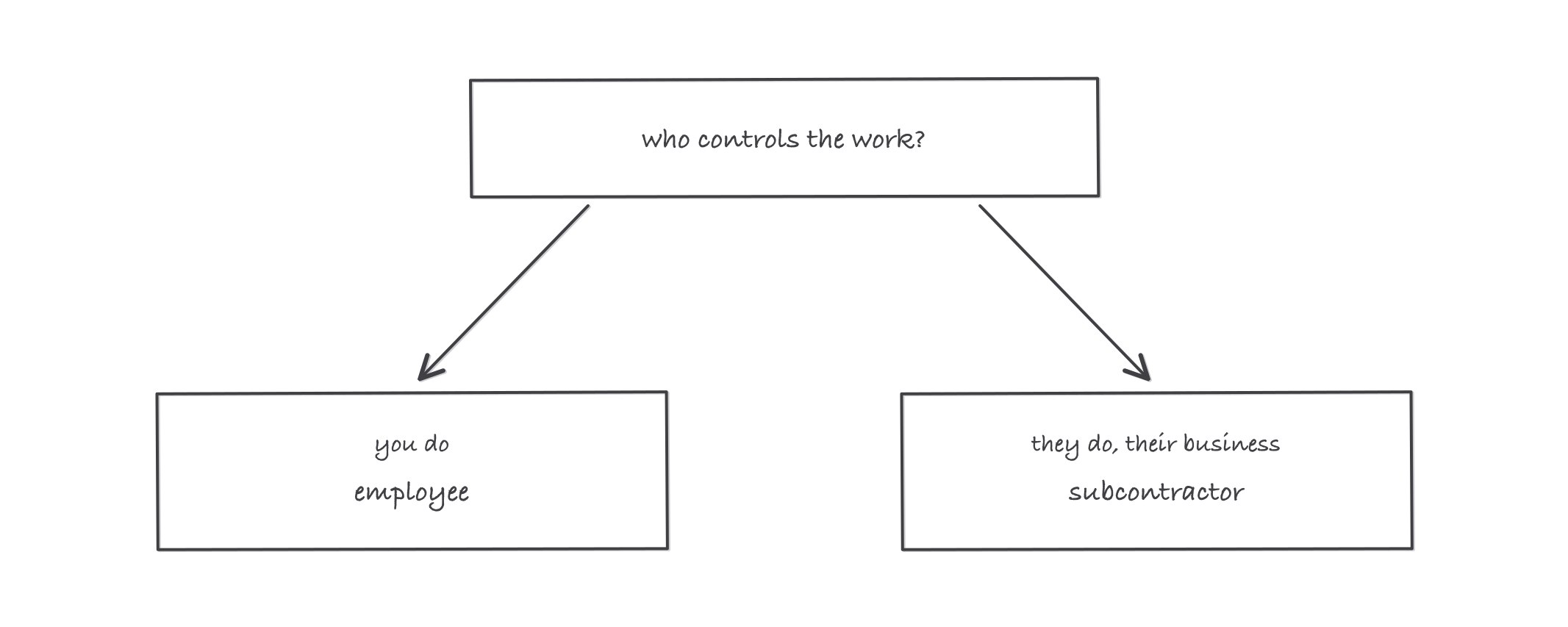
The label on the paperwork does not decide; the direction of control does
The pattern in practice
Compare two carpenters on your jobs. One works your hours, on your schedule, with your tools, only for you, paid weekly: employee, whatever the paperwork says. The other runs a two-person trim company, quoted your job from plans, carries general liability and comp on their own crew, invoices by the scope, and is working three other builders this month: subcontractor. Most real cases sit between these, which is why the call deserves professional eyes.
Protect legitimate sub relationships with the paperwork that reflects reality: a written subcontract per scope, the sub’s certificate of insurance on file, their invoices rather than your timesheets, and their license number where the trade requires one. The paperwork does not create the status, but it evidences the facts that do.
What misclassification costs
When a misclassified worker is reclassified, the employer typically faces back payroll taxes both shares, penalties and interest, retroactive workers comp premiums, exposure for unpaid overtime, and liability for the injury or unemployment claim that usually triggered the audit in the first place. Note that trigger: these cases rarely start with an inspector. They start when the “sub” gets hurt with no comp coverage, or files for unemployment, and an agency asks what the relationship really was.
Where it bites
- “But they signed an independent contractor agreement.” A contract that contradicts the facts is evidence of nothing except that you knew the question existed.
- “But they wanted to be paid on a 1099.” The worker’s preference does not change the law, and the worker will not bear the penalties. You will.
- “Everyone in this market does it.” Common is not compliant, and enforcement sweeps are industry-wide precisely because it is common.
- One test passed is not all tests passed. Different agencies apply different versions, and satisfying one does not bind another. When the relationship is close to the line, get advice, or hire properly.