Business · General Contracting
Contract Clauses That Matter
Part of Contractor License, Start to Finish · step 13 of 21 · next: Subcontract Agreements
In learning paths: Contractor License, Start to Finish
Assumes you know: Contract Types: Fixed, Cost-Plus, T&M, GMP
A handful of clauses decide who gets paid, when, and who eats the loss when a project goes sideways. Most of a construction contract is boilerplate you can live with. These are the clauses you read twice, price, and negotiate. This is business practice, not legal advice: enforceability of several of these clauses varies sharply by state, and a construction attorney in your state is the authority on yours.
Why it matters on the job
Contracts allocate risk, and risk is money. A clause that shifts a payment risk or a delay risk onto you has a price, whether or not you charged for it. Contractors who read only the price and the schedule are agreeing to numbers they never saw.
Payment clauses
Pay-when-paid says the GC pays the sub after the owner pays the GC, and courts in many states read it as a timing clause: payment can be delayed a reasonable time, but not withheld forever. Pay-if-paid goes further: owner payment is a condition of any payment at all, shifting the owner’s insolvency risk down the chain. Some states enforce pay-if-paid when drafted clearly; others restrict or void it. Know which words are in your contract and what your state does with them.
Retainage clauses hold back a percentage of each payment, commonly 5 to 10 percent, until completion. On a $400,000 subcontract at 10 percent, that is $40,000 of your money funding the project until closeout. Price the carrying cost, and note when the contract says retainage is released.
Risk-shifting clauses
Indemnification makes you cover someone else’s losses. Watch the breadth: an indemnity covering claims “arising out of” your work, even when caused by the other party’s own negligence, is far heavier than one limited to your negligence. Many states restrict the broadest forms in construction contracts, but the safe practice is to negotiate the words, not to bet on a statute.
Liquidated damages fix a daily price for late completion, say $1,500 per day. Finish 12 days late and you owe $18,000: no argument about actual damages, just arithmetic. LDs are enforceable in general when they are a reasonable pre-estimate of loss rather than a penalty. Price the schedule risk before you sign the number.
No-damages-for-delay says that if the project is delayed, even by the owner, your remedy is more time, never money. Extended overhead, idle equipment, remobilization: all uncompensated. Some states limit these clauses; every contractor should surface them at bid time and price or negotiate them.
Control clauses
Changes: who can order changes, how they are priced, and what you must do when directed to proceed. Termination for convenience lets the owner end the contract without cause, usually paying cost to date plus limited overhead, and rarely lost profit on unbuilt work. Order of precedence decides which document wins a conflict. Notice provisions set short windows for claiming time or money; miss the window and many contracts say the claim is waived.
Worked example: pricing one clause
A proposed contract carries liquidated damages of $1,500 per day and a schedule you judge to have a realistic risk of running 10 days over. Expected exposure: 10 days at $1,500 is $15,000. Your options are to negotiate the rate down, buy the schedule risk out with acceleration money, or carry $15,000 of contingency in the bid. Doing none of the three means you priced the risk at zero and kept it anyway.
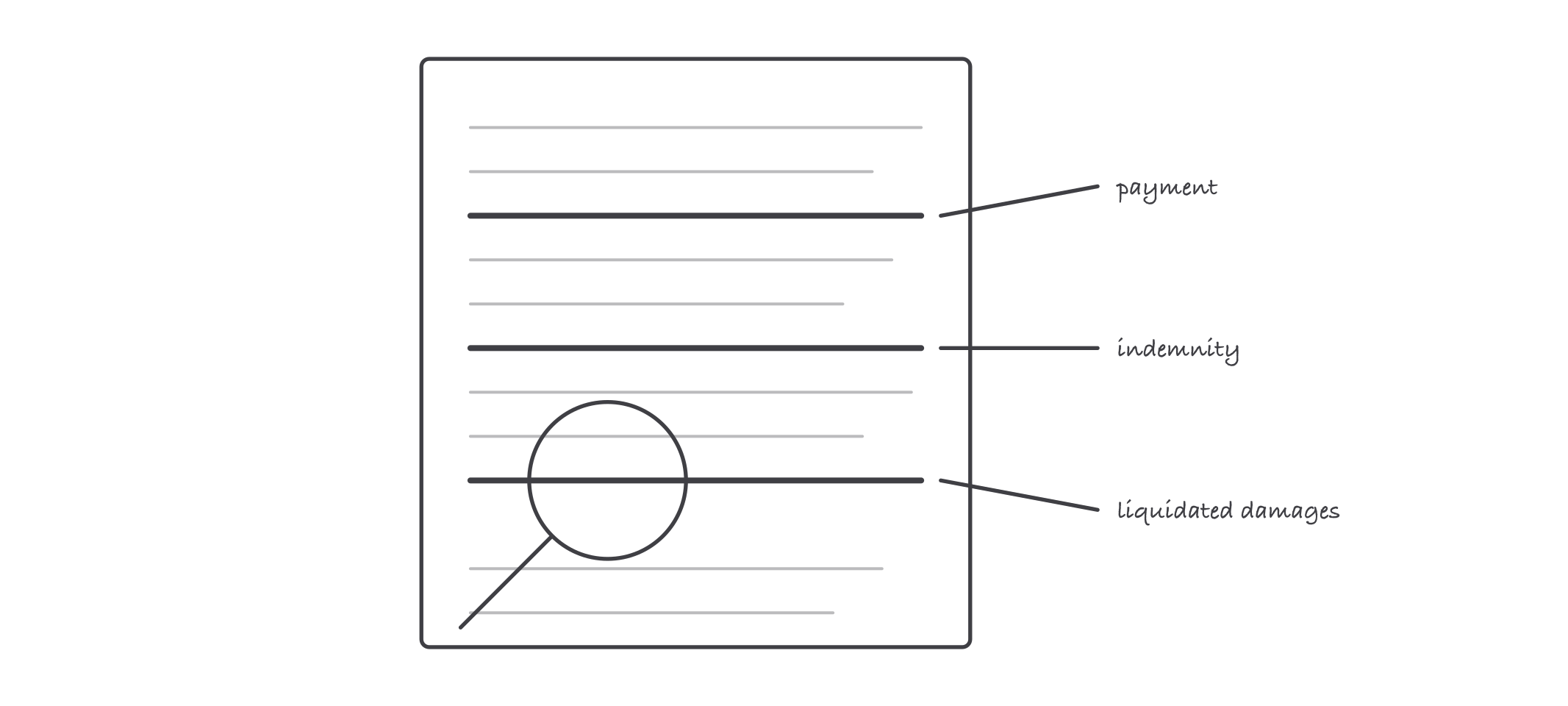
Most boilerplate is survivable: the payment, indemnity and damages clauses are where the money moves
Where it bites
- Treating pay-if-paid as pay-when-paid. One is a delay, the other can be a total bar. The difference is a few words and, in a bad year, your solvency.
- Signing broad-form indemnity without insurance to match. If your policy excludes liability you assumed by contract, the indemnity is coming out of the business, not the carrier. Have your agent read what you sign.
- Missing notice windows. The best-documented claim in the world dies if the contract required notice in writing within a set number of days and you called instead. Diary the notice periods the day you sign.
- Assuming a clause is unenforceable. “That would never hold up” is a legal opinion. Buy one from an attorney; do not improvise it.
Exam relevance
Business and law exams test clause recognition and effect: what pay-if-paid does, how liquidated damages are computed, what indemnification means, and what notice failures cost. Scenario questions give you a clause and a set of facts and ask who bears the loss. Learn each clause as a risk-transfer device and the answers follow.