Learn · HVAC/R
Chilled-Water Pumping
Part of Commercial HVAC Systems · step 3 of 10 · next: VRF and VRV Systems
In learning paths: Commercial HVAC Systems
Assumes you know: Chillers
Chilled-water pumps move water between the chiller evaporator and building coils. Their arrangement determines which pump maintains chiller flow, which pump answers building demand, and how variable-speed control changes the operating point.
Why it matters on the job
A warm building with a running chiller may have the wrong water flow. The problem can be a pump, valve, strainer, air pocket, control sensor, bypass, or coil. Plant diagnosis follows flow and differential pressure, not only leaving-water temperature.
Primary-only and primary-secondary
In a primary-only system, one pumping loop moves water through both chillers and building coils. It may operate at constant or variable flow, subject to the chiller’s allowed flow range and the plant design.
In a primary-secondary system, primary pumps circulate through the chillers while secondary pumps circulate through the building. A common pipe or hydraulic bridge lets the two loop flows differ without forcing one pump set to become the other set’s series pump.
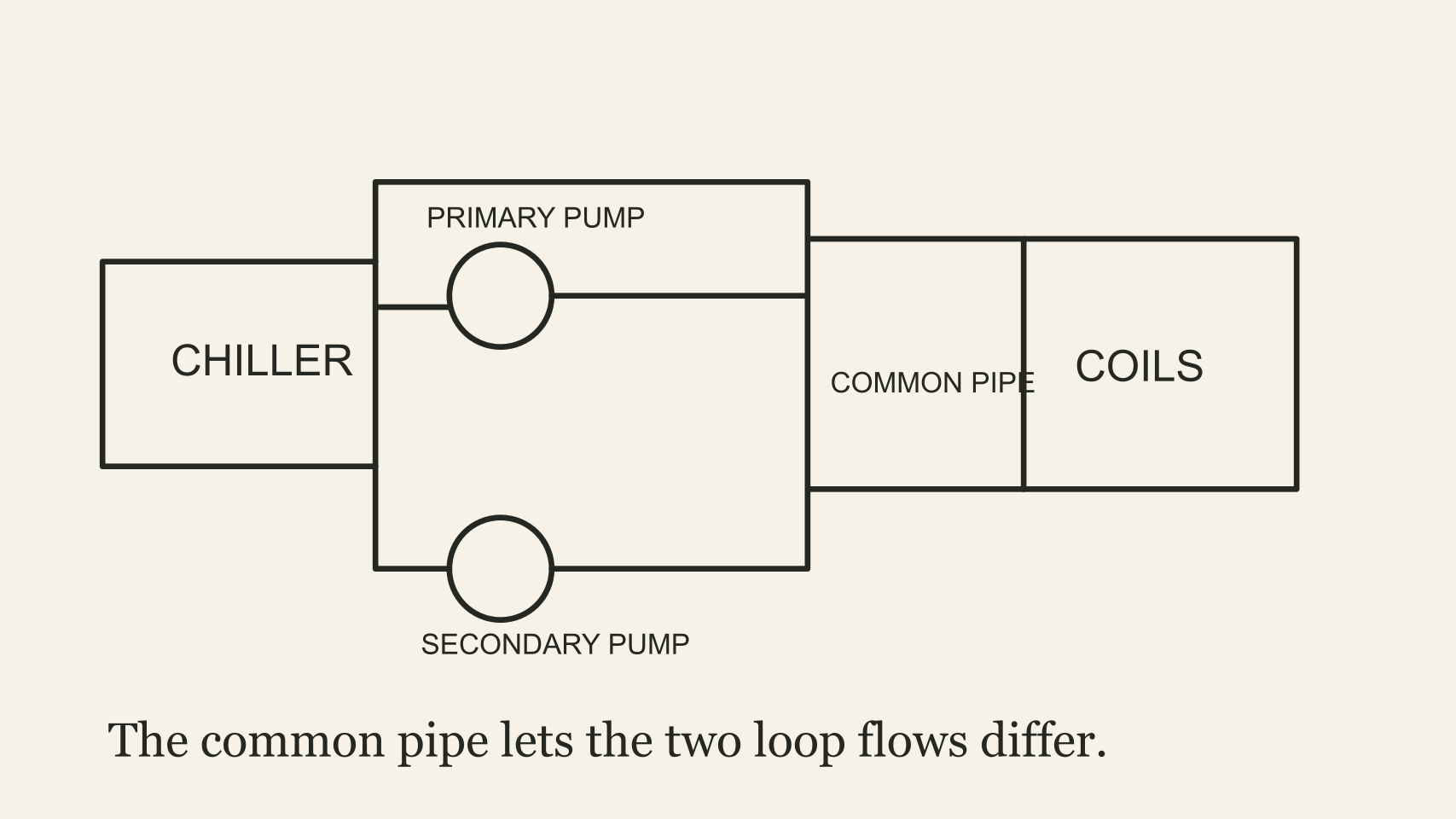
The common pipe separates chiller-loop flow from building-loop demand
Worked example
An illustrative primary loop delivers 600 gpm through the operating chillers while the secondary loop currently needs 450 gpm.
- Primary flow: 600 gpm
- Secondary flow: 450 gpm
- Difference through the common pipe: 600 − 450 = 150 gpm
The extra 150 gpm returns through the common pipe toward the primary return. If secondary demand rises to 700 gpm while primary flow remains 600 gpm, the secondary loop draws 100 gpm from the return side through the common pipe, which mixes warmer return water into the secondary supply. Flow direction at that connection is a powerful operating clue.
Where it bites
- Pump speed is not flow. Confirm with a flow meter, calibrated differential pressure, or another valid method.
- Do not violate chiller flow limits. Variable primary flow stays inside the manufacturer’s permitted range and rate of change.
- A wide-open remote valve may be asking for pressure. Check whether the differential-pressure sensor and setpoint represent the critical path.
- More pumping can reduce plant efficiency. Judge the whole plant, including pumps, chillers, and towers.