Learn · HVAC/R
Air-Handling Units
Part of Commercial HVAC Systems · step 5 of 10 · next: Filtration and Pressure Drop
In learning paths: Commercial HVAC Systems
Assumes you know: Airflow Fundamentals
An air-handling unit, or AHU, is the central air path for a building or group of zones. It mixes outdoor and return air, filters it, changes its temperature and moisture condition, and uses a fan to deliver it through the duct system.
Why it matters on the job
An AHU is not one component. A bad space condition can begin at the outdoor-air damper, filter bank, coil valve, fan, sensor, or duct system. The useful diagnostic habit is to walk through the unit in the same direction as the air.
Read the sections in order
Return air and outdoor air meet in the mixing section. The mixed air crosses filters and heating or cooling coils. The fan supplies enough pressure to overcome the unit and distribution losses. Humidification, heat recovery, sound control, or additional filter stages may appear in the path.
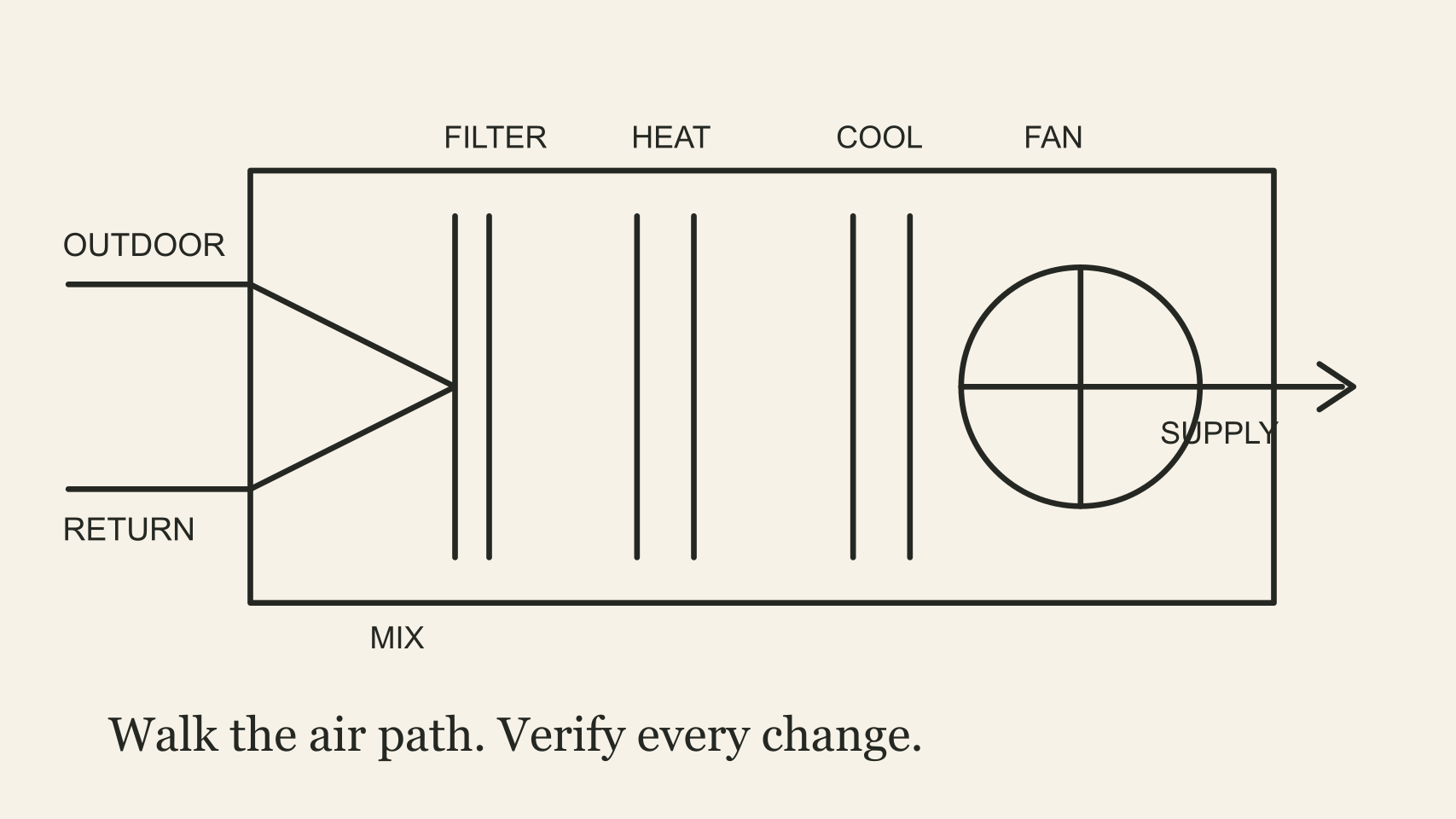
Temperature, pressure, and command checks belong to the section where the air changes
At each section compare three things: the control command, the physical position or condition, and the measured result. A cooling-valve command is not proof of water flow. A damper-position graphic is not proof that the blades moved. A fan-status point is not proof of delivered airflow.
Worked example
An illustrative AHU handles 12,000 cfm. Outdoor air is 20% of the total airflow under the current operating condition.
- Outdoor airflow: 12,000 cfm × 0.20 = 2,400 cfm
- Return airflow: 12,000 cfm − 2,400 cfm = 9,600 cfm
- If a field measurement finds only 1,200 cfm outdoors, the actual fraction is 1,200 ÷ 12,000 = 10%
The calculation identifies a mismatch. It does not identify the cause. Damper calibration, pressure relationships, intake blockage, measurement method, and fan operation still need to be checked.
Where it bites
- Follow the active sequence. Occupied, warm-up, economizer, cooling, heating, and smoke modes create different normal positions.
- Dirty coils and filters affect pressure and heat transfer. They can create a fan complaint and a capacity complaint at the same time.
- Standing water is not an air problem. Drain pans and condensate traps need their own inspection.
- A graphic is only as reliable as its point. Verify what each displayed value physically represents.