Learn · HVAC/R
Mechanical Ventilation and Exhaust
Part of Commercial HVAC Systems · step 9 of 10 · next: Building Controls and BAS Basics
In learning paths: Commercial HVAC Systems
Assumes you know: Air-Handling Units
Mechanical ventilation brings outdoor air into a building and distributes it to occupied spaces. Exhaust removes air from selected rooms or processes. Recirculation and transfer paths connect those flows into a building pressure relationship.
Why it matters on the job
A damper shown at 20% open does not prove a particular outdoor airflow. Wind, intake blockage, fan pressure, duct resistance, damper geometry, and exhaust operation all change the result. Ventilation is an airflow measurement problem.
Account for the whole building
Outdoor air may enter through an AHU, rooftop unit, or dedicated outdoor-air system. Exhaust fans remove air from toilets, kitchens, garages, laboratories, or other spaces. Some air moves between rooms before it reaches an exhaust point.
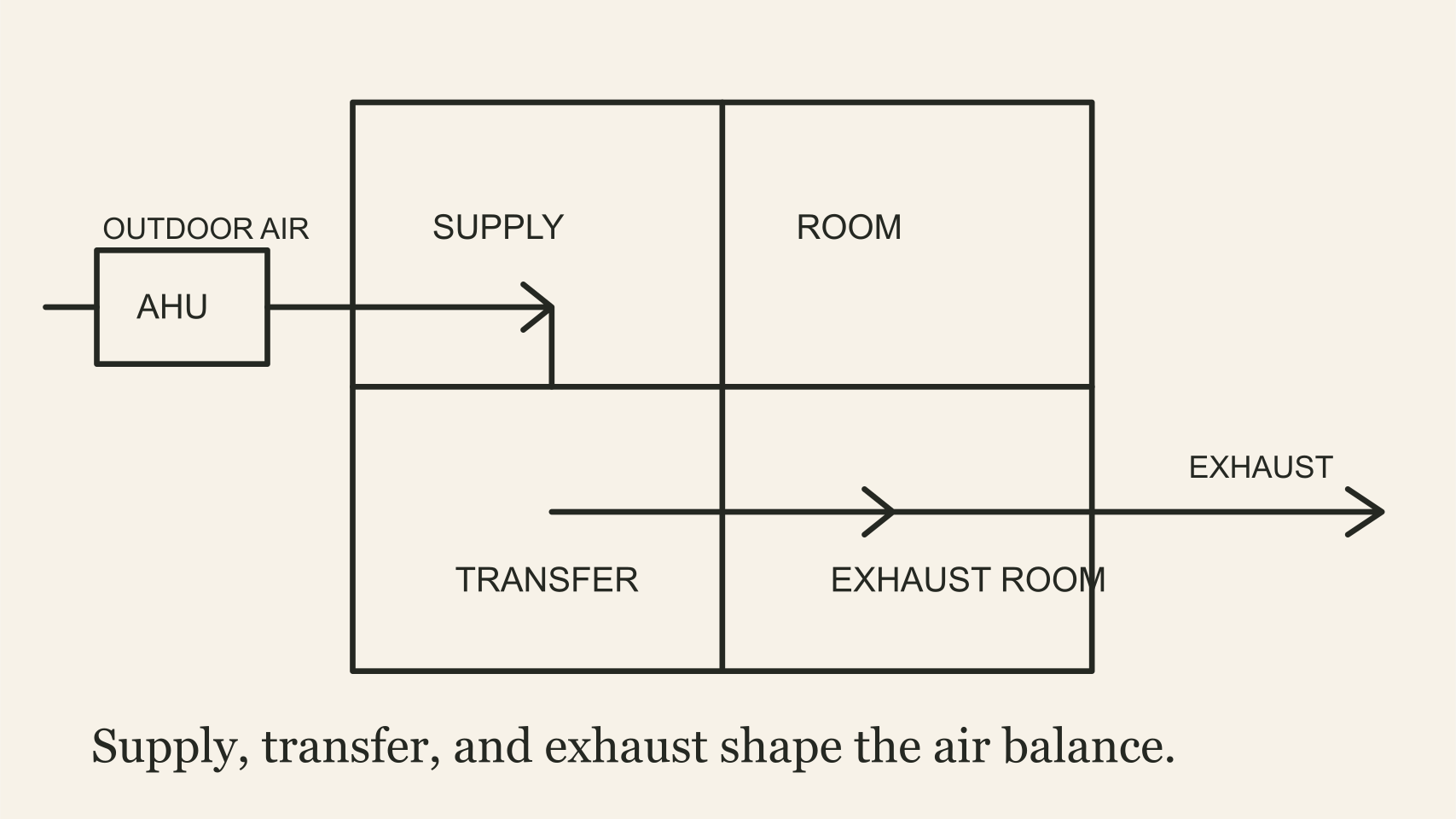
Supply, return, transfer, and exhaust belong to one air balance
If mechanical exhaust exceeds intentional outdoor air, the difference must enter through doors, cracks, shafts, and other leakage paths. If supply exceeds exhaust and return, the building tends to pressurize. The design goal and allowable relationship depend on the space and adopted requirements.
Worked example
An illustrative AHU brings in 3,000 cfm of outdoor air. Toilet and general exhaust remove 2,200 cfm. A process exhaust system removes another 500 cfm.
- Total exhaust: 2,200 + 500 = 2,700 cfm
- Outdoor air minus exhaust: 3,000 − 2,700 = 300 cfm
Ignoring other fans and leakage, the mechanical balance is 300 cfm positive. That estimate does not prove building pressure. Door position, stack effect, wind, duct leakage, and unmeasured systems can dominate the field condition.
Where it bites
- Damper position is not airflow. Measure or calculate airflow using an appropriate field method.
- Minimum outdoor air can disappear at part load. VAV systems need controls that preserve the required ventilation as supply airflow changes.
- Exhaust needs replacement air. An exhaust fan cannot remove air the building cannot supply.
- Outdoor air is not always clean air. Intake location, wildfire smoke, traffic, moisture, and filtration affect operating choices.