Learn · HVAC/R
Variable-Air-Volume Systems
Part of Commercial HVAC Systems · step 7 of 10 · next: Air Terminals and Room Air Distribution
In learning paths: Commercial HVAC Systems
Assumes you know: Air-Handling Units
A variable-air-volume system supplies conditioned air from a central AHU while terminal boxes vary the airflow delivered to individual zones. The central fan and zone dampers respond together as loads change.
Why it matters on the job
One uncomfortable zone can be a local box problem, while many uncomfortable zones can point to the AHU, duct static pressure, supply-air temperature, or controls. VAV diagnosis starts locally and then checks the shared system.
What the box controls
A pressure-independent VAV box measures airflow and modulates its damper toward an airflow setpoint. The zone controller changes that setpoint in response to temperature demand and any active minimum or maximum limits. Some boxes include a reheat coil or fan.
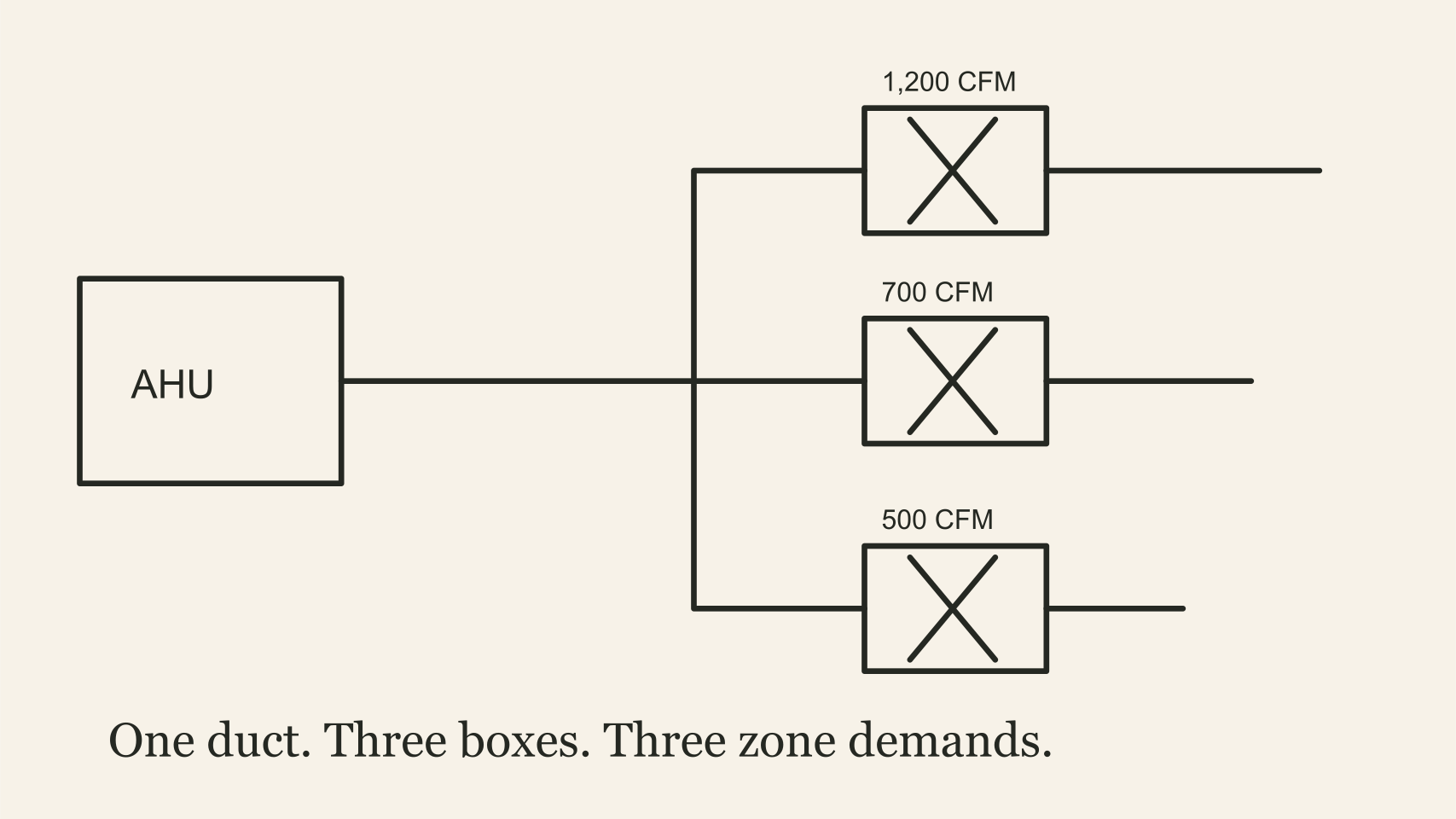
The AHU supplies the shared condition; each terminal meters the amount its zone receives
As terminal dampers close, duct pressure tends to rise. A variable-speed supply fan can slow down to maintain its static-pressure target. The static sensor location and reset logic therefore influence every box on the duct.
Worked example
Three illustrative zones currently request 1,200, 700, and 500 cfm.
- Total terminal demand: 1,200 + 700 + 500 = 2,400 cfm
- The first zone becomes satisfied and drops to 600 cfm.
- New demand: 600 + 700 + 500 = 1,800 cfm
- Airflow demand fell by 2,400 − 1,800 = 600 cfm, or 25%
The fan should respond to the changing system, but its exact speed does not have to fall 25%. Fan curves, leakage, minimum airflow, duct pressure control, and other zones determine the operating point.
Where it bites
- A damper at 100% is a clue, not a diagnosis. It may indicate low duct pressure, a bad airflow sensor, an undersized box, or a genuine high load.
- Minimum airflow has more than one purpose. Ventilation and equipment requirements can keep a box open when the zone needs little cooling.
- Reheat can hide bad upstream control. Simultaneous cooling and heating deserves a sequence review.
- Do not tune one box in isolation. A static-pressure or supply-temperature change affects the whole system.