Learn · Plumbing
Water Pressure and Flow
Part of Journeyman Plumber Exam Prep · step 14 of 31 · next: Cross-Connections and Backflow
Part of Advanced Water Distribution · step 1 of 6 · next: Pressure-Reducing Valves
In learning paths: Journeyman Plumber Exam Prep · Advanced Water Distribution
Assumes you know: Applied Math for Plumbers
Pressure is the stored energy that pushes water through pipe; flow is what you get when you spend it. The two trade against each other: every foot of height climbed, every fitting passed, and every gallon per minute demanded takes pressure away, and your job is to make sure enough is left at the last fixture.
Why it matters on the job
Every complaint that sounds like “weak shower upstairs” is a pressure budget problem. So is every failed inspection for an undersized line. The municipal main typically delivers 40 to 80 psi at the street, and a fixture at the far end of the house typically needs a flowing pressure of around 15 to 20 psi to work as designed, with your code’s tables governing the exact figures. Everything between the street and the shower valve spends from that budget. If you cannot account for where the pressure goes, you cannot size pipe, place a booster, or diagnose a starving fixture.
Static versus flowing pressure
Static pressure is what a gauge reads with no water moving. Flowing pressure, also called residual pressure, is what the same gauge reads while a fixture runs. Static pressure tells you what the system could deliver; flowing pressure tells you what it actually delivers under load. A house can gauge 60 psi static and still starve a shower, because friction losses only appear when water moves. Always ask which one a number is before you use it.
Pressure and height
Water has weight, and a column of it presses down on its base. The conversion is fixed: 1 psi supports a column about 2.31 ft tall, which flips to 0.433 psi for every foot of height. Climb and you lose it; drop and you gain it back. This loss has nothing to do with pipe size or flow rate. A 6 in main and a 1/2 in tube lose exactly the same 0.433 psi per foot of rise.
Friction loss
Moving water rubs against pipe wall and fights its way through fittings and valves, and that rubbing costs pressure too. Friction loss grows with flow rate, grows as pipe diameter shrinks, and accumulates with length. Unlike elevation loss it is zero when nothing runs, which is exactly why static readings hide it. The meter itself is a major friction item; so is an aging gate valve half closed by debris.
Worked example
A shower head sits 30 ft above the street main. The main delivers 65 psi static.
- Elevation loss: 30 ft × 0.433 psi/ft = 12.99, call it 13 psi. Static pressure at the shower head: 65 − 13 = 52 psi.
- Open the valve and the friction bills arrive. Say the meter and service line drop 8 psi at design flow, and the interior piping and fittings drop another 14 psi.
- Flowing pressure at the head: 52 − 8 − 14 = 30 psi. That clears a code-typical fixture minimum of 15 to 20 psi with room to spare.
Run the same arithmetic with a 40 psi main and the margin nearly vanishes: 40 − 13 − 8 − 14 = 5 psi, a starving shower. Same house, same pipe, different street.
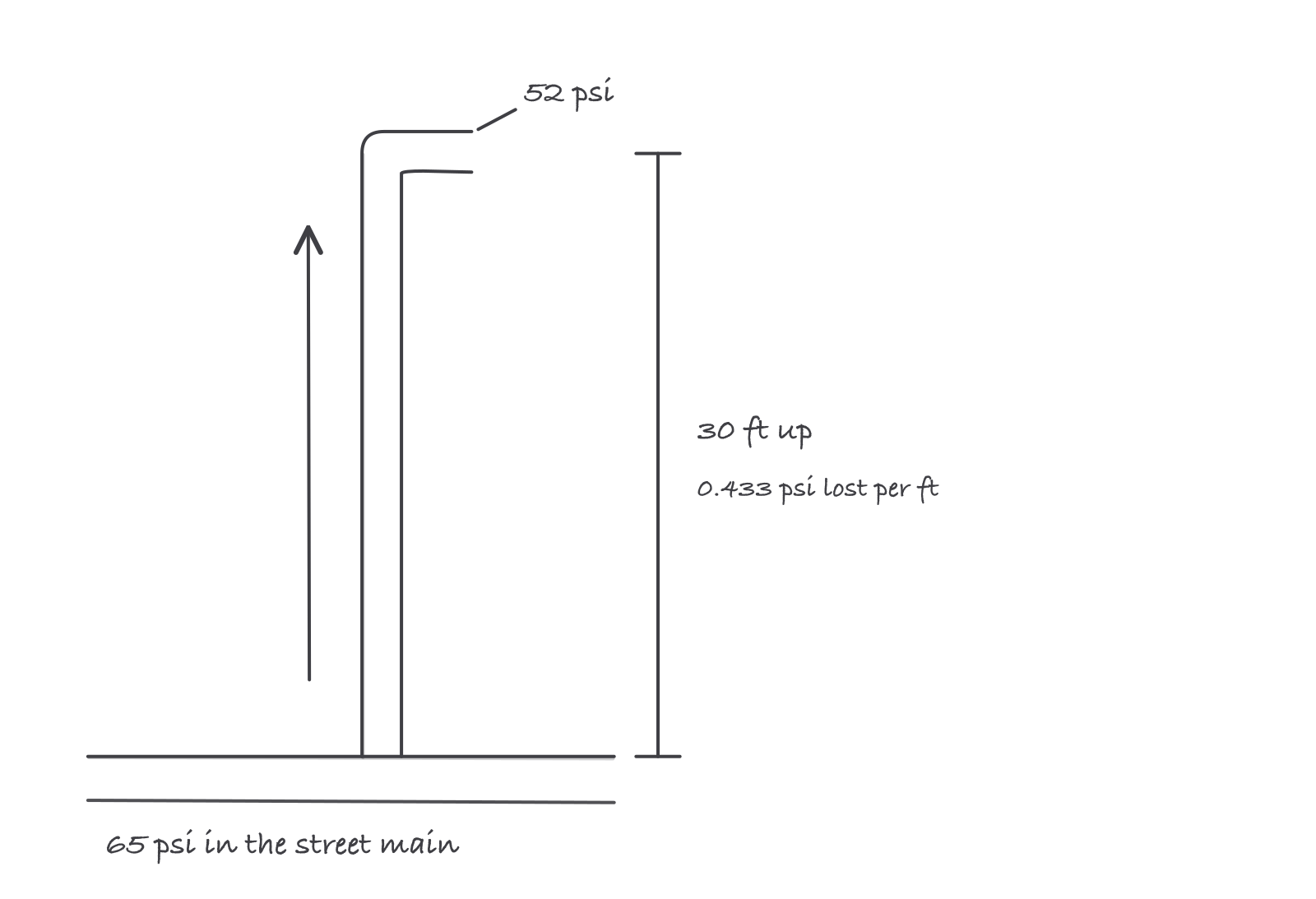
Climbing costs pressure at a fixed rate: 0.433 psi per foot, before a single fitting is counted
Where it bites
- A static gauge reading proves almost nothing. 60 psi static with everything off is compatible with a miserable 10 psi flowing at the tub. Test under flow before you blame the fixture.
- High pressure is a defect, not a bonus. Both model codes require pressure reduction where static pressure exceeds 80 psi. Over that, fixtures erode, washers fail, and water hammer gets vicious.
- Elevation loss cannot be piped away. Upsizing pipe cuts friction loss only. If the budget fails on height alone, the answer is a booster pump, not bigger tube.
- The worst case is the far fixture at peak demand. A system is judged at its weakest point with other fixtures running, not at the hose bib by the meter on a quiet afternoon.
Verified requirements
| Where | Expires | Renewal | Continuing education |
|---|---|---|---|
| Texas | Confirm with issuer | Confirm with issuer | Confirm with issuer |
| Texas | Confirm with issuer | Confirm with issuer | Confirm with issuer |
| Illinois | Confirm with issuer | Confirm with issuer | Confirm with issuer |
Information comes from issuing-authority sources. Confirm current rules, fees and eligibility with the authority before acting.