Learn · Plumbing
Hot-Water Recirculation
Part of Advanced Water Distribution · step 6 of 6
In learning paths: Advanced Water Distribution
Assumes you know: Water Heaters
A hot-water recirculation system returns cooled water from the distribution piping to the water heater instead of sending that standing volume down a fixture drain. A small pump moves the loop, and a control decides when the pump runs.
Why it matters on the job
The water heater can be hot while a distant fixture still waits. The delay lives in the pipe between them: that pipe is full of water that cooled after the previous draw. Recirculation changes the distribution problem without increasing the heater’s recovery rate.
What the loop does
Hot water leaves the heater through the normal supply piping. Near the distant fixtures, a return line closes the path back to the heater. When the pump runs, cooled water in the loop moves back to the heater while hot water advances toward the fixtures.
Short branches connect fixtures to the circulated loop. The loop gets hot water close. The branch still holds a smaller standing volume that must clear when the fixture opens.
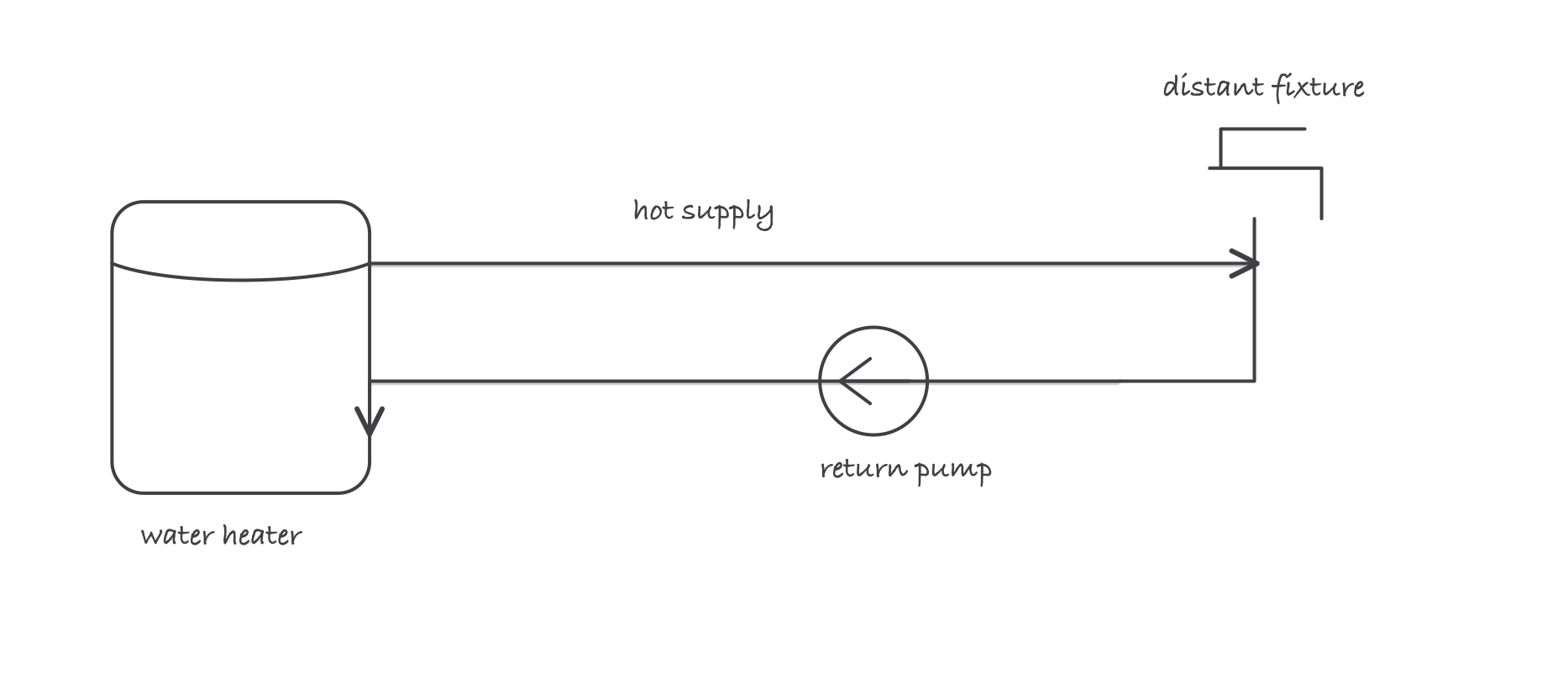
The return path moves standing water back to the heater instead of down the drain
The control is part of the system
A demand-controlled system runs the pump when someone asks for hot water, then stops it after hot water reaches the end of the loop. The Department of Energy identifies demand-initiated control as the preferred way to operate this arrangement.
The pump is not there to raise fixture pressure, and it does not add heating capacity. Its job is circulation. Pump selection, check-valve arrangement, balancing, insulation, and the heater manufacturer’s requirements still belong in the project design.
Worked example
Suppose an uncirculated branch holds an illustrative 0.50 gal between the heater and a fixture. The fixture flows at 2.0 gpm.
- Wait time: 0.50 gal ÷ 2.0 gal/min = 0.25 min
- Convert to seconds: 0.25 min × 60 = 15 seconds
- Water sent down the drain on 4 cold starts per day: 0.50 gal × 4 = 2 gal/day
- Annual standing volume: 2 gal/day × 365 days = 730 gal/year
The numbers are illustrative, but the method transfers. Measure or calculate the actual volume between the heater and the fixture, divide by the fixture flow, and you have the best-case purge time before temperature losses and mixing.
Where it bites
- A recirculation pump does not fix an undersized heater. It shortens distribution delay. It cannot create recovery capacity.
- The return line does not eliminate every wait. Water in the short branch between the loop and fixture still has to clear.
- Control strategy changes the result. A pump that runs on demand behaves differently from one that runs continuously or from a timer that ignores actual use.
- Distance alone does not predict the wait. The standing volume and fixture flow determine the best-case purge time. Two runs of equal length can hold different volumes.