Learn · Plumbing
Pressure-Reducing Valves
Part of Advanced Water Distribution · step 2 of 6 · next: Pressure Zoning in Tall Buildings
In learning paths: Advanced Water Distribution
Assumes you know: Water Pressure and Flow
A pressure-reducing valve, or PRV, takes a higher, changing inlet pressure and regulates a lower downstream pressure. In a common direct-acting design, downstream pressure acts on a diaphragm against an adjustable spring to move the valve toward open or closed.
Why it matters on the job
Excess pressure is hard on fixtures, valves, hoses, and water use. Too little downstream pressure creates a different complaint. A PRV sits between those problems, so diagnosis must compare pressure on both sides and under both static and flowing conditions.
How the valve balances
The adjustment spring pushes the valve toward open. Downstream pressure pushes against the diaphragm and spring. When downstream pressure rises above the balance point, the valve throttles toward closed. When downstream pressure falls as fixtures open, the spring moves it toward open.
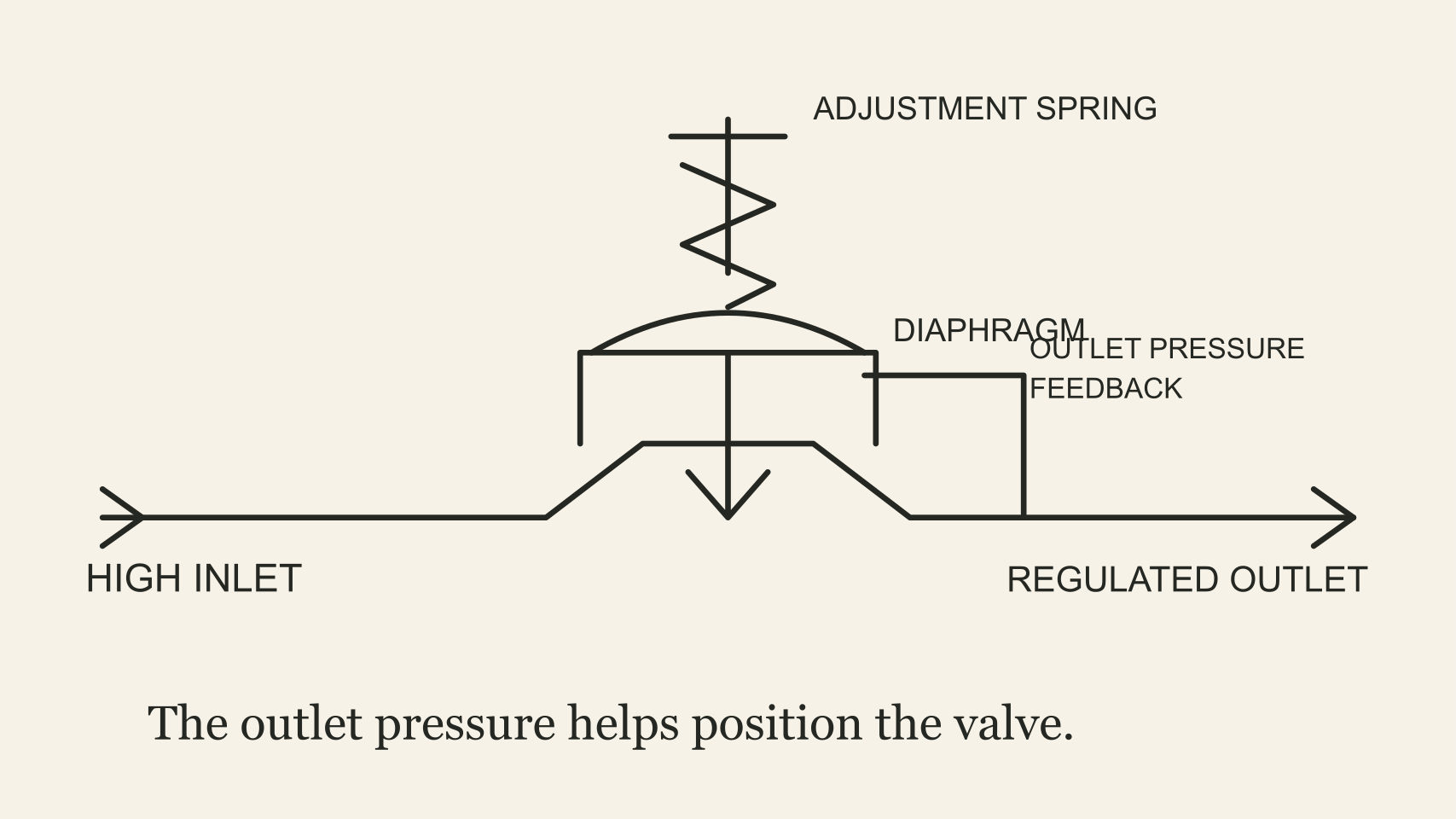
The outlet pressure feeds back against the spring to position the valve
The PRV cannot create pressure. Its outlet also changes with flow, valve sizing, inlet conditions, adjustment, debris, wear, and the piping system. Use the manufacturer’s procedure for setting and servicing the actual valve.
Static and dynamic checks
Measure inlet and outlet pressure with no water flowing, then repeat while a known fixture or test connection flows. A normal static reading with severe downstream drop under flow points toward capacity, restriction, or supply problems rather than an adjustment alone.
Some PRV installations create a closed system by preventing expanded heated water from pushing back into the public main. That changes the thermal-expansion problem. Verify the system’s expansion control instead of treating a rising static pressure as another PRV adjustment.
Worked example
An illustrative service reads 110 psi upstream and the PRV is set to deliver 55 psi downstream at the test condition.
- Pressure reduced across the valve: 110 psi − 55 psi = 55 psi
- Later, upstream pressure falls to 90 psi while the downstream reading remains near 55 psi under the same low-flow condition.
- Available difference is now 90 psi − 55 psi = 35 psi
The second reading shows the regulator continuing to control despite a changing inlet. It does not prove adequate capacity at design flow. That requires a flowing test and the valve’s performance data.
Where it bites
- Do not diagnose from one static gauge reading. Compare upstream and downstream pressure at rest and under flow.
- A PRV is not a booster. It can only reduce available pressure.
- Thermal expansion can raise downstream pressure after heating. Confirm expansion control before chasing the adjustment screw.
- Code thresholds are local. Determine when pressure regulation is required from the adopted code and authority having jurisdiction.