Learn · Plumbing
Which Code Governs Fuel Gas
Assumes you know: Fuel Gas Fundamentals, Which Code Applies Where
The gas piping in a building is usually not governed by the plumbing code. Fuel gas has its own book, adopted on its own schedule, and often enforced by a different agency than the one behind the plumbing code in the same building. The rest of this group tells you that your code governs. Naming that book is where gas work starts.
Why it matters on the job
You can know your plumbing code cold and still be reading the wrong document at the meter. Gas piping questions answered out of the plumbing code are answered out of a book that does not contain the answer, and the split follows through to the paperwork: which permit you pull, which inspector shows up, and which office signs the job off.
The two books to know by name
The International Fuel Gas Code is published by the International Code Council as one of the fifteen coordinated I-Codes. It sits in the same family as the International Plumbing Code, the International Residential Code and the International Private Sewage Disposal Code. Same publisher as the IPC, separate book, separate adoption.
NFPA 54, the National Fuel Gas Code, is the other document you will meet governing fuel gas piping in the United States.
Both are model documents, which means neither one governs anything until a jurisdiction adopts it, and both are sold rather than published openly.
Name the book, buy the book
This page will not paraphrase what either code requires. Their text is purchased, and a plausible-sounding summary of a gas provision is exactly how a wrong sizing, a wrong material or a wrong test pressure gets onto a live job. Three things matter here: the name of the document, the fact that it is separate from your plumbing code, and how to find out which edition governs your address. The requirement itself lives in the book, and the book is worth its price.
Adoption is recorded code by code
ICC operates a code-adoption reporting process in which jurisdictions submit which code book and which year they adopted, per code, along with adoption and effective dates. That structure is the fact to take away. There is no single row that says what code a jurisdiction runs; there is a row per discipline, each carrying its own book, its own edition year and its own dates.
The I-Codes are updated every three years, and ICC develops them through a governmental consensus process. Jurisdictions do not have to move at that pace, and they routinely do not, which is what produces the gap in the example below.
Worked example: read one address’s adoption record
Take an illustrative adoption record for one jurisdiction. The years are an example; the arithmetic and the three-year cycle are real.
- The record shows the plumbing code adopted at the 2021 edition, effective January 2022.
- The same record shows the fuel gas code adopted at the 2018 edition, effective January 2019.
- Measure the gap between the two books on your job. The I-Codes update every three years, so (2021 − 2018) ÷ 3 = 1 full revision cycle. Two books, one job, one cycle out of step with each other.
- Now measure the gas book against the newest published edition. If that is the 2024 edition, then (2024 − 2018) ÷ 3 = 2 cycles, which is 6 years of revisions the governing document does not contain.
- Read the consequence. Anything you look up about gas in a current book has been through two rounds of change since the edition that governs this address, and the 2021 plumbing code on the same job has been through one fewer round than that.
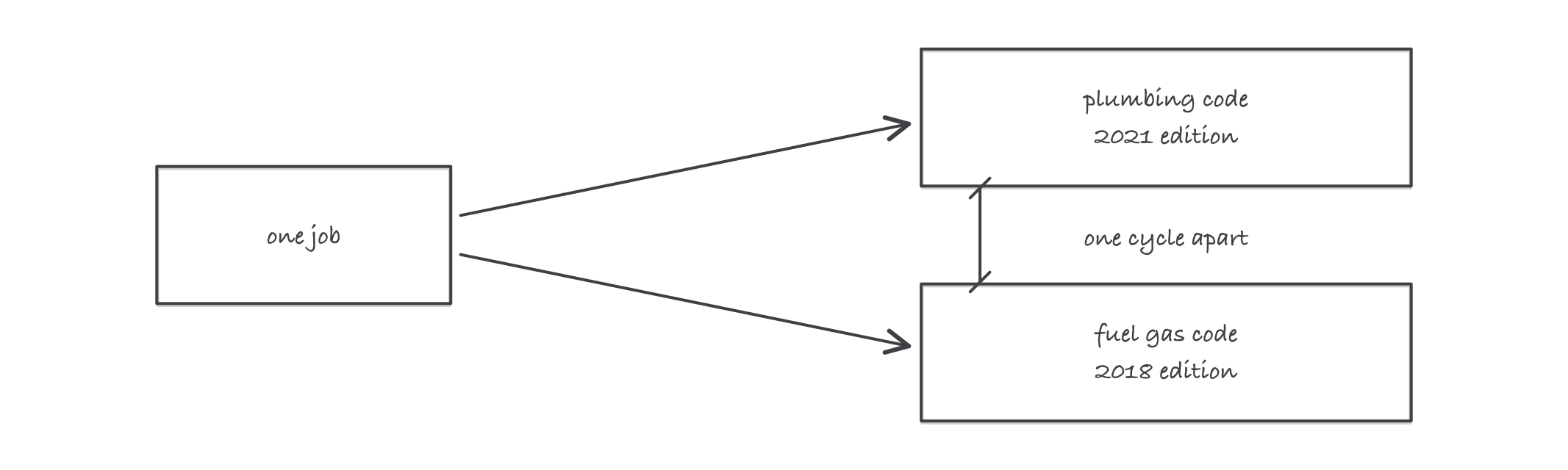
Adoption is recorded code by code, so a single job can run two books at two different editions
Both dates in step 1 and step 2 matter, and they are collected separately for a reason. When a job straddles a changeover, the adoption date and the effective date are different questions, so ask the office which one decides the edition for a permit already in flight.
Where it bites
- “Your code” is at least two codes. The habit of saying it in the singular is what lets a gas question get answered from a plumbing book. Say which book out loud before you look anything up.
- The publisher of your plumbing code does not predict the publisher of your fuel gas code. Adoption is per discipline, and a jurisdiction can run one publisher for plumbing and another for fuel gas without anything being unusual about it.
- A different agency means a different counter. Where fuel gas is adopted by another department, the permit, the inspection and sometimes the authorization to do the work run through an office that has nothing to do with your plumbing permit. Find that out before the day of the inspection, not on it.
- Editions drift apart on the same job. Two books at two edition years is normal rather than a filing error, and the gas book is often the older of the two.
- Neither code’s text is free, and neither is quotable here. Anyone summarizing gas code values to you (a page, a supplier, a coworker) is between you and the document. Get the edition your jurisdiction adopted.
Exam relevance
Journeyman and master exams are written against a specific adopted code, and the gas portion is written against that jurisdiction’s adopted fuel gas document rather than its plumbing code. Know the name of the fuel gas book your board examines on, know its edition year, and know that adoption is recorded per code and per edition. Candidates who bring only the plumbing code to a code-lookup section arrive without the book the gas questions come from.
Verified requirements
| Where | Expires | Renewal | Continuing education |
|---|---|---|---|
| Texas | Confirm with issuer | Confirm with issuer | Confirm with issuer |
| Texas | Confirm with issuer | Confirm with issuer | Confirm with issuer |
| Illinois | Confirm with issuer | Confirm with issuer | Confirm with issuer |
Information comes from issuing-authority sources. Confirm current rules, fees and eligibility with the authority before acting.