Learn · Plumbing
Traps and Trap Seals
Part of Journeyman Plumber Exam Prep · step 8 of 31 · next: How Plumbing Vents Work
In learning paths: Journeyman Plumber Exam Prep
Assumes you know: How DWV Systems Work
A trap is a bent section of pipe below a fixture that holds standing water, and that plug of water is the only barrier between the room and the sewer. Every fixture on a drainage system drains through one, either in the piping below it or, as with a toilet, molded into the fixture itself.
Why it matters on the job
Sewer gas is not just a smell. It carries hydrogen sulfide, methane, and whatever else the sewer is breeding, and a dry trap turns a drain opening into an open pipe to all of it. When a customer reports a sewer odor, the first suspect is a lost trap seal, and your job is to figure out what took it. Everything in the venting lessons exists to protect the few inches of water this lesson describes.
Anatomy of a P-trap
Water enters from the fixture down the inlet leg, rounds the U bend, rises over the high point inside the outlet side, and spills into the horizontal arm toward the drain. Two points define the geometry:
- The crown weir: the level the water spills over into the outlet.
- The top dip: the highest point of the passage’s inside bottom surface, at the bend between the legs.
When the fixture stops draining, water settles and fills the bend between those two points. That standing water is the trap seal. Its depth is the vertical distance from the crown weir down to the top dip, and both model codes require a fixture trap seal of 2 to 4 inches.
What the seal actually resists
The seal is a short column of water, which makes it a pressure gauge. When pressure on the sewer side differs from pressure in the room, the water shifts toward the lower pressure. Measure pressure in inches of water column and the arithmetic is direct: 1 inch of pressure difference displaces about 1 inch of seal. Suction on the drain side pulls water over the weir and down the drain. Positive pressure on the drain side pushes the seal the other way and can bubble sewer gas up through it into the room.
Worked example
A lavatory trap holds the code minimum seal of 2 in.
- Vented drainage systems are designed to hold pressure swings at the trap to about plus or minus 1 in of water column.
- Worst-case suction pulls about 1 in of seal over the weir. Remaining seal: 2 − 1 = 1 in.
- The seal survives with 1 in of margin. Now imagine the vent gone: a hard surge in an unvented stack can pull several inches of water column, more than the 2 in the trap holds, and the seal is gone in one event.
That subtraction is the entire case for venting, which the next lesson builds.
How seals die
- Siphonage: the fixture’s own discharge or a nearby fixture’s discharge pulls the seal out. The vent system exists to stop this.
- Back pressure: positive pressure low in a stack pushes gas through the seal.
- Evaporation: an unused floor drain or guest-bath trap dries out over weeks.
- Wicking: a stray string or clump of hair draped over the weir siphons the seal drop by drop.
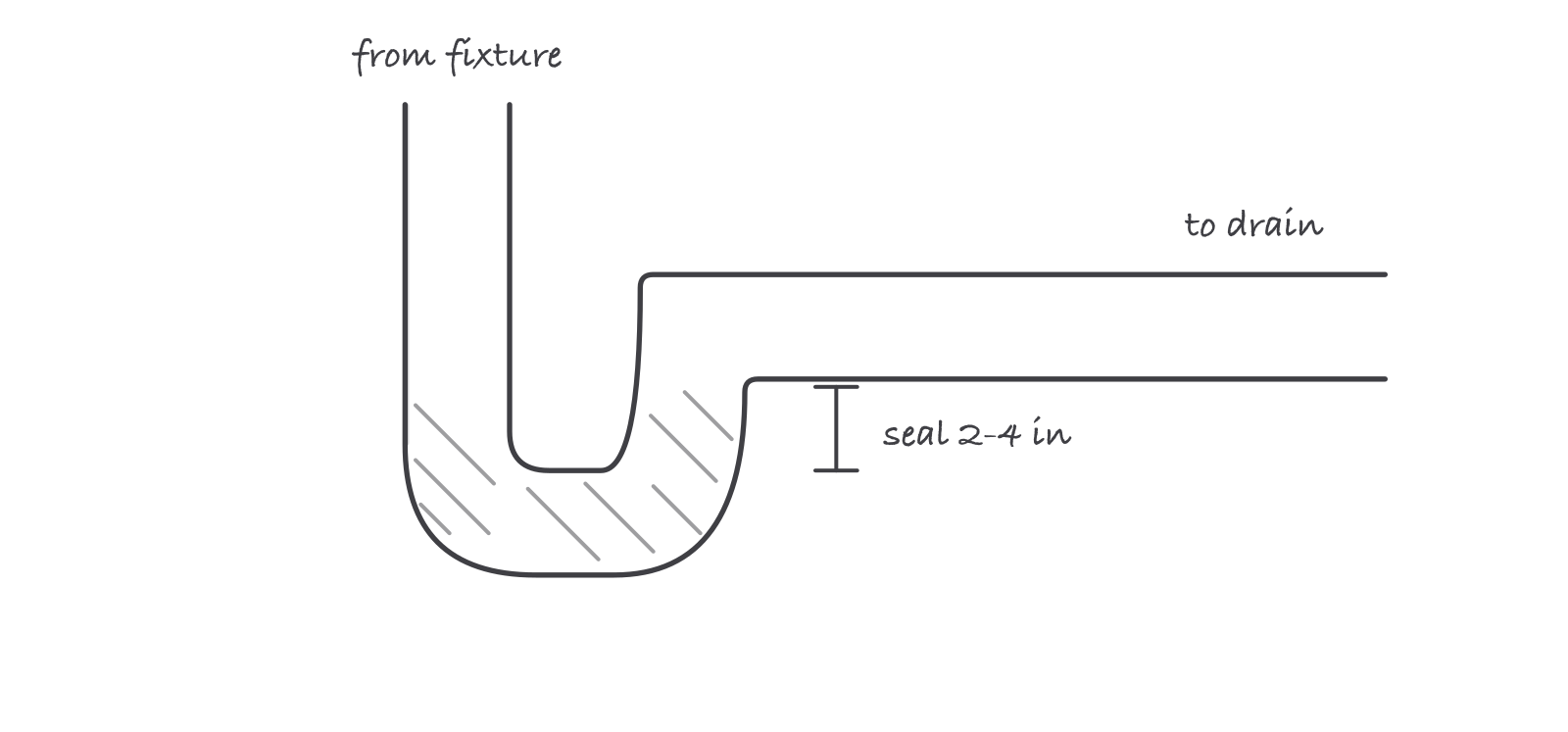
The trap seal: standing water from the top dip up to the crown weir, 2 to 4 in deep by code
Where it bites
- S-traps are prohibited under both model codes. The vertical drop right after the trap runs full bore and siphons the seal every time the fixture drains. You will still find thousands in old houses; recognize them and know why they fail.
- Double trapping is also prohibited. Two seals in series trap air between them, and the fixture drains slow forever.
- A deeper seal is not a substitute for a vent. Deep-seal traps have their uses, but code venting rules still apply.
- Dry floor drains are a maintenance problem, not a mystery. Trap primers or regular filling keep rarely used traps wet.
Exam relevance
Exams test the vocabulary (weir, dip, seal depth), the 2 to 4 in requirement, the list of prohibited traps (S-trap, bell trap, crown-vented trap), and the seal-loss mechanisms. A favorite question style gives you a symptom, like a sewer smell at an unused shower, and asks for the cause. Reason from the seal: what removed the water?
Verified requirements
| Where | Expires | Renewal | Continuing education |
|---|---|---|---|
| Texas | Confirm with issuer | Confirm with issuer | Confirm with issuer |
| Texas | Confirm with issuer | Confirm with issuer | Confirm with issuer |
| Illinois | Confirm with issuer | Confirm with issuer | Confirm with issuer |
Information comes from issuing-authority sources. Confirm current rules, fees and eligibility with the authority before acting.