Learn · Plumbing
Cleanouts
Part of Journeyman Plumber Exam Prep · step 13 of 31 · next: Water Pressure and Flow
In learning paths: Journeyman Plumber Exam Prep
Assumes you know: How DWV Systems Work
A cleanout is a capped, accessible opening into a drain that lets you run a cable or camera through the pipe without cutting it. Every drainage system will eventually clog; cleanouts are the code’s insistence that when it does, someone can reach the blockage.
Why it matters on the job
The plumber who installs a system without proper cleanouts is taxing every plumber who services it afterward, and often that is the same person, standing in a crawlspace with a saw. Inspectors check cleanout placement because the code treats access as part of the system, not a courtesy. And service work lives on them: the first question on any stoppage call is where the nearest cleanout is and which direction it rods.
Where they go
Both model codes place cleanouts by the same pattern; the exact trigger angles, spacings, and exceptions differ between the UPC and IPC, so the adopted code supplies the numbers.
- At the upper end of each horizontal drain. A stoppage is cleared by rodding downstream from above it, so access starts at the top of every run.
- At changes of direction. Cable does not steer well through stacked bends. Each code defines how much accumulated turn triggers a cleanout.
- At the base of stacks and at the building drain to building sewer junction. The transitions where clogs love to form. The junction cleanout usually extends to grade outside so the sewer can be rodded without entering the building.
- At intervals on long runs, so no stretch of pipe sits beyond the practical reach of a cable. The working figure in both model codes is on the order of 100 ft for building drains and sewers.
Built for the tool
A cleanout is shaped around the machine that will use it. The fitting is a wye or cleanout tee oriented so the removed plug points the cable downstream, entering with the flow rather than fighting the fitting. Codes require clear space in front of the opening to swing rods and feed cable, on the order of 18 in for 3 in and larger pipe and 12 in for smaller, and require the cleanout to stay accessible: an access cover if it lives behind finish, a riser to grade if it lives underground.
Worked example
A single-story building drain runs 90 ft from the base of its one stack to the foundation wall, straight, then continues as the building sewer to the main.
- Upper end: the base-of-stack cleanout covers the upstream terminal of the run.
- Interval check: 90 ft is inside the 100 ft working interval, so no mid-run cleanout is forced by spacing.
- Junction: a cleanout at the building drain to sewer transition, extended to grade.
- Result: two cleanouts serve the whole run, and every foot of pipe is within one cable length of an opening. Add a pair of 90 degree bends mid-run and the change-of-direction rules come into play, which is where the two codes count differently; check the adopted text.
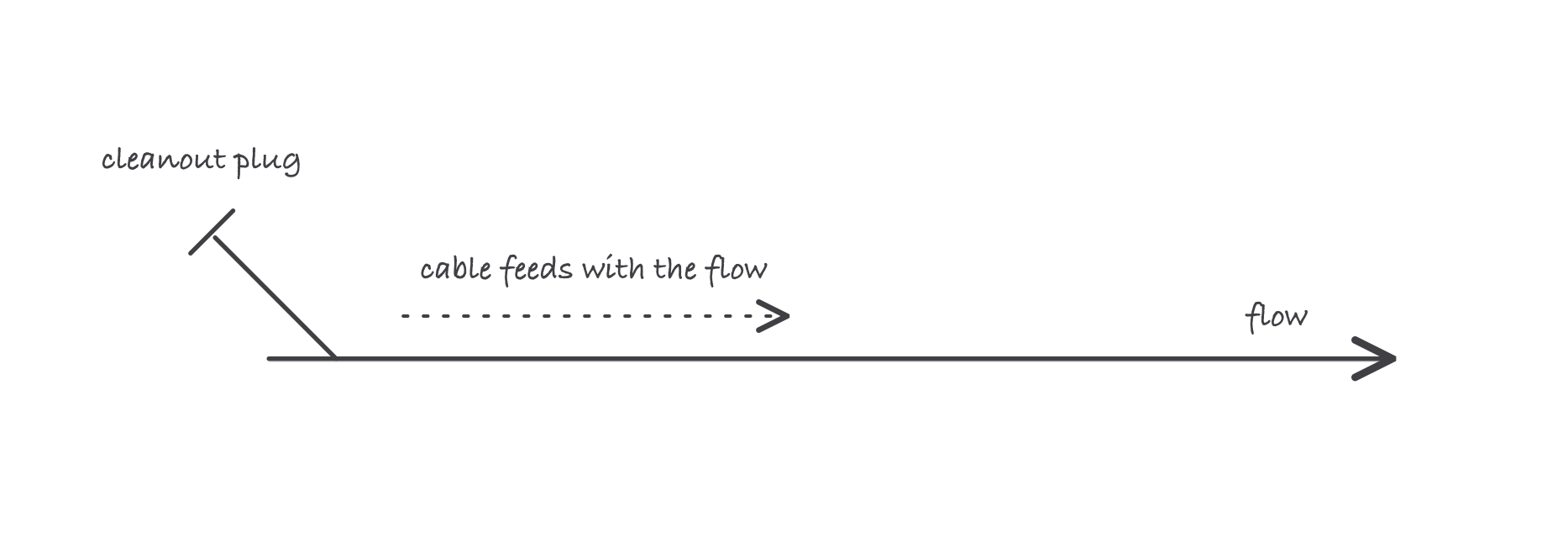
Placed at the upstream end and angled with the run: the plug comes off and the cable feeds downstream with the flow
Where it bites
- Buried and tiled-over cleanouts. A cleanout under new tile or behind unbroken drywall legally does not exist. Protect access during remodels, and note locations on service tickets.
- No swing room. A cleanout facing a joist 6 in away meets the letter of nothing. Clearance in front of the plug is a code requirement, not a nicety.
- Plugs that will never come off again. A dry, overtightened plug seizes for good. Thread lubricant at install is a gift to the future; countersunk plugs belong where a raised one is a trip hazard.
- A cleanout is not a fixture connection. Tying a new drain into a handy cleanout removes the access the code required. Both codes prohibit it.
Exam relevance
Cleanout questions are code-lookup questions: where they are required, what spacing applies, what clearance the plug needs, and which direction the fitting must face. The pattern in this lesson answers the concept questions; the numbers must come from the UPC or IPC edition your jurisdiction adopts, so practice finding the cleanout section quickly in your exam’s code book.
Verified requirements
| Where | Expires | Renewal | Continuing education |
|---|---|---|---|
| Texas | Confirm with issuer | Confirm with issuer | Confirm with issuer |
| Texas | Confirm with issuer | Confirm with issuer | Confirm with issuer |
| Illinois | Confirm with issuer | Confirm with issuer | Confirm with issuer |
Information comes from issuing-authority sources. Confirm current rules, fees and eligibility with the authority before acting.