Learn · Plumbing
Applied Math for Plumbers
Part of Journeyman Plumber Exam Prep · step 2 of 31 · next: Pipe Materials and When to Use Them
In learning paths: Journeyman Plumber Exam Prep
Plumbing math is a small set of calculations used constantly: converting between fractions and decimals, computing the fall of a sloped drain, and sizing the diagonal of an offset. None of it goes past multiplication, but all of it gets done on a ladder with a tape measure in one hand, so the skill is doing it fast and in the trade’s units.
Why it matters on the job
A drain pitched wrong fails inspection or fails the customer. An offset cut without the 45 math wastes pipe and fittings, and on copper, wasted cuts are wasted money. The plumbers who look effortless on rough-in are doing this arithmetic in their heads, not because they are gifted, but because it is the same three calculations every day.
Fractions to decimals and back
Tapes speak sixteenths; calculators speak decimals. Convert without thinking:
- To decimal: divide. 5/8 = 0.625. 3/16 = 0.1875.
- To the tape: multiply the decimal part by 16 and take the nearest sixteenth. A tape has no mark for 0.44 in, but 0.44 × 16 = 7.04, so it lands on 7/16.
Keep the common anchors memorized: 1/8 = 0.125, 1/4 = 0.25, 3/8 = 0.375, 1/2 = 0.5, 5/8 = 0.625, 3/4 = 0.75, 7/8 = 0.875.
Slope, fall, and grade
Horizontal drains must drop continuously toward the sewer. The trade states that drop as slope in inches per foot: the common requirement for smaller drains is 1/4 in per ft, with your code’s table governing by pipe size. Three quantities relate:
Fall = slope × run. Fall is total drop in inches, slope is in inches per foot, run is horizontal distance in feet.
Rearrange as needed: slope = fall ÷ run, and run = fall ÷ slope. The same idea expressed as a ratio is grade: 1/4 in per ft is 0.25 in in 12 in, about a 2% grade.
The 45 degree offset
Pipes jog around obstacles with two 45 degree fittings. The three legs of that jog form a right triangle: the offset (how far sideways you need to move), the run (how far along the original direction the jog consumes), and the travel (the diagonal length of pipe between the fittings). For 45 degree fittings, offset and run are equal, and:
Travel = offset × 1.414.
The constant 1.414 is the square root of 2, the diagonal of a square. Going the other way, offset = travel × 0.707. Other fitting angles have their own constants; 45 is the one to know cold, and the one NCCER drills first.
Worked example: one rough-in, both calculations
A 3 in drain must run 32 ft across a crawlspace to the stack, and on the way it must jog 14 in sideways around a footing using two 45s.
- Fall for the run: at 1/4 in per ft, fall = 0.25 × 32 = 8 in. The pipe enters the crawlspace 8 in higher than it lands at the stack. Check the space can absorb that before you drill the first joist.
- Travel for the offset: travel = 14 × 1.414 = 19.796, call it 19.8 in. On the tape: 0.8 × 16 = 12.7, so 19 13/16 in end to end between the 45s, before fitting allowances, which Joining Methods covers.
- Sanity check the answer: the diagonal must be longer than the offset but less than double it. 19.8 sits between 14 and 28. Good.
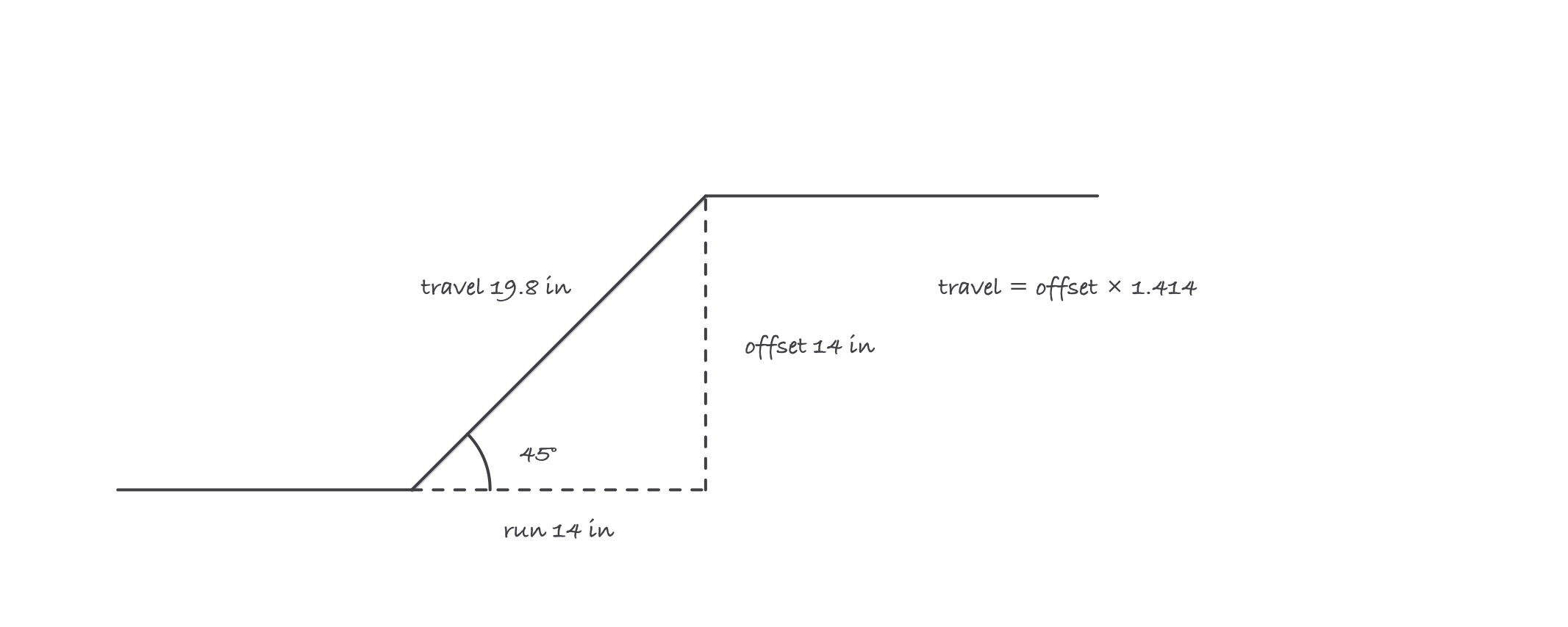
The 45 degree offset is a right triangle: travel is always the offset times 1.414
Where it bites
- Slope has a ceiling as well as a floor. Pitch a small drain too steep and the water can outrun the solids. Where more drop must be absorbed than slope allows, the fix is a vertical drop with fittings, not extra grade. Slope and Grade, in the DWV track, covers the code detail.
- Fall is computed on the horizontal run, not the pipe length. For ordinary drain slopes the difference is tiny, but measure your run across the floor, not along the diagonal, and the arithmetic stays honest.
- 1.414 only works for 45s. Use it on 22 1/2 or 60 degree fittings and the pipe comes up short or long. Each angle has its own multiplier; check the fitting before you check the math.
- Round at the end, not in the middle. Convert to sixteenths once, at the final answer. Rounding each intermediate step stacks error into a visible gap at the fitting.