Learn · Plumbing
Which Code Applies Where
Part of Journeyman Plumber Exam Prep · step 25 of 31 · next: Fixture Requirements and Clearances
In learning paths: Journeyman Plumber Exam Prep
Assumes you know: UPC vs IPC: The Two Model Codes
The code that governs your work is not a book you buy; it is a stack you assemble. A model code sits at the bottom, a state adoption with amendments sits on top of it, a municipal ordinance may sit on top of that, and the authority having jurisdiction, the AHJ, interprets the result. This lesson is the method for assembling that stack for any address, because no memorized map stays true.
Why it matters on the job
Code adoption changes on legislative schedules, not trade ones. States switch model codes, skip editions, and rewrite chapters, and a contractor who “knows the code” from five years ago or one county over can be confidently wrong. Bidding, pulling permits, and passing inspection in a new jurisdiction all start with the same research task, and it takes an hour when you know where to look.
Assembling the stack
Layer 1: find the adopting authority. Somewhere, a body with legal authority adopted a plumbing code. Usually it is a state agency: a plumbing board, a building commission, a department of labor or health. In states that leave plumbing to local government, the county or city is the adopting authority, and the answer can change at a municipal line. The agency’s own website is the primary source; search the state name with “plumbing code adoption.”
Layer 2: identify the model code and the edition. The adoption names a base document and a year, and the year matters as much as the title. Jurisdictions routinely run editions that are one or two cycles old, so a provision you read in the current model code may not exist in the adopted one. Confirm the edition before you open the book.
Layer 3: read the amendments. No state adopts a model code clean. Amendments arrive either as a published amendment package, a list of struck and substituted sections, or as a fully rewritten state code that only started life as the model. Amendments concentrate exactly where the money is: materials, venting, water heaters, licensing hooks. Assume the section you care about is amended until you have checked.
Layer 4: check for local overlays. Where state law allows, cities and counties layer their own ordinances on top: stricter materials rules, local licensing, administrative changes. Home-rule states allow more of this; some states expressly preempt it. The permit office knows which world you are in.
Layer 5: ask the AHJ, and get it in writing. The inspector’s office is both the final interpreter and the cheapest research shortcut. A five-minute call answers what governs, and an email answer is worth keeping.
One more wrinkle: the plumbing stack is not the only stack. Fuel gas may be adopted under a different agency and a different model code than plumbing, and mechanical under a third. Each discipline gets its own pass through the layers.
Worked example
You are taking your first job in an unfamiliar county. The research pass, in order:
- Search the state’s plumbing code adoption. Result: a state board adopts a model code, 2021 edition, statewide.
- Pull the board’s amendment package. It replaces the model water heater chapter and modifies vent termination rules: two of the things you were about to assume.
- Call the county permit office: does the county add anything? They confirm state code only, but flag a local licensing registration you need before pulling permits.
- File the amendment package with your code book and note the edition on the bid. Total time: about an hour, before pricing a single fixture.
Every fact in that walkthrough came from the jurisdiction itself, which is the point: the method produces current answers, a memorized map produces stale ones.
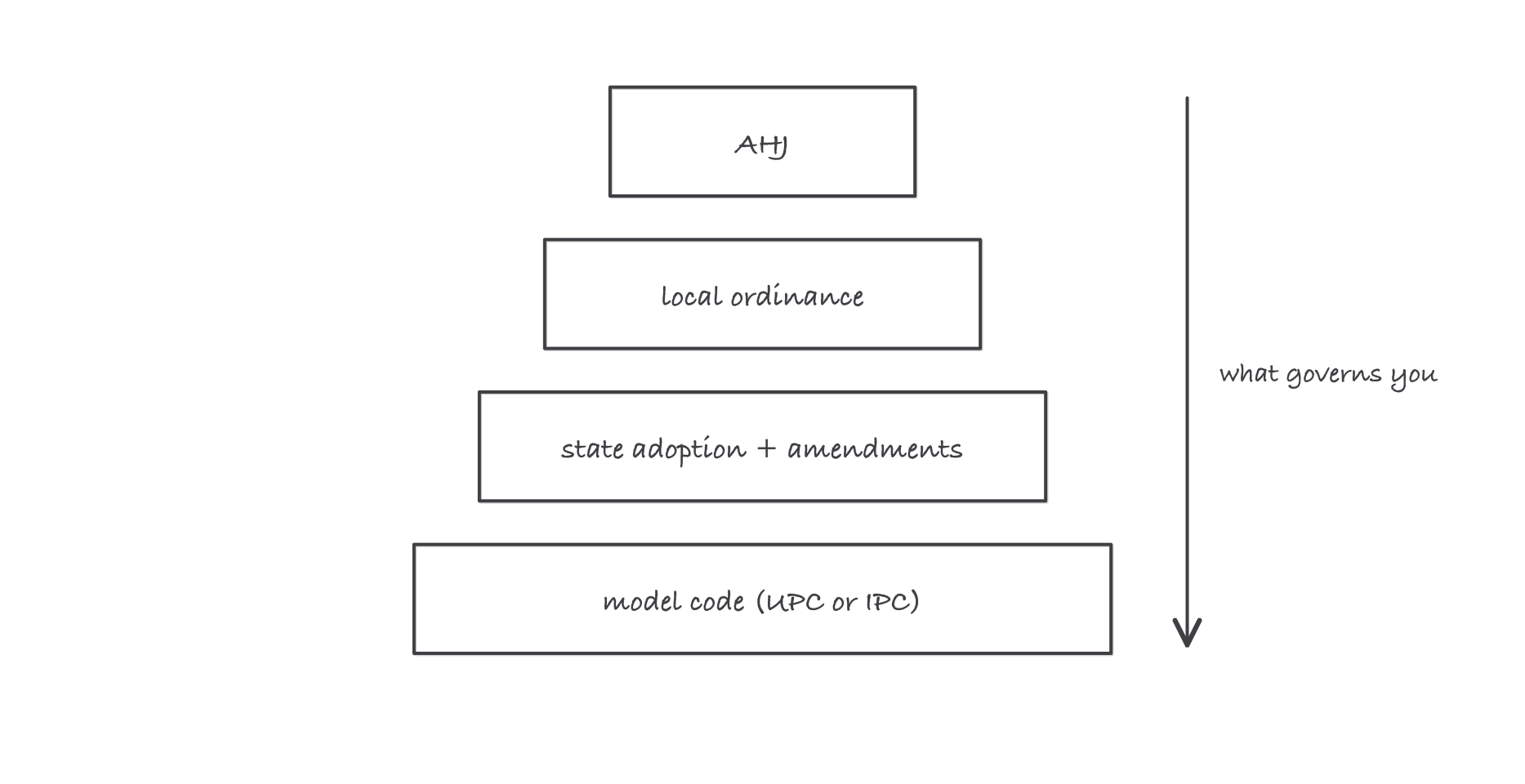
The governing code is the whole stack read top down, not the book at the bottom
Where it bites
- The current model code is not your code. Reading the newest edition when your state adopted an older one imports provisions that do not exist for you, and misses ones that still do.
- Amendments hide in plain sight. The state code that “adopts the UPC” may have substituted the exact table you are relying on. Check the amendment list for your section number specifically.
- Crossing a city line can change the answer. In local-adoption states, the same street can be under two codes. Verify per jurisdiction, not per metro area.
- Online code libraries default to the model text. Free code viewers usually display the unamended model edition. Useful for study, dangerous for compliance.
Exam relevance
Licensing exams tell you which code and edition they are written against; believing them over your field habits is the first exam skill. Master-level and contractor exams add administrative questions: who the AHJ is, how alternative methods get approved, and how state amendments relate to the model code. The stack picture answers all of them.
Verified requirements
| Where | Expires | Renewal | Continuing education |
|---|---|---|---|
| Texas | Confirm with issuer | Confirm with issuer | Confirm with issuer |
| Texas | Confirm with issuer | Confirm with issuer | Confirm with issuer |
| Illinois | Confirm with issuer | Confirm with issuer | Confirm with issuer |
Information comes from issuing-authority sources. Confirm current rules, fees and eligibility with the authority before acting.