Learn · Plumbing
Venting Methods
Part of Journeyman Plumber Exam Prep · step 10 of 31 · next: Drain Sizing and DFUs
In learning paths: Journeyman Plumber Exam Prep
Assumes you know: How Plumbing Vents Work
A venting method is a piping arrangement that gets air to a trap. Running one dedicated vent from every single trap to the roof would work, but it would waste pipe, labor, and wall space, so both model codes define arrangements that let one air path protect several fixtures. Every one of them is a different route to the same goal: air on the drain side of the seal before pressure can build.
Why it matters on the job
Vent method choice drives your material list, your wall layout, and whether the rough-in passes. It is also the sharpest UPC versus IPC divide in the whole trade: the two codes permit different methods, size them by different procedures, and set different limits. A bathroom group vented legally in an IPC state can be a violation across the state line. Learn the methods as ideas here; take the numbers from your adopted code.
Geometry that never changes
Two principles sit under every method.
The vent takeoff stays above the water. The vent must connect to the drainage so it cannot be flooded and plugged by normal flow. The takeoff comes off the trap arm above the arm’s flow line, and the vent rises from there; both codes put hard numbers on the fitting angles and heights.
The trap arm cannot fall more than one pipe diameter before the vent connects. If the arm drops more than its own diameter, the trap outlet sits below the top of the pipe at the vent connection, and the arm can run full bore and siphon like the outlawed S-trap. This single rule explains why trap arms have maximum lengths.
Worked example
A 1 1/2 in lavatory trap arm runs at the standard 1/4 in per foot.
- Maximum allowed fall across the arm: one pipe diameter, 1 1/2 in.
- Length that produces that fall: 1.5 ÷ 0.25 = 6 ft of run.
- So the physics allows about 6 ft before the geometry goes bad. The codes then publish their own trap arm limits in table form, and they differ: the UPC’s fixed lengths are shorter than what the IPC’s slope-based rule allows. The principle sets the ceiling; your adopted table sets the law.
The named methods
- Individual vent. One trap, one vent. The base case, legal everywhere, and the one to fall back on when a shared method will not fit.
- Common vent. Two fixtures connecting at the same level share one vent at their junction. Think back-to-back lavatories.
- Wet vent. A pipe that is a drain for one fixture and a vent for another at the same time. This is how a whole bathroom group gets vented through one or two pipes. Both codes allow wet venting; their rules about which fixtures, which sizes, and which arrangements differ substantially.
- Circuit vent. A battery of similar fixtures on one horizontal branch protected by a vent connected near the last fixture. Common in commercial restroom batteries; heavily rule-bound in both codes.
- Combination waste and vent. An oversized, flat-graded drain whose own air space does the venting. Used where a vertical vent cannot exist, like island sinks and floor drains in open slabs.
- Air admittance valves. One-way valves that let air in but no gas out. The IPC recognizes AAVs meeting the ASSE standard; the model UPC does not, and jurisdictions amend in both directions. Never install one on assumption.
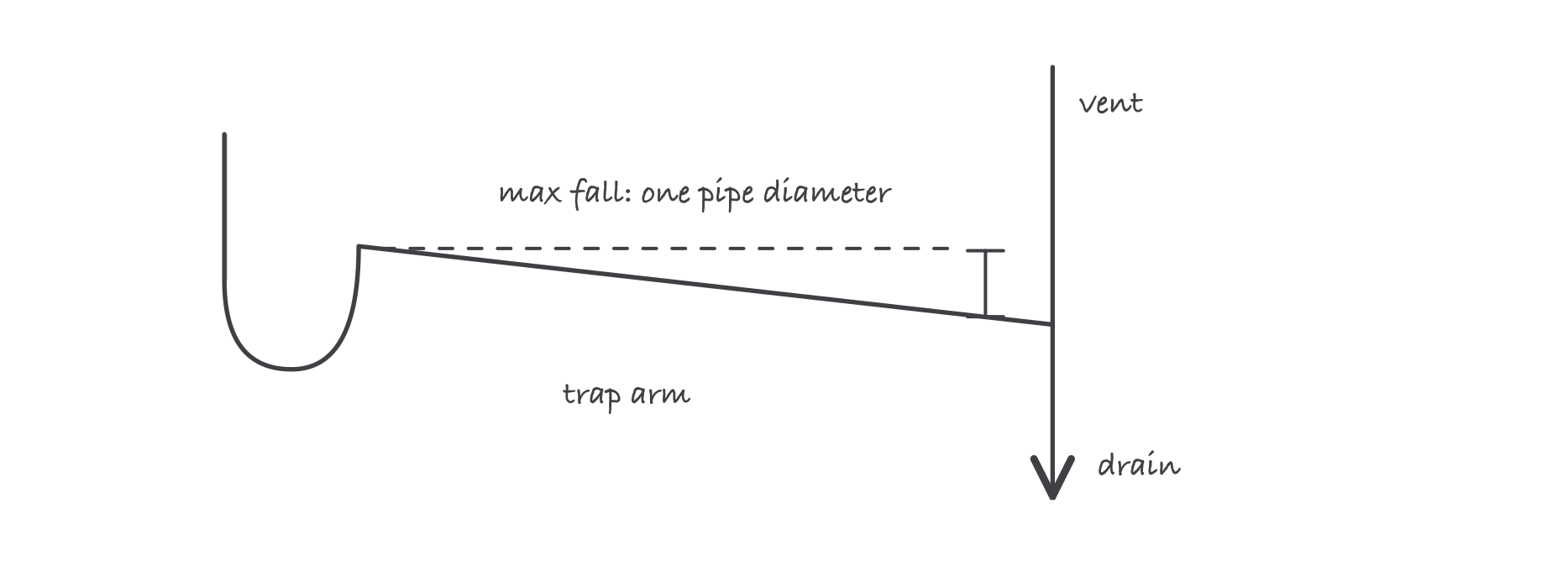
The geometry every method serves: air joins the arm before the arm falls one pipe diameter
Where it bites
- Memorizing the wrong code’s limits. Trap arm tables, wet vent rules, and AAV acceptance are exactly where the UPC and IPC part ways. Check the book that governs the job, not the one you apprenticed under.
- A wet vent is still a vent. Oversizing rules exist because the pipe must keep an open air channel above its drainage flow. Load it beyond its wet-vent rating and every fixture upstream loses protection.
- AAVs die in service. They are mechanical, they stick, and they get buried behind drywall with no access. Where they are legal, access is usually required; give them air and a way to be replaced.
Exam relevance
Vent methods are prime exam territory for both journeyman and master tests. Expect isometrics where you name the method shown, spot the trap arm that is too long, or pick the takeoff that is below the flow line. Sizing questions come straight from the adopted code’s vent tables, and the UPC and IPC size vents by different procedures, so practice lookups in the code your exam uses.
Verified requirements
| Where | Expires | Renewal | Continuing education |
|---|---|---|---|
| Texas | Confirm with issuer | Confirm with issuer | Confirm with issuer |
| Texas | Confirm with issuer | Confirm with issuer | Confirm with issuer |
| Illinois | Confirm with issuer | Confirm with issuer | Confirm with issuer |
Information comes from issuing-authority sources. Confirm current rules, fees and eligibility with the authority before acting.