Learn · Plumbing
How Plumbing Vents Work
Part of Journeyman Plumber Exam Prep · step 9 of 31 · next: Venting Methods
In learning paths: Journeyman Plumber Exam Prep
Assumes you know: Traps and Trap Seals
A vent is a pipe that feeds air to the drainage system so the pressure at every trap stays close to atmospheric. Vents carry no water. Their entire job is to protect the 2 to 4 inches of water standing in each trap seal.
Why it matters on the job
Venting is where drainage layouts pass or fail. A drain with no vent still drains, which is exactly why unvented work gets covered up and sold: the failure is not a puddle, it is a siphoned trap, a gurgling fixture, and sewer gas in a bedroom six months later. Understand the pressure story and every vent rule in the code stops being arbitrary.
The drinking straw
Put a straw in a glass of water, cap the top with your finger, and lift it out. The water hangs in the straw. Take your finger off and it falls. Nothing is holding the water up; the atmosphere is pushing it up from below, and with the top capped, no air can push down from above. Unbalance the pressure across a column of water and the column moves toward the low side.
A trap seal is that same water column lying on its side in a U bend. The room side of the seal always feels atmospheric pressure. If the drain side also feels atmospheric pressure, the seal sits still. If the drain side goes negative, the atmosphere pushes the seal over the weir and down the drain, exactly as it pushes water up a straw you sip on. A vent is how you take your finger off the straw: it opens the drain side to outside air so no imbalance can build.
The three pressure events
Self-siphonage. A fixture’s own discharge fills its trap arm full bore. The moving slug acts like a piston, and the low pressure behind it sucks the trap it just left. Small, quick fixtures like lavatories are the classic victims.
Induced siphonage. Discharge from another fixture rushes past the point where your trap arm connects and drags air with it, lowering pressure at your trap. Your fixture never ran, but its seal left anyway.
Back pressure. Near the base of a stack, falling water decelerates and compresses the air ahead of it. Traps connected low in the system feel positive pressure and can have gas bubbled through them. This is why lower-floor fixtures gurgle when upper floors discharge.
A vent placed close to the trap, connected to outdoor air, relieves all three: it supplies air where suction develops and gives compressed air somewhere to go.
Worked example
Take the numbers from the traps lesson and finish them.
- A lavatory trap holds a 2 in seal. Vented systems are designed to keep pressure swings at the trap within about plus or minus 1 in of water column.
- Vent working: worst swing 1 in, seal loses 1 in, and 2 − 1 = 1 in remains. The seal recovers on the next use.
- Vent blocked: the lav’s own discharge runs the arm full bore and the slug can pull several inches of water column, more than the 2 in stored. The trap is dry before the sink finishes draining.
Same fixture, same trap, one working air path between them.
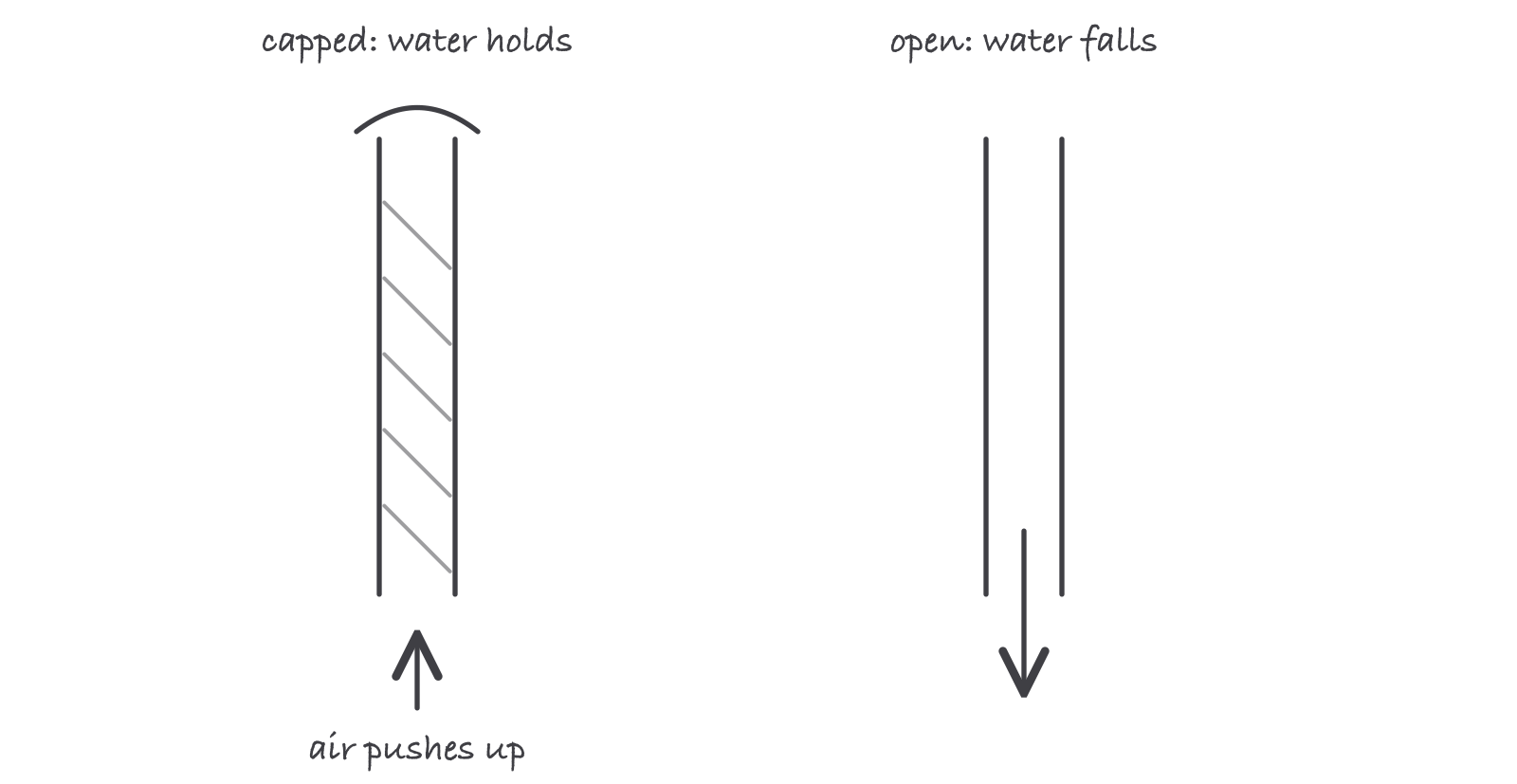
The whole theory of venting in one kitchen experiment: unequal air pressure moves a water column
Where it bites
- Vents must drain themselves. A vent is dry pipe, but rain and condensation get in, so vents are graded back to the drain. A sagging vent that holds water is a capped straw.
- Vent terminals can close in winter. Frost buildup chokes small terminals in cold climates. Both model codes require enlarged terminals in cold regions; the trigger temperatures and sizes are code-specific.
- Gurgling is a diagnosis, not a quirk. A fixture that gurgles is a trap fighting for air. Find out what blocked or undersized its air supply.
- A drain that works today proves nothing. Unvented drains function until the day the pressure event lines up. Working is not the same as right.
Exam relevance
Exams test the mechanism, not just the rules: expect to name which pressure event a scenario describes (self-siphonage, induced siphonage, back pressure) and to say what a vent does about it. Isometric questions ask where air gets into a layout. If you can tell the straw story with pressures on both sides of the seal, the whole question group falls open.
Verified requirements
| Where | Expires | Renewal | Continuing education |
|---|---|---|---|
| Texas | Confirm with issuer | Confirm with issuer | Confirm with issuer |
| Texas | Confirm with issuer | Confirm with issuer | Confirm with issuer |
| Illinois | Confirm with issuer | Confirm with issuer | Confirm with issuer |
Information comes from issuing-authority sources. Confirm current rules, fees and eligibility with the authority before acting.