Learn · Plumbing
Booster Pump Systems
Part of Advanced Water Distribution · step 4 of 6 · next: Water Heaters
In learning paths: Advanced Water Distribution
Assumes you know: Pressure Zoning in Tall Buildings
A booster pump system adds pressure when the available water service cannot meet the building’s required flow and residual pressure. In larger buildings, multiple pumps, variable-speed drives, a pressure tank, sensors, check valves, and controls work together as a packaged set.
Why it matters on the job
A booster can mask a bad pressure calculation and create damaging pressure downstream. The job is not to make the gauge number bigger. It is to supply each zone across its demand range without starving the top, overpressurizing the bottom, short-cycling pumps, or losing service when one pump is unavailable.
The pump and the system meet
A pump operates where its pump curve intersects the system curve. As flow rises, piping friction rises. Changing pump speed shifts the pump curve so a variable-speed set can respond to changing demand more efficiently than constant-speed pumping with throttling alone.
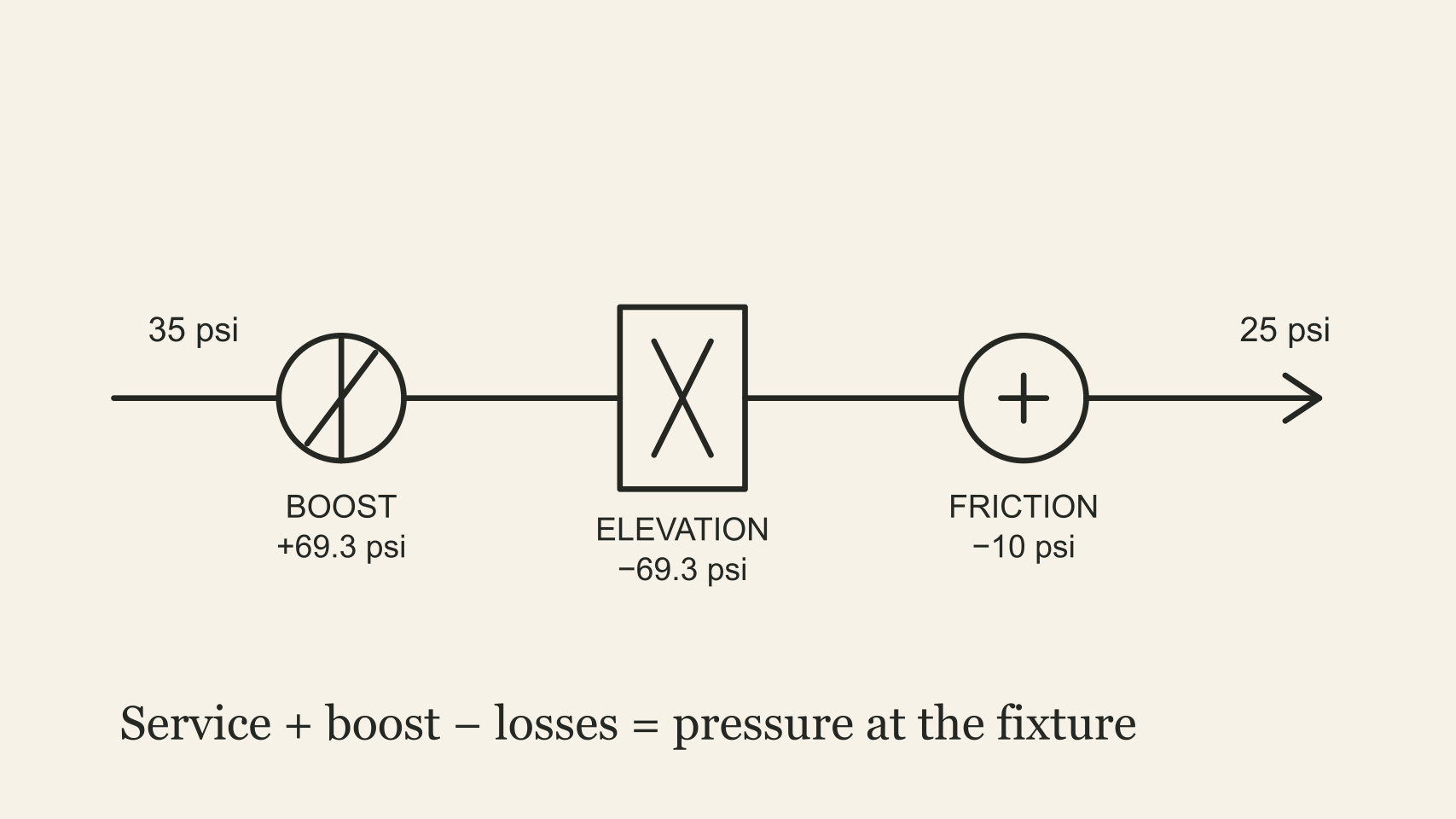
The booster supplies the missing part of the pressure budget, not the whole budget by default
Controls often stage and rotate pumps, maintain a pressure target, and alarm on abnormal conditions. Redundancy, tank sizing, relief protection, bypasses, shutdown conditions, and safe suction pressure belong in the engineered design and approved equipment package.
Worked example
An illustrative upper zone has 35 psi available at the service under design flow. The highest fixture is 160 ft above the service, needs 25 psi residual pressure, and the calculated friction loss is 10 psi.
- Elevation loss: 160 ft × 0.433 psi/ft = 69.3 psi
- Total pressure needed: 69.3 + 25 + 10 = 104.3 psi
- Illustrative boost required: 104.3 − 35 = 69.3 psi
That is a pressure budget, not a pump selection. Selection also needs the design flow, pump curves, minimum and maximum demand, suction limits, equipment ratings, redundancy, and the control location.
Where it bites
- Design from minimum service pressure under flow. A midnight static reading can badly overstate what the utility supplies at peak demand.
- Do not throttle away an oversized selection as the first plan. Oversizing wastes energy and can worsen control.
- Sensor location defines what the controller protects. A setpoint at the pump discharge is not the same as pressure at the remote zone.
- Low suction pressure is a system limit. Boosting discharge pressure does not authorize drawing the service below permitted conditions.