Learn · Plumbing
Pipe Materials and When to Use Them
Part of Journeyman Plumber Exam Prep · step 3 of 31 · next: Joining Methods: Solder, Press, Solvent, Threaded
In learning paths: Journeyman Plumber Exam Prep
Assumes you know: How Building Plumbing Systems Work
Pipe material is chosen by system first: pressurized supply, gravity drainage, or fuel gas. Each material earns its place by what it tolerates, heat, pressure, soil, sunlight, and what it costs to buy and to join. Learn the short list and the reasons, and every “what do we run this in?” question becomes a two-step lookup.
How Building Plumbing Systems Work gave you the two-system map; this lesson stocks it with materials. Joining Methods, next, covers how each one connects.
Why it matters on the job
Apprentices touch material decisions daily even when they never make them: loading the van, roughing in what the journeyman specifies, spotting the difference between the white plastic that handles heat and the white plastic that does not. Materials are also where codes differ: your jurisdiction’s adopted code and local amendments decide what is legal in the ground, in a wall, or on a water heater. The patterns below hold broadly; the local code list governs.
Supply side materials
- Copper tube is the traditional standard: durable, heat-proof, and code-accepted almost everywhere. It comes in wall thicknesses named by letter, Type K thickest, then L, then M, with K and L for underground and demanding service and M common inside walls where allowed. Sticker colors follow the type: green for K, blue for L, red for M.
- PEX, cross-linked polyethylene, is the flexible workhorse of modern residential supply: it snakes through framing with few fittings, tolerates hot and cold service, and installs fast. It cannot be exposed to sunlight for long and keeps its distance from water heater connections per its listing.
- CPVC is rigid plastic rated for hot and cold distribution, joined by solvent cement.
- PVC handles cold water only on the supply side, you will see it on services and irrigation, never on hot water distribution. Heat softens it.
Drainage side materials
- PVC (DWV grade) is the dominant drain, waste, and vent material in most of the country: light, cheap, solvent-welded, white.
- ABS, the black plastic cousin, fills the same role where local code and practice prefer it. PVC and ABS are not interchangeable partners: joining them to each other is restricted, and their cements differ.
- Cast iron still earns its keep in commercial work and quiet-critical walls: falling water in cast iron is dramatically quieter than in plastic, and it is fireproof.
- Galvanized steel supply and drain piping is legacy work you will demo, not install: decades of corrosion close it down from the inside.
Fuel gas runs in its own family, black steel pipe most commonly, with CSST and copper where listed and permitted, and none of the water materials substitute. The gas track covers it.
Worked example: what size is this pipe
Sizes are nominal, names, not measurements, and each material family maps its name to a real outside diameter its own way. Copper tube is the clean one: outside diameter is always the nominal size plus 1/8 in.
You find an unlabeled copper line and measure the OD with a tape: 7/8 in.
- Nominal size = OD − 1/8 in = 7/8 − 1/8 = 6/8 = 3/4 in copper.
- Cross-check with the other direction: a 1/2 in copper line would tape at 1/2 + 1/8 = 5/8 in OD. Too small; the measurement is unambiguous.
- Steel pipe will not follow this rule: its nominal sizes run closer to inside diameter, and its OD for 3/4 in nominal is over an inch. Measuring OD identifies family as well as size once you know the maps.
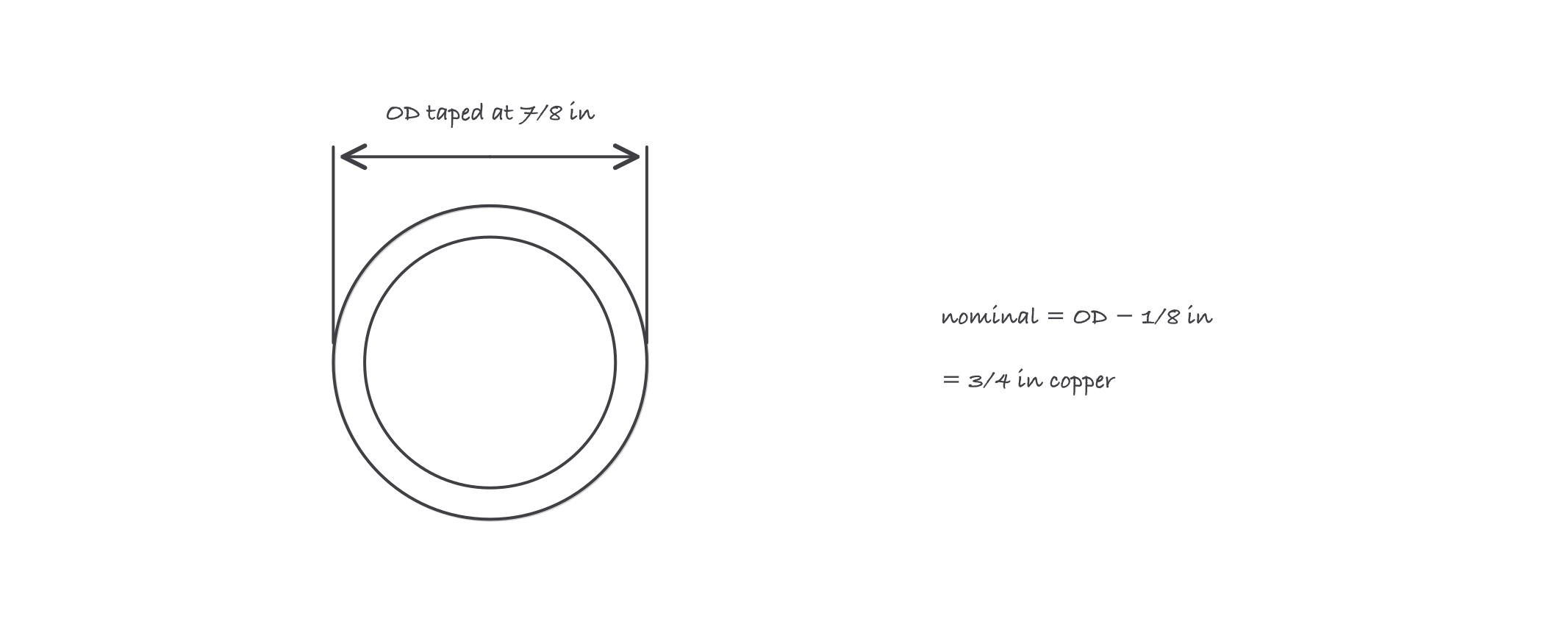
Copper’s naming rule: the outside diameter always runs 1/8 in over the nominal size
Where it bites
- White pipe is not one material. PVC and CPVC look alike at a glance; only CPVC is rated for hot distribution, and their cements are not interchangeable. Read the print line on the pipe, every time.
- Type M copper and Type L copper look identical bare. Once the sticker is gone, wall thickness is the only difference, and some jurisdictions and uses require L. The print stamp and sticker color are your record; when in doubt, measure and check.
- “It fits” is not “it is allowed.” ABS and PVC fittings mate mechanically but the cemented joint between them is restricted to specific transition situations. Use the listed transition cement or a mechanical coupling.
- Nominal is not actual, in any family. Order fittings by nominal size and material, never by what your tape said. A 3/4 in copper fitting and a 3/4 in steel fitting share a name and nothing else.
- Sunlight is a materials spec. PEX degrades in UV; storing sticks on the south side of the van rack for a summer shortens their life before installation.