Learn · Plumbing
Water Heater Safety: T&P Valves and Expansion
Part of Journeyman Plumber Exam Prep · step 19 of 31 · next: Fuel Gas Fundamentals
In learning paths: Journeyman Plumber Exam Prep
Assumes you know: Water Heaters
A storage water heater is a pressure vessel with a fire under it, and its safety hardware exists to break two specific chains of events: a tank that gets too hot, and a system that has nowhere to put expanding water. The temperature and pressure relief valve handles the first; the thermal expansion tank handles the second.
Why it matters on the job
A water heater that fails safe is a puddle. One that fails wrong is a bomb: water held above 212°F under pressure flashes to steam the instant the tank lets go, expanding on the order of 1,600 times, and tanks have gone through roofs. Every rule in this lesson, the valve, its rating, the discharge pipe, the expansion tank, is a link in preventing exactly that. This is also the hardware inspectors check first on every heater install.
The T&P valve and its two triggers
The temperature and pressure relief valve threads into the tank’s top or upper side, with its sensing element reaching into the hottest water. It opens on either of two independent triggers, and the standard rating is 210°F or 150 psi, whichever comes first.
The pressure trigger protects the vessel: 150 psi sits safely below the tank’s working strength, and relieving there stops overpressure from splitting seams. The temperature trigger protects against something worse. Water at atmospheric pressure boils at 212°F; water in a sealed tank can be pushed far past that without boiling. Relieve at 210°F and the water can never reach the superheated state where a rupture becomes a steam explosion. That is why a T&P valve is never optional, never plugged, and never replaced with a pressure-only valve.
The discharge pipe is part of the valve. It runs full size, falls by gravity to an approved termination within inches of the floor or to a safe location your code names, and ends with a plain, unthreaded opening. A threaded end invites a cap, and a capped T&P discharge has already killed people.
The storage temperature question
Setpoint is a genuine trade-off, so learn both sides. Storing at 120°F keeps scald risk low, since burns at that temperature take minutes rather than seconds, but 120°F is also the bottom of the range where Legionella bacteria survive in a tank. Storing hotter, around 140°F, controls the bacteria but delivers water that scalds in about 5 seconds. The approach many professionals favor is to do both: store hot, then temper delivery to about 120°F with a thermostatic mixing valve at the heater. Your code and the appliance instructions govern; shower and tub valves add their own scald protection.
Thermal expansion and the closed system
Heat water and it expands. In an open system the extra volume pushes harmlessly back toward the main. But a check valve, a pressure reducing valve, or a backflow preventer closes the system, and then the expansion has nowhere to go. Water is nearly incompressible, so a small added volume in a rigid, full system drives pressure up fast, cycling the T&P valve or hammering fixtures every time the burner runs. The fix is a thermal expansion tank: a small vessel with an air cushion behind a diaphragm, mounted on the cold side near the heater, that swallows the expansion volume and gives it back on the next draw.
Worked example
A 50 gal heater warms its tank from a 50°F fill to a 120°F setpoint in a closed system.
- Water expands roughly 2% over that 70°F rise. Expansion volume: 50 gal × 0.02 = 1 gal.
- Without an expansion tank, that extra gallon must squeeze into piping that is already full. Pressure climbs with each heating cycle until something relieves; a system that starts at 60 psi can pass the T&P valve’s 150 psi trigger during a single recovery, and a weeping T&P valve on a schedule is the classic signature.
- With an expansion tank holding about 2 gal of air cushion, precharged to the system’s static pressure, the 1 gal of expansion compresses the cushion instead, and system pressure rises modestly instead of spiking.
A T&P valve that drips every heating cycle is doing its job; the system around it is what failed.
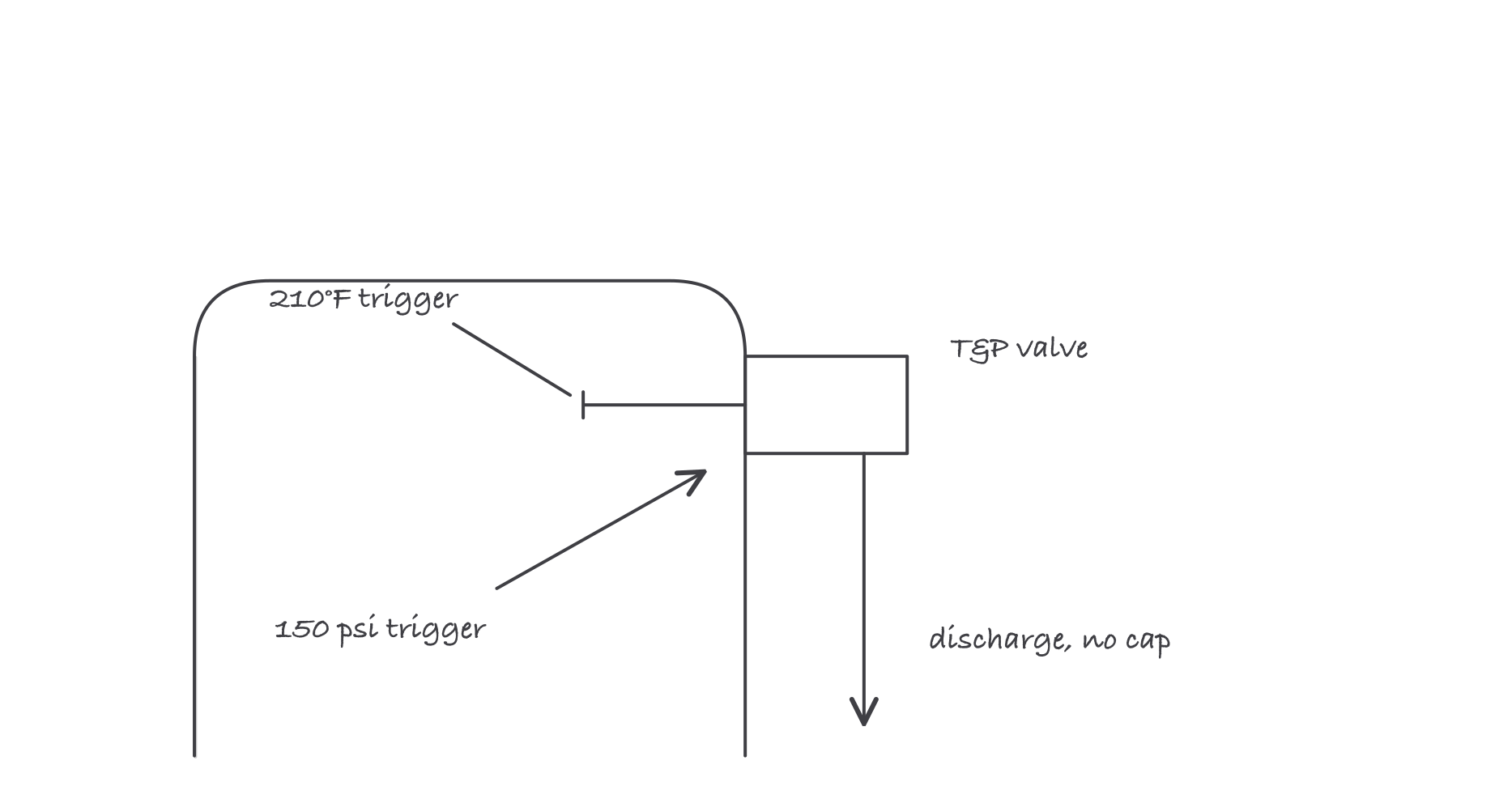
One valve, two independent triggers: 210°F or 150 psi, whichever arrives first opens the discharge
Where it bites
- Test levers are tested rarely for a reason, and that reason is wrong. A T&P valve unexercised for years can seize shut, invisibly. Manufacturers call for periodic testing; expect an old valve to drip after and be ready to replace it.
- The discharge pipe rules are exam and inspection bait. Full size, gravity fall, approved termination, air gap, no threads, no cap, no trap. Any reduction or upturn can slow relief exactly when the valve needs full flow.
- New PRV, new symptoms. Fitting a pressure reducing valve on a service closes the system. If a heater starts weeping right after unrelated service work, look for the new check or PRV upstream.
- An expansion tank has a service life. A failed diaphragm turns the tank into dead weight, waterlogged and useless, and the expansion symptoms return. Tap it: air cushion sounds hollow at the top, waterlogged sounds dull throughout.
Verified requirements
| Where | Expires | Renewal | Continuing education |
|---|---|---|---|
| Texas | Confirm with issuer | Confirm with issuer | Confirm with issuer |
| Texas | Confirm with issuer | Confirm with issuer | Confirm with issuer |
| Illinois | Confirm with issuer | Confirm with issuer | Confirm with issuer |
Information comes from issuing-authority sources. Confirm current rules, fees and eligibility with the authority before acting.