Learn · Plumbing
Cross-Connections and Backflow
Part of Journeyman Plumber Exam Prep · step 15 of 31 · next: Water Distribution Systems
In learning paths: Journeyman Plumber Exam Prep
Assumes you know: Water Pressure and Flow
A cross-connection is any point where the potable water system touches, or could touch, anything that is not potable: a hose end in a bucket, a boiler feed, an irrigation line, a submerged fill spout. Backflow is what happens when flow at that point reverses and the non-potable side rides the plumbing backward into the drinking water.
Why it matters on the job
Water supply piping is designed on the assumption that water moves one way. The assumption fails routinely, and when it fails at a cross-connection, a house or a whole neighborhood drinks whatever was on the wrong end. Real incidents have put pesticides, boiler treatment chemicals, and pool water into mains. Cross-connection control is the part of the trade where a lazy shortcut can poison people who never met you, and code treats it accordingly.
The two ways water runs backward
This distinction organizes everything else in the subject, including which device you install.
Backpressure is the downstream system pushing. Anything that can raise pressure on the non-potable side above supply pressure can drive flow backward: a boiler with its own heat-driven pressure, a pump on an irrigation or fire system, an elevated tank. The supply is at normal pressure; it loses the pushing contest.
Backsiphonage is the supply side sucking. When supply pressure collapses, a broken main, a hydrant drawing hard during a fire, a pump failure, pressure in the piping can fall below atmospheric. The system becomes a drinking straw, and atmosphere pushes liquid from any submerged opening up into the pipe. Nothing downstream did anything wrong; the vacuum came from upstream.
Ask of every scenario: was the contaminated side pushed in, or was it sucked in? Devices that stop one do not necessarily stop the other.
Matching protection to hazard
The gold standard is the air gap: a physical vertical separation between the supply outlet and the flood rim, the way a faucet hangs above a sink. Nothing flows backward across open air. Where an air gap is impractical, mechanical devices stand in, in rough order of capability: atmospheric and pressure vacuum breakers stop backsiphonage only; double check assemblies handle both reversals for low hazards; a reduced pressure zone assembly, the RPZ, handles both reversals for high hazards and proves itself by dumping water from its relief port when a check fouls. Your code assigns devices by degree of hazard, pollutant versus contaminant, and the testable assemblies require certified periodic testing.
Worked example
A house sits on a hill, with its hose bib 25 ft above the street main. The hose is stretched to a stock tank dosed with pesticide, end submerged. A water main breaks at the bottom of the hill and the utility’s pressure collapses to zero.
- The water in the house piping is now an unsupported column 25 ft tall. It starts falling toward the break.
- The falling column pulls suction at the top. Convert the height: 25 ft × 0.433 psi/ft = 10.8 psi below atmospheric at the hose bib, roughly half a vacuum.
- Atmospheric pressure pushes tank liquid up the submerged hose exactly as it pushes soda up a straw. The pesticide mix is now in the house piping, and when the main is repaired, normal pressure distributes it.
A 30-cent hose connection vacuum breaker at the bib breaks the siphon by letting air, not tank liquid, feed the falling column. Classify the event before you trust the fix: this was backsiphonage, so a vacuum breaker works; against a pumped or heated downstream system it would not.
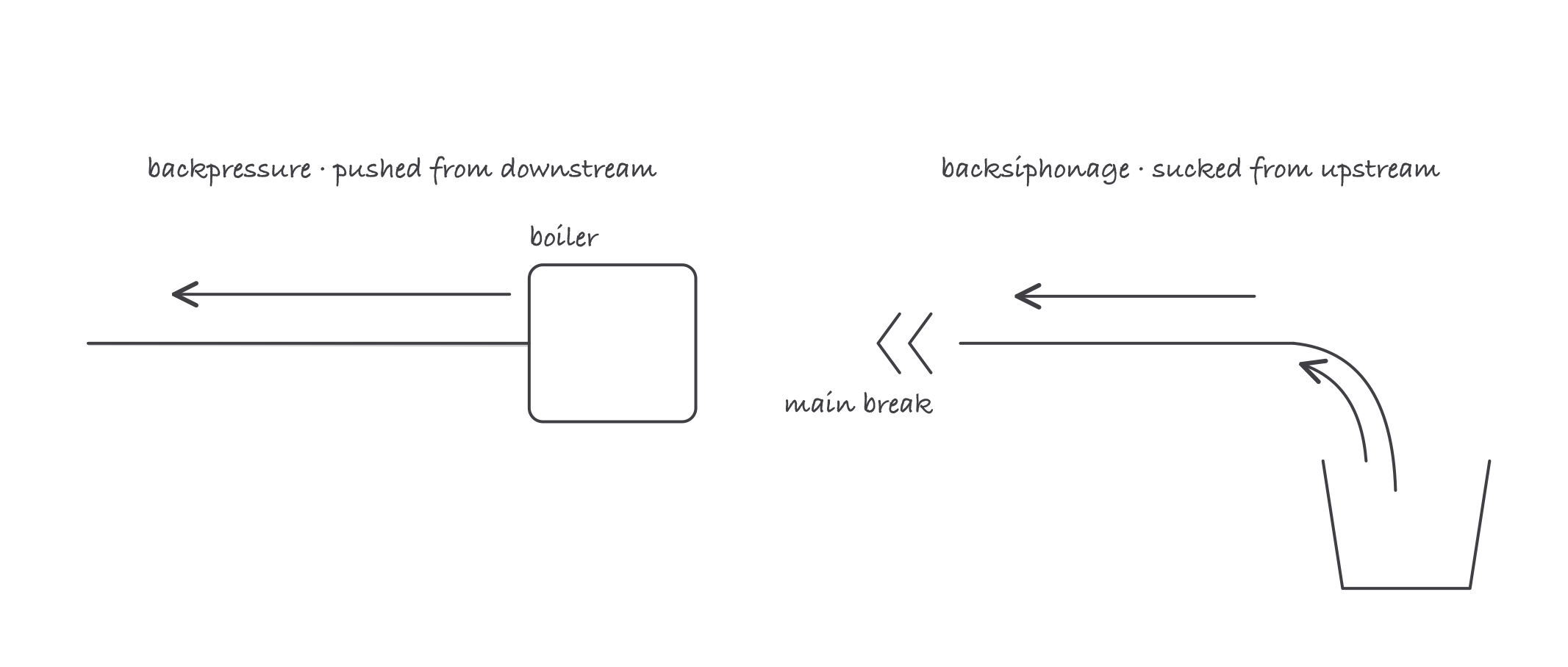
The two reversals: backpressure is pushed from downstream, backsiphonage is sucked from upstream
Where it bites
- The hazard is potential, not observed. A cross-connection is a violation while everything is working fine. “It has never flowed backward” is not a defense; the main break happens once, at 2 a.m., during a fire.
- Vacuum breakers on backpressure duty fail silently. An atmospheric vacuum breaker downstream of a pump or under continuous pressure is misapplied and protects nothing. Match the device to the reversal mechanism first, then to the hazard degree.
- An RPZ that spits is talking to you. Discharge from the relief port means a check is fouled and the assembly is doing its failsafe job. Plumbing the relief port solid to hide the drip defeats the design; give it the air-gapped drain the listing requires.
- The ordinary garden hose is the most common cross-connection in America. It reaches buckets, pools, drains, and sprayers. That is why hose threads get vacuum breakers and why laundry tubs and bibs show up on exams and in consent decrees alike.
Verified requirements
| Where | Expires | Renewal | Continuing education |
|---|---|---|---|
| United States (federal) | Yes | 3 years | Recertification requires a class of 2 to 12 hours depending on the program plus a written exam of 25 to 100 questions; some programs also require a hands-on practical. Recertification may be taken up to six months early without losing time on the certification. |
| Texas | Confirm with issuer | Confirm with issuer | Confirm with issuer |
| Texas | Confirm with issuer | Confirm with issuer | Confirm with issuer |
| Illinois | Confirm with issuer | Confirm with issuer | Confirm with issuer |
Information comes from issuing-authority sources. Confirm current rules, fees and eligibility with the authority before acting.