Learn · Plumbing
Fuel Gas Fundamentals
Part of Journeyman Plumber Exam Prep · step 20 of 31 · next: Gas Pipe Sizing
In learning paths: Journeyman Plumber Exam Prep
Fuel gas is energy delivered as flammable vapor through pipe. Everything in gas work follows from three numbers: how much heat the gas carries per cubic foot, how heavy it is compared to air, and how hard it is pushing. Natural gas carries a nominal 1,000 Btu per cubic foot, and that round number is the conversion key for the whole trade.
Why it matters on the job
Gas piping looks like small water piping and behaves nothing like it. The pressures are tiny, the units are different, and a mistake does not drip on the floor: it fills a space with fuel and waits for a spark. Before you size a pipe or set a regulator, you need the physical story of the two gases you will actually meet, natural gas and LP.
Two gases, two directions
Natural gas is mostly methane and is lighter than air. Leak it into a room and it rises, spreads along the ceiling, and finds its way out through any high opening. Given ventilation, it wants to leave.
LP gas, propane in most of the country, is heavier than air. Leak it and it sinks. It rolls downhill like invisible water, pools in basements, crawl spaces, trenches, and boat hulls, and sits there. It does not dissipate upward; it waits at ankle height where the water heater pilot lives.
This is the single most important safety fact in fuel gas work. It is why LP appliances and regulators are kept out of pits and unventilated low spaces, why you sniff low when you suspect a propane leak and high for natural gas, and why a trench full of propane is treated as a live hazard. Both gases are odorized with mercaptan so your nose gets a warning, but odorant can fade in new piping and in soil, so a meter, not your nose, clears a space.
Pressure in inches of water
Gas appliances run on pressure too small for a psi gauge to read usefully, so the trade measures in inches of water column, written in. w.c. Picture a U-shaped tube half full of water: connect gas to one side and the pressure pushes the water column up the other side. The height difference in inches is the pressure. A column of water 27.7 in tall weighs in at 1 psi, so 1 in. w.c. is about 0.036 psi.
Typical supply at a natural gas appliance is around 7 in. w.c. Typical supply at an LP appliance is around 11 in. w.c. Treat both as typical operating figures: the appliance rating plate and your code govern. Getting from utility distribution pressure down to these numbers is the regulator’s whole job.
Worked example
Put the numbers together the way a service call does.
- Convert appliance pressure to psi. Natural gas at 7 in. w.c.: 7 ÷ 27.7 = 0.25 psi. LP at 11 in. w.c.: 11 ÷ 27.7 = 0.40 psi. A child’s balloon holds more.
- Convert an appliance rating to gas flow. A furnace rated 100,000 Btu/hr on natural gas at 1,000 Btu per cubic foot needs 100,000 ÷ 1,000 = 100 cubic feet of gas per hour.
- Read the consequence: gas piping moves a large volume at almost no pressure. There is no pressure to spare, which is why pipe sizing, the next lesson, is unforgiving about length and load.
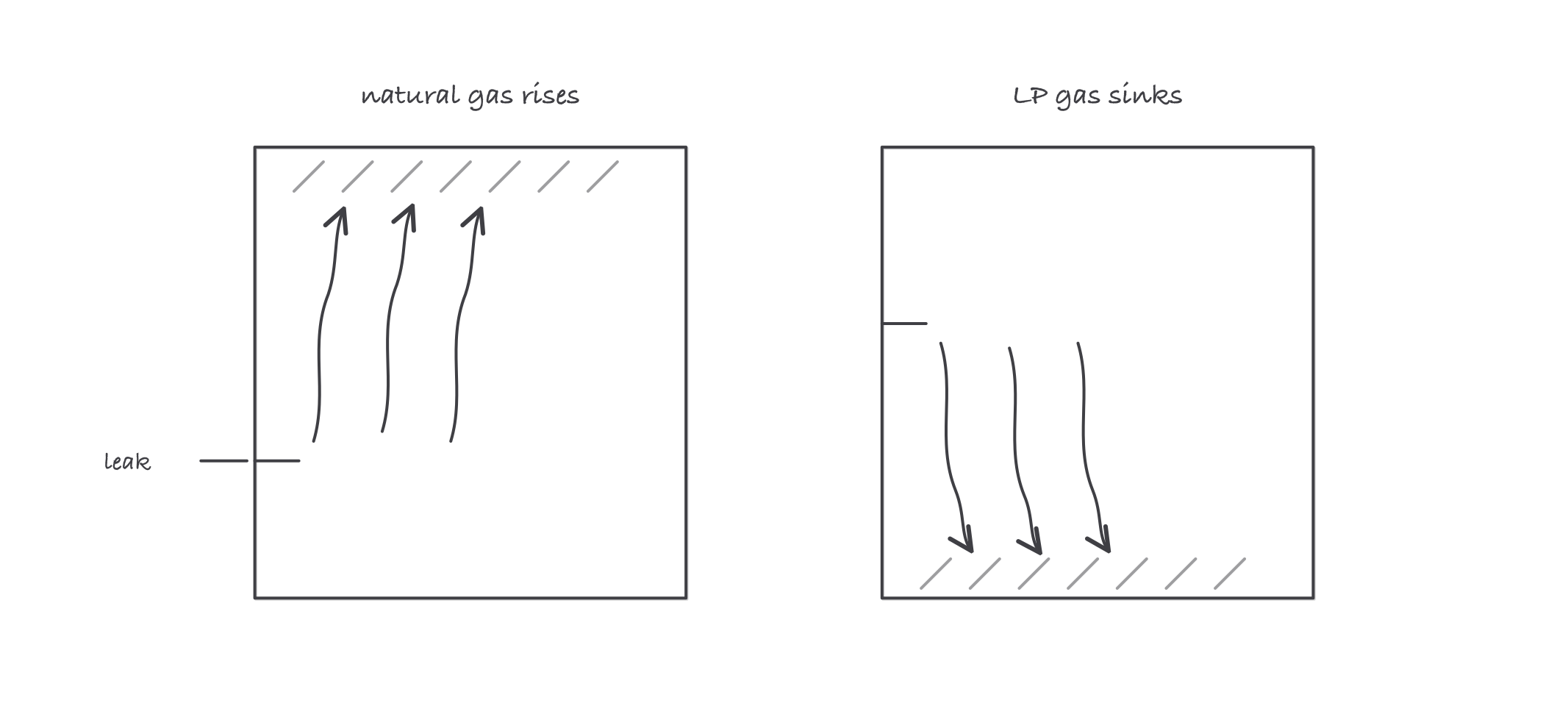
Natural gas rises and dissipates, LP sinks and pools: sniff high for one, low for the other
Where it bites
- Propane in a low spot does not leave. A cleared room can still hold a flammable layer in the sump pit or stairwell. Ventilate low and meter low before you trust an LP space.
- Confusing in. w.c. with psi wrecks equipment. Pressure-testing a system with the appliance gas valves still connected exposes 0.25 psi components to test pressures many times higher. Valves and regulators are not rated for it.
- The 1,000 Btu figure is nominal. Delivered heating value varies by utility and by season. Use it for sizing arithmetic, but the utility’s stated value governs engineered work.
- Odorant is a warning, not a guarantee. New steel pipe and soil can scrub mercaptan from the gas. Treat a suspected leak as real until a combustible gas indicator says otherwise.
Exam relevance
Exams lean on exactly these fundamentals: which gas is heavier than air and what that means for where it accumulates, typical appliance supply pressures for NG versus LP, and Btu-to-cubic-feet conversions using the nominal 1,000 Btu figure. If a question describes a leak collecting near the floor, it is describing LP, and every answer about ventilation and detection placement follows from that.
Verified requirements
| Where | Expires | Renewal | Continuing education |
|---|---|---|---|
| Texas | Confirm with issuer | Confirm with issuer | Confirm with issuer |
| Texas | Confirm with issuer | Confirm with issuer | Confirm with issuer |
| Illinois | Confirm with issuer | Confirm with issuer | Confirm with issuer |
Information comes from issuing-authority sources. Confirm current rules, fees and eligibility with the authority before acting.