Learn · Plumbing
Testing and Inspection Requirements
Part of Journeyman Plumber Exam Prep · step 27 of 31 · next: The Journeyman Plumber License
In learning paths: Journeyman Plumber Exam Prep
Assumes you know: UPC vs IPC: The Two Model Codes
Plumbing inspection is staged to match one rule: nothing gets covered until it has been tested and seen. Every jurisdiction arranges the details differently, but the sequence is universal, underground work before backfill, rough-in before walls close, and a final before occupancy, with a specific test belonging to each stage.
Why it matters on the job
Scheduling is money. A failed rough inspection idles the drywall crew; covering untested work invites the order every plumber dreads, to open it back up. Knowing what the inspector will test, and testing it yourself first, turns inspection from a gamble into a formality. The pattern below is code-typical; your jurisdiction’s amendments and your inspector’s checklist govern.
The phases and their tests
Underground. Building sewers and under-slab drainage are inspected in the open trench, on proper bedding, before any backfill. The piping holds a water or air test while the inspector can still see every joint. Backfilling first is the classic new-crew violation, and the remedy is a shovel.
Rough-in, or top-out. With the building framed and all piping run but no fixtures set, the whole system is tested at once.
- DWV: the classic test is water. Cap every opening, fill the system to give a head of water, typically 10 ft above the highest fitting being tested, and hold, typically 15 minutes, with no drop. The stack itself often provides the head: fill to the roof, or use a test riser. The air alternative, where allowed, is code-typically around 5 psi held for the same order of time.
- Water supply: pressurized with water at not less than working pressure, or an air test where the code permits it. Joints visible, no drop on the gauge.
- Fuel gas: its own test, covered in the gas testing lesson, often witnessed under a separate permit.
Beyond gauges, the rough inspector is reading the installation: materials and listings, slope, support spacing, nail plates where pipe runs close to stud faces, firestopping at penetrations, and vent terminations.
Final. Fixtures set, water on. The final is functional: fixtures fill, drain, and hold trap seals, faucets and stops do not weep, the water heater’s temperature and pressure relief valve has its full-size discharge tube to an approved location, backflow devices are the right type, installed and, where testable, tested with paperwork. The final is also where fixture clearances get a last look.
Worked example
Why 10 ft of head, and what it proves. Water weighs in at 0.433 psi per foot of height.
- Fill a two-story DWV system to 10 ft above its highest fitting. That top fitting feels 10 × 0.433 = 4.33 psi.
- Every fitting lower in the system feels more: a joint 12 ft further down feels 22 × 0.433 = 9.5 psi.
- So the 10 ft head is a floor, not a uniform load: the test is measured from the highest fitting so that the weakest-loaded joint in the system still sees 4.33 psi, several times the pressure a full drain ever produces in service.
- Practical reading: on a tall system, test in stages or the bottom joints see more pressure than fittings are rated for. Codes cap how much system height one water test can load, which is why high-rise DWV is tested floor by floor.
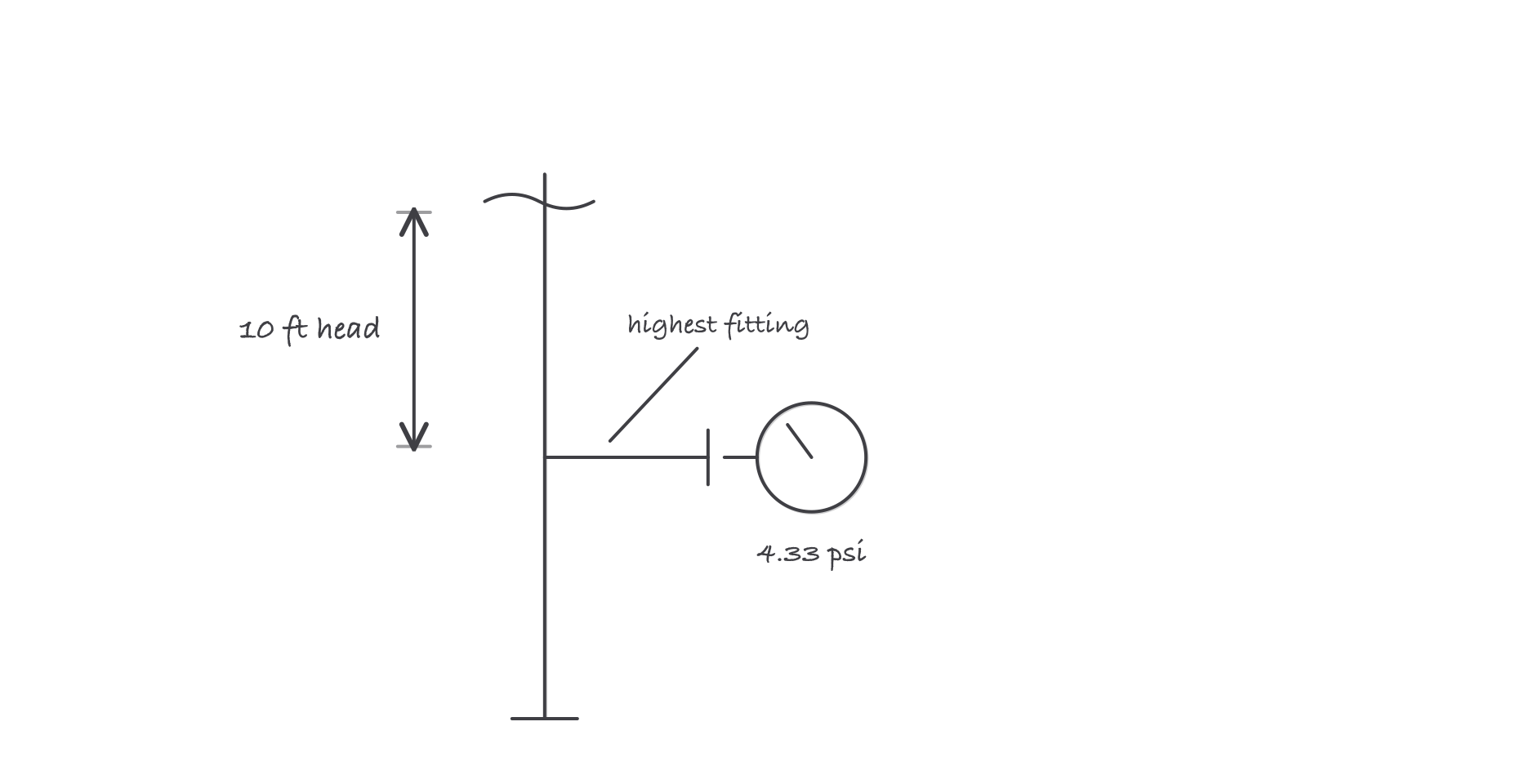
The water test loads the system from the top down: 10 ft of head means 4.33 psi at the highest fitting and more below
Where it bites
- Covering work before the card is signed. Insulation and drywall crews move on their own schedule. Until the inspection passes, protecting exposed work is part of the job.
- Testing only what the inspector tests. The inspector’s gauge check is a spot audit. Run your own test the day before; finding your leak beats the inspector finding it at your hourly cost times a reschedule.
- Air-testing plastic DWV where it is prohibited. Several codes bar air tests on plastic drainage because failure is violent. Check before you charge a PVC stack with a compressor.
- The forgotten relief valve tube. Finals fail over small, cheap items: a missing T&P discharge tube, a missing vacuum breaker on a hose bib, an unsecured water heater strap in seismic country. Walk the final checklist before calling it in.
Exam relevance
Test parameters are gift questions if you know the typical numbers and whose they are: 10 ft head and 15 minutes for the water test, the air-test figures, and the 0.433 psi per foot conversion behind them. Expect one calculation converting head to pressure at a given fitting, and one sequencing question on what must be inspected before covering. The answer to every sequencing question is the same principle: visible, tested, then covered.
Verified requirements
| Where | Expires | Renewal | Continuing education |
|---|---|---|---|
| Texas | Confirm with issuer | Confirm with issuer | Confirm with issuer |
| Texas | Confirm with issuer | Confirm with issuer | Confirm with issuer |
| Illinois | Confirm with issuer | Confirm with issuer | Confirm with issuer |
Information comes from issuing-authority sources. Confirm current rules, fees and eligibility with the authority before acting.