Learn · Plumbing
Lead-Free Requirements for Potable Water
Assumes you know: Pipe Materials and When to Use Them
“Lead free” is a legal threshold with a number attached. Federal law defines it as a weighted average of 0.25% lead calculated across the wetted surfaces of a pipe, pipe fitting, plumbing fitting and fixture, and 0.2% lead for solder and flux. A part sold as lead free still contains lead. It contains little enough, averaged the way the rule tells you to average it, to be legal for drinking water.
Why it matters on the job
You make this call every time you reach into the van for a fitting, a valve or a roll of solder. The rule covers plumbing installed or repaired in public water systems and in facilities that provide water for human consumption, so a service call on forty-year-old pipe is inside the rule, not grandfathered out of it. The prohibition on lead in potable plumbing dates to June 1986, and since September 1, 2023 manufacturers and importers have had to certify their products against the current definition.
Two numbers, two methods
0.25% applies to pipe, pipe fittings, plumbing fittings and fixtures, and it is a weighted average across wetted surfaces.
0.2% applies to solder and flux. The weighted-average method belongs to the first figure; the solder and flux limit is stated as a straight 0.2%.
Getting these two mixed up is the ordinary mistake. They are different numbers for different products, and the tighter one governs the material you melt.
What “wetted surface” is averaging
The wetted surfaces are the internal faces the drinking water actually touches. The outside of a valve body is not wetted; the bore through it is. The rule takes each component’s lead content and weights it by the share of the assembly’s total wetted surface that component contributes, then adds the weighted figures together.
That weighting has a consequence worth holding onto: a small component with a higher lead content can sit inside a compliant assembly, while the same content in the component carrying most of the wetted surface sinks it.
Worked example: run the weighted average
Take a three-component valve assembly. The component values here are illustrative, in the style of a manufacturer’s compliance sheet; the 0.25% limit is the federal one.
- Body: 70% of the wetted surface, 0.30% lead
- Insert: 20% of the wetted surface, 0.20% lead
- Seat: 10% of the wetted surface, 0.05% lead
- Weight each component by its share of the wetted surface. Body: 0.30 × 0.70 = 0.21. Insert: 0.20 × 0.20 = 0.04. Seat: 0.05 × 0.10 = 0.005.
- Add the weighted figures: 0.21 + 0.04 + 0.005 = 0.255%.
- Compare against the limit. 0.255% sits above 0.25%, so this assembly does not meet the lead-free definition, and it misses by 0.005 of a percentage point.
- Now find the lever. Take the seat’s lead all the way to zero and you save 0.005, which lands on 0.250% exactly. That is the limit itself, with nothing spare.
- Go at the body instead. Specify it at 0.25% lead: 0.25 × 0.70 = 0.175, and 0.175 + 0.04 + 0.005 = 0.22%. It passes with room.
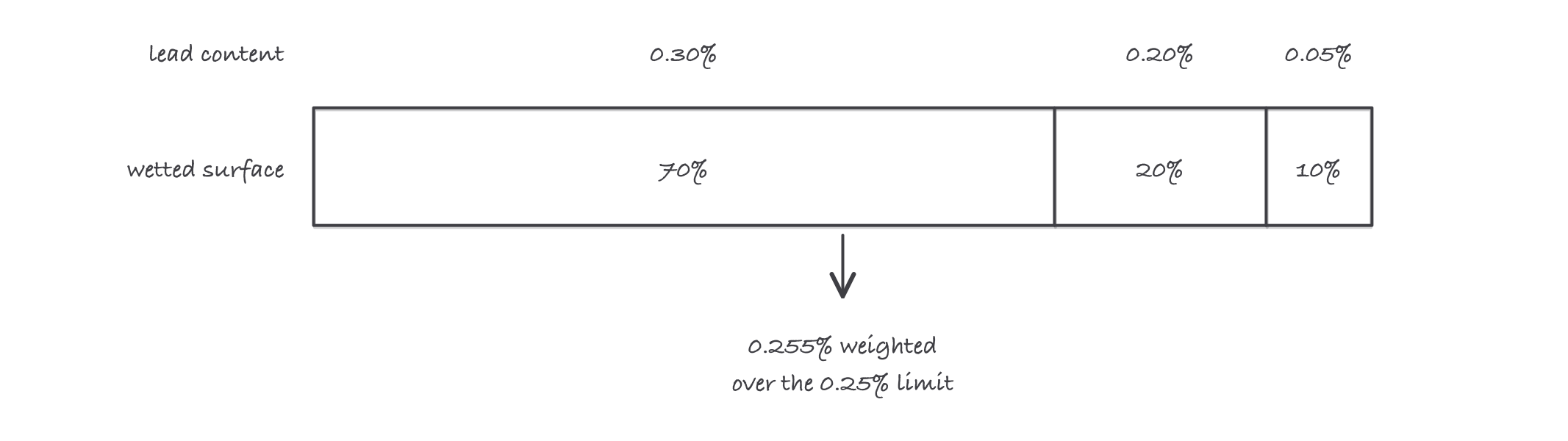
The average is weighted by surface, so the body’s 70% share carries most of the result
The body holds 70% of the wetted surface, so it drives 70% of the arithmetic. That is the whole reason the rule says weighted average instead of average.
Where it bites
- Lead free does not mean zero lead, and lead present does not mean illegal. Both readings send people the wrong way: one has plumbers assuming a compliant part is lead-free in the chemical sense, the other has customers calling a legal fitting a violation.
- The exemptions surprise people. EPA exempts plumbing devices used exclusively for nonpotable services, and names toilets, bidets, urinals, fill valves, flushometer valves, fire hydrants, tub fillers, shower valves, service saddles, and water distribution main gate valves 2 inches in diameter or larger. The organizing idea is consumption: nobody fills a glass at a tub filler.
- An exempt device still sits on a potable branch. A shower valve sits outside the rule and still sits on a potable branch that feeds fixtures inside it. Read the exemption as the boundary of the federal requirement, then let the job, the specification and the adopted code decide what you actually install.
- Old stock is the quiet failure. The rule attaches to what you install today, not to when the part was bought. Leftover solder and salvaged fittings from before the current definition are the classic route to a non-compliant repair on a compliant job.
- Repairs count as much as new work. “It was already there” is not a defense for what you put back.
Exam relevance
Expect the two numbers and, more often, the method behind the first one. Be ready to say what the 0.25% is averaged over (wetted surfaces, weighted by each component’s share) and to recognize that solder and flux carry their own 0.2% figure. Exemption questions usually work by naming a device and asking whether the rule reaches it, so know that the exempt list is built around devices that do not supply water for drinking.
Verified requirements
| Where | Expires | Renewal | Continuing education |
|---|---|---|---|
| Texas | Confirm with issuer | Confirm with issuer | Confirm with issuer |
| Illinois | Confirm with issuer | Confirm with issuer | Confirm with issuer |
Information comes from issuing-authority sources. Confirm current rules, fees and eligibility with the authority before acting.