Learn · Plumbing
Gas Pipe Sizing
Part of Journeyman Plumber Exam Prep · step 21 of 31 · next: Gas Pressure Testing
In learning paths: Journeyman Plumber Exam Prep
Assumes you know: Fuel Gas Fundamentals
Gas pipe sizing answers one question for every section of pipe: can this diameter deliver this many cubic feet per hour over this distance without losing more pressure than the appliances can spare? The standard hand method is the longest-run method, and its central trick is that you measure one distance and use it for everything.
Why it matters on the job
An undersized gas line starves appliances. The furnace short-cycles, the tankless water heater throws error codes, the range flame lifts off the burner when the furnace kicks in. None of it looks like a piping problem, so it burns service hours for years. Sizing is cheap at rough-in and miserable to fix behind drywall.
The longest-run method
Four steps, always in this order.
1. Total the demand. List every appliance with its input rating in Btu/hr from the rating plate. Convert to cubic feet per hour by dividing by the heating value, nominally 1,000 Btu per cubic foot for natural gas.
2. Measure the longest run. Follow the pipe from the meter to the farthest appliance, adding up developed length along the pipe route, not the straight-line distance. That single number is your table row.
3. Use that one row for every section. Here is the counterintuitive part: even a short branch close to the meter is sized from the longest-run row. The method guards the pressure available at the far end of the system, and every section shares responsibility for it. Using each branch’s own shorter length is the classic sizing error, and it undersizes the system.
4. Size each section for the load it carries. The section leaving the meter carries everything. After each tee, the load drops by whatever branched off. Read the smallest pipe size in your row that meets or exceeds each section’s load.
The table values below are illustrative, in the neighborhood of the model code tables for schedule 40 steel on low-pressure natural gas. Your code’s tables, for your pipe material and pressure drop, govern the job.
Worked example
A house has a furnace at 80,000 Btu/hr, a water heater at 40,000 Btu/hr, and a range at 65,000 Btu/hr. The meter feeds a trunk; the water heater tees off first, then the furnace, and the range is the far end of the line.
- Demand: 80,000 + 40,000 + 65,000 = 185,000 Btu/hr. At 1,000 Btu per cubic foot, that is 185 cfh total. Per appliance: furnace 80 cfh, water heater 40 cfh, range 65 cfh.
- Longest run: meter to range, measured along the pipe, comes to 60 ft. That row governs every section.
- Illustrative 60 ft row: 1/2 in carries 50 cfh, 3/4 in carries 105 cfh, 1 in carries 195 cfh.
- Size sections. Meter to first tee carries all 185 cfh: 1 in (195 ≥ 185). After the water heater tee, 80 + 65 = 145 cfh remains: 1 in still (105 is too small). After the furnace tee, 65 cfh remains: 3/4 in. Branches: water heater 40 cfh at 1/2 in, furnace 80 cfh at 3/4 in.
Notice the water heater branch is 8 ft of pipe, and you still sized it from the 60 ft row.
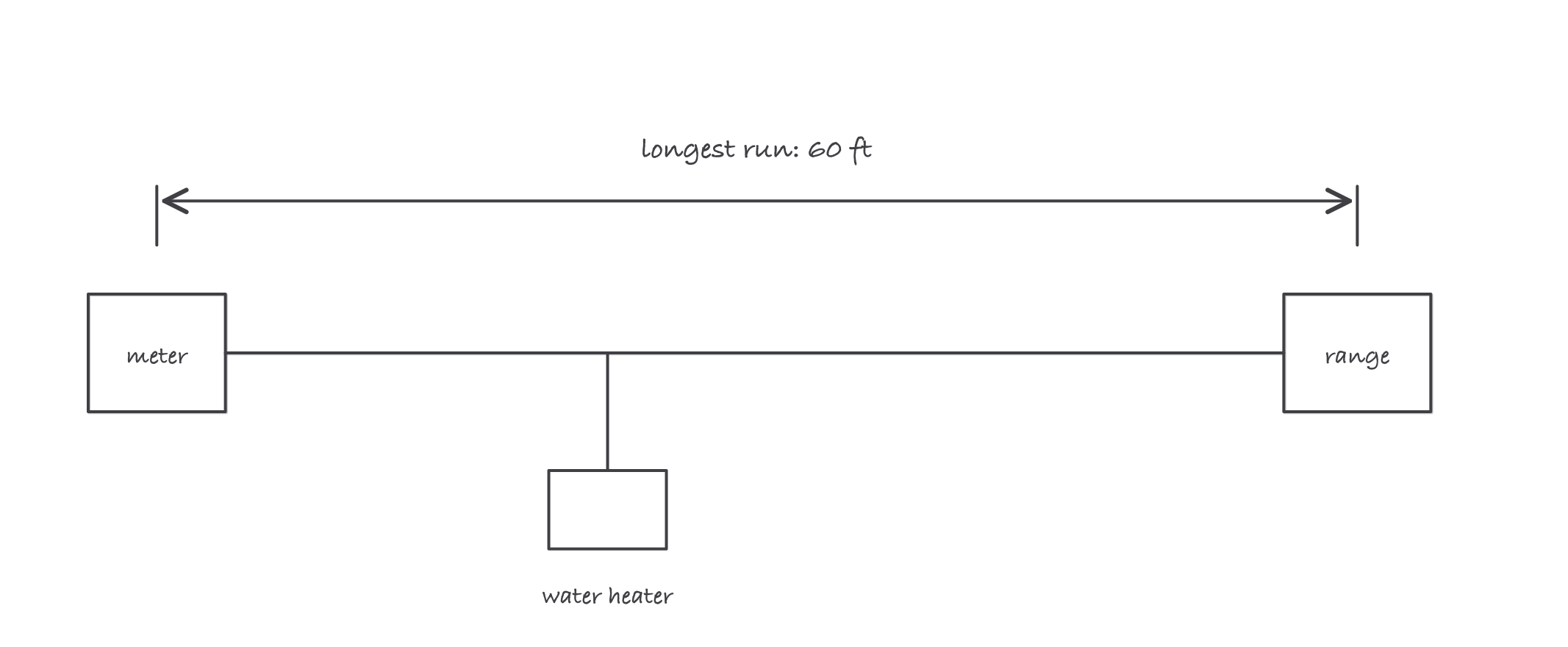
One measurement rules the whole table: every section is sized from the longest run
Where it bites
- Sizing branches by their own length. The method fails quietly: everything works until the coldest day, when every appliance fires at once and the far end starves.
- Forgetting future load. A capped tee for the outdoor grill or a future range conversion counts if it is piped. Size for what the pipe can serve, or document what it cannot.
- Mixing tables. CSST, copper, and steel each have their own tables, and elevated-pressure systems with a regulator are a different method entirely. The table must match the material and the pressure drop your system is designed around.
- Scaling ratings from the nameplate of a replaced appliance. A swapped 40,000 Btu/hr water heater becoming a 199,000 Btu/hr tankless is a resizing event, not a reconnection.
Exam relevance
Sizing problems are exam staples. Expect to convert Btu/hr to cfh, identify the longest developed length, and size two or three sections from a provided table. The distractor answers are always the ones you get by using each section’s own length, so the method itself is what is being tested. Know which row governs and the rest is arithmetic.
Verified requirements
| Where | Expires | Renewal | Continuing education |
|---|---|---|---|
| Texas | Confirm with issuer | Confirm with issuer | Confirm with issuer |
| Texas | Confirm with issuer | Confirm with issuer | Confirm with issuer |
| Illinois | Confirm with issuer | Confirm with issuer | Confirm with issuer |
Information comes from issuing-authority sources. Confirm current rules, fees and eligibility with the authority before acting.