Learn · Plumbing
Water Efficiency and WaterSense
Assumes you know: Water Pressure and Flow
WaterSense is a label, not a rule. EPA sponsors it as a voluntary partnership program, and it is two things at once: a label that goes on water-efficient products, and a resource for helping people save water. Nothing about it obliges anyone to install anything.
Why it matters on the job
Customers ask for “the low-flow one” and mean four different things by it. Specifiers write WaterSense into a project and think they have written a code requirement. Being able to say in one breath what the label certifies, and what it leaves to law and code, keeps you out of both conversations going wrong.
What the label certifies
Labeled products are certified to use at least 20 percent less water, to save energy, and to perform as well as or better than regular models. Three commitments in one certification.
The third is the one people skip over, and it is doing real work. Efficiency on its own is easy to achieve badly: restrict a showerhead far enough and it uses less water every minute while the shower runs longer. Binding performance to the certification is what stops the saving being handed back in extra minutes.
What carries the label
The labeled product categories are Residential Toilets, Showerheads, Bathroom Faucets, Commercial Toilets, Urinals, Spray Sprinkler Bodies, Irrigation Controllers, and Point-of-Use Reverse Osmosis Systems.
Two features of that list are worth reading closely. It runs well past indoor fixtures into irrigation hardware (spray sprinkler bodies and irrigation controllers), so a WaterSense conversation on a residential job is not confined to the bathroom. And the faucet category is bathroom faucets specifically, which is a reminder to check the list rather than assuming a fixture type is covered because a neighboring one is.
A label sits on top of the rules, not instead of them
The program is voluntary. Where you meet WaterSense as an obligation, the obligation is coming from something else: a project specification, a green building program, a utility rebate, or a local ordinance that chose to reference the label. The label itself never carries that force.
Separately, mandatory limits apply to many of these fixtures regardless of any label, and those come from law and adopted code. Those values are not published on the EPA pages behind this material, so you will not find them here. Look them up in the document that sets them, because a flow or flush figure carried secondhand is how the wrong fixture ends up specified.
Worked example: measure first, then predict
A customer wants lower water use in a four-person household and asks what a shower swap is worth.
- Bucket-test the existing head. 1 gallon in 25 seconds gives 60 ÷ 25 = 2.4 gpm.
- Count the actual use: 4 people, one 8-minute shower each per day, so 4 × 8 = 32 shower-minutes per day.
- Daily volume as it stands: 32 × 2.4 = 76.8 gal/day.
- Apply the label’s floor of 20 percent less water: 2.4 × 0.80 = 1.92 gpm, giving 32 × 1.92 = 61.44 gal/day.
- Difference: 76.8 − 61.44 = 15.36 gal/day, and 15.36 × 365 = 5,606 gallons a year for this household.
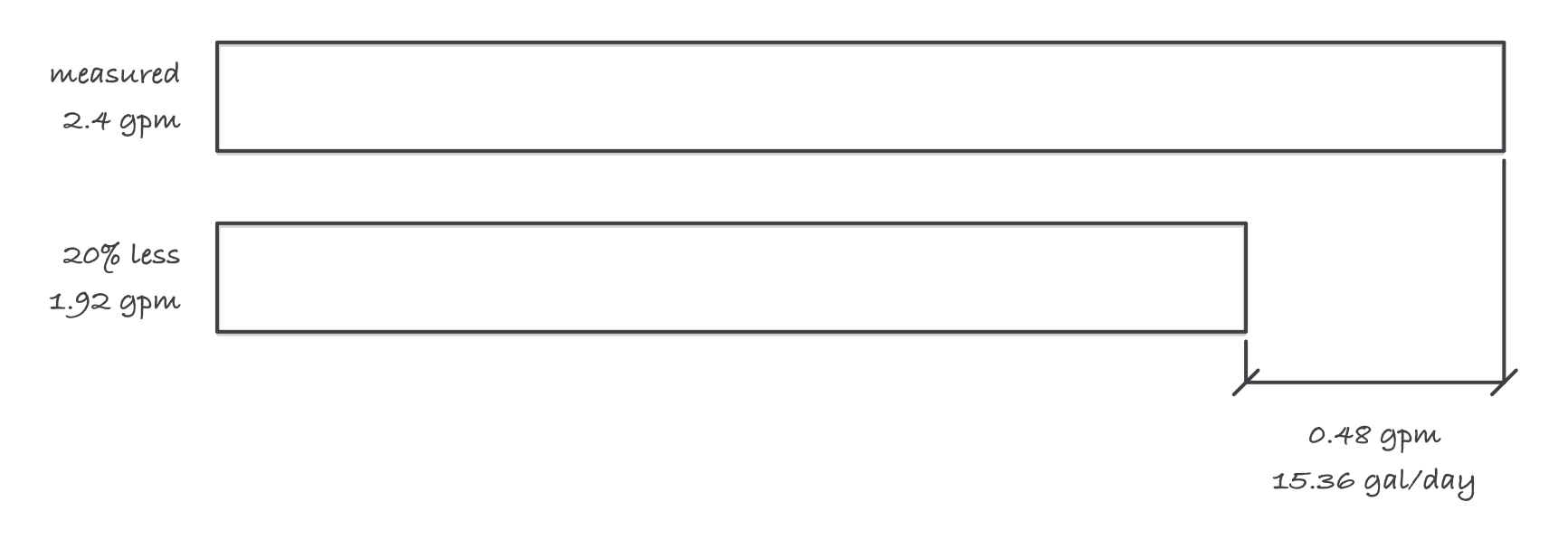
Twenty percent off a measured 2.4 gpm is 0.48 gpm, which is 15.36 gallons a day for this household
That 20 percent is the label’s floor measured against regular models, not against the head you tested. If the head on the wall is already an efficient one, the real saving is smaller than this; if it is an old high-flow head, it is larger. The arithmetic gives you the shape of the answer and the method for getting a real one: measure what is there, read the rating of what you are proposing, and subtract.
Where it bites
- The requirement always comes from somewhere else. WaterSense is voluntary, so “it has to be WaterSense” is always coming from a spec, an ordinance or a rebate program. Ask which one, because that document is where the actual requirement is written.
- The 20 percent is not 20 percent off whatever is installed. It is a floor against regular models. Predicting a saving for one house means measuring that house’s fixture, not subtracting a fifth from an assumption.
- Low flow at a fixture can mean the opposite of efficiency. A clogged aerator, a partly closed stop and a failing pressure regulator all read as low flow on a bucket test. Compare the measurement against the fixture’s rating before calling it efficiency; the diagnosis lesson works this the other way around.
- Efficiency without performance gets given back. A fixture that annoys the person using it is used for longer, refilled, or run twice. This is why the certification includes performing as well as or better than regular models, and why a bargain low-flow head that is not labeled can cost water rather than save it.
- Check the category list before you promise a label. The labeled categories are specific, and a customer’s “WaterSense kitchen” may be asking for something the program does not label.
Efficiency work is a measurement job before it is a product job. Get the flow that exists, get the rating of what replaces it, and the conversation stops being about labels and becomes about gallons the customer can see on a bill.