Learn · Plumbing
Hydronic Heating Basics
Assumes you know: Water Pressure and Flow
Hydronic heating moves heat as hot water: a boiler warms it, a circulator pushes it around a piping loop, and emitters, radiators, baseboard, or floor tubing, release the heat into rooms before the cooled water returns to the boiler. For a plumber the appeal is obvious: a hydronic system is a pressurized closed piping loop, built with the materials, joints, and hydraulic logic you already own, plus one new habit, thinking in heat instead of just flow.
Why it matters on the job
Hydronics is where experienced plumbers grow into higher-value work: boiler swaps, radiant floors, and the service calls nobody else in the area can diagnose. The systems reward exactly the fundamentals this track built, Water Pressure and Flow especially, because every hydronic question eventually becomes a flow-and-pressure-drop question with a temperature attached.
The closed loop and its cast
A minimal system is a circle: boiler, supply piping out, emitters in the rooms, return piping back, and a circulator, a small pump, keeping the water moving. Because the loop is closed and sealed, three support players are non-negotiable:
- An expansion tank gives heated water somewhere to go. Water expands as it warms; in a sealed loop with no air cushion, that expansion would spike the pressure every firing cycle. The tank’s air charge absorbs it, the same physics as thermal expansion control on a closed potable system.
- Air control devices, air separators and vents, remove the air that comes out of solution when water heats. Air in a hydronic loop makes noise, blocks circulation in high points, and corrodes components.
- A fill and pressure arrangement keeps the loop at its working pressure, and a relief valve protects it, the same safety logic as Water Heater Safety.
The loop’s water stays the same water, around and around. Heat is the only thing that enters and leaves.
Heat rides on flow: the one formula
The trade’s central relationship connects heat delivered, flow, and temperature change. In words: heat per hour equals flow times 500 times the temperature drop. In symbols:
BTU/hr = GPM × 500 × ΔT
ΔT is the temperature difference between supply and return, how much heat each gallon gives up. The 500 is water’s bookkeeping constant: 1 gallon weighs about 8.33 lb, 60 minutes make an hour, and each pound releases 1 Btu per degree Fahrenheit, so 8.33 × 60 ≈ 500. The formula rearranges to answer every design question: GPM = BTU/hr ÷ (500 × ΔT).
Worked example: sizing the flow
A boiler must deliver 100,000 BTU/hr to a house, with the system designed for a 20 °F temperature drop, water leaves the boiler at 180 °F and returns at 160 °F.
- Required flow: GPM = 100,000 ÷ (500 × 20) = 100,000 ÷ 10,000 = 10 GPM.
- Check it forward: 10 GPM × 500 × 20 = 100,000 BTU/hr. The loop carries the boiler’s full output.
- Now the design trade-off you will meet everywhere: run the same boiler at a 40 °F drop and the flow halves, GPM = 100,000 ÷ (500 × 40) = 5 GPM, smaller pipe, smaller circulator, but cooler water reaching the far emitters. ΔT and GPM are two levers on one machine.
That 10 GPM number then feeds straight into Water Pressure and Flow thinking: pipe size and circulator selection come from moving 10 GPM around the loop’s friction at an acceptable head.
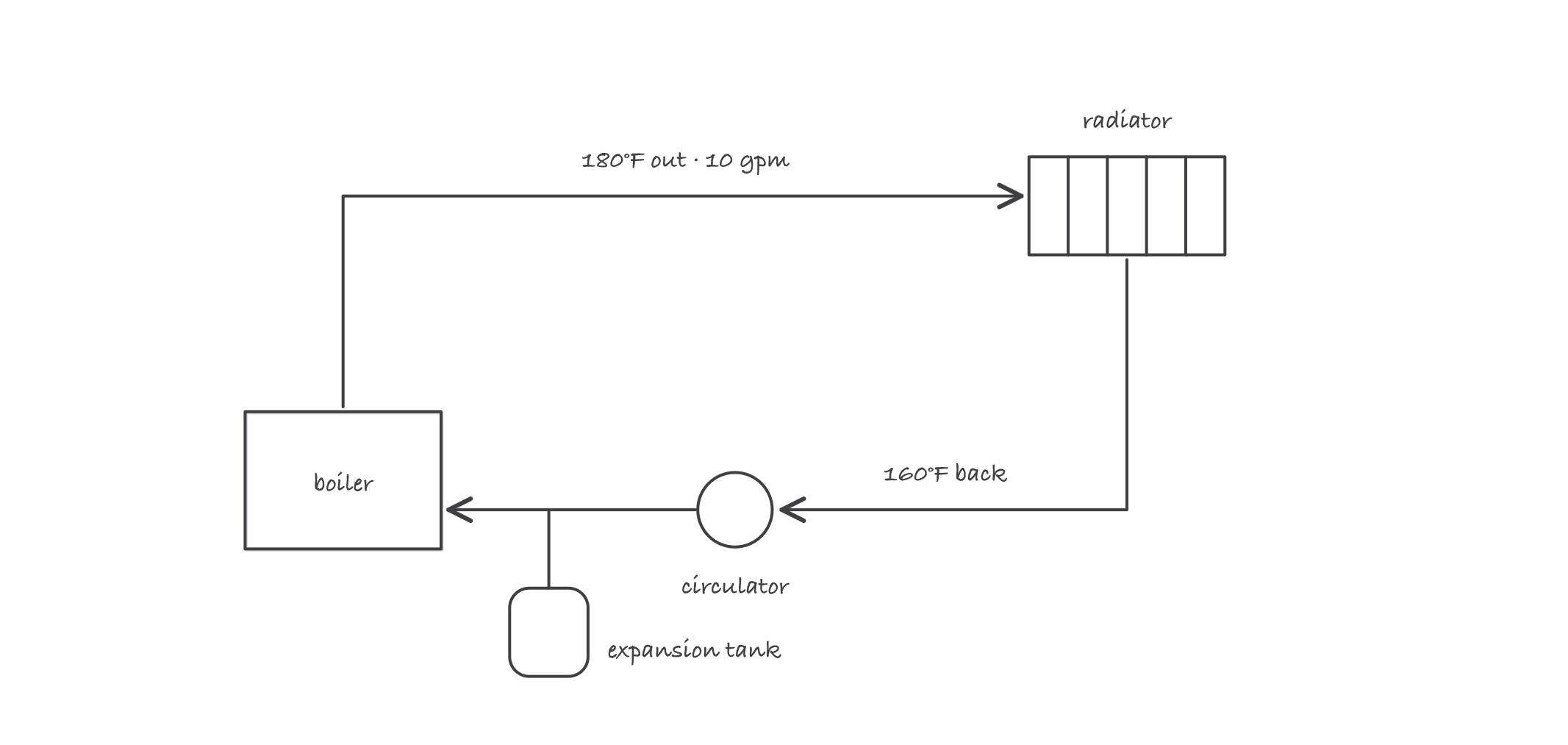
One closed circle: 10 gpm carrying 100,000 BTU per hour on a 20 degree drop
Where it bites
- Air is the number one service call. A gurgling loop or a cold upper-floor zone is air-bound until proven otherwise. Purge, vent, and check the air separator before condemning hardware.
- A dead cold emitter with a hot loop is a flow problem, not a heat problem. Check valves installed backward, a stuck zone valve, or a failed circulator starve emitters that the boiler is perfectly willing to feed.
- The expansion tank fails quietly. A waterlogged tank shows up as the relief valve weeping every firing cycle, the same symptom-versus-cause trap as on water heaters. Check the tank’s air charge, not just the relief valve.
- Boiler water is not potable water. The loop is a closed non-potable system, often treated; its connection to the potable fill runs through backflow protection, tying straight back to Cross-Connections and Backflow.
- Oversizing flow “to be safe” backfires: velocity noise, erosion, and pumping cost. Trust the formula, then verify against the emitter and boiler documentation.