Learn · Plumbing
Water Heaters
Part of Journeyman Plumber Exam Prep · step 18 of 31 · next: Water Heater Safety: T&P Valves and Expansion
Part of Advanced Water Distribution · step 5 of 6 · next: Hot-Water Recirculation
In learning paths: Journeyman Plumber Exam Prep · Advanced Water Distribution
Assumes you know: Water Distribution Systems
A water heater is a device that adds a measured amount of heat to a measured amount of water, and everything about selecting and installing one falls out of that sentence. Storage heaters bank hot water ahead of demand; tankless heaters make it at the moment of demand; both are sized by the same arithmetic of gallons, temperature rise, and Btu.
Why it matters on the job
Water heaters are the appliance you will touch most: installs, swaps, no-hot-water calls, and sizing questions on every bid. A heater that is too small generates callbacks; one that is too big wastes the customer’s money twice, at purchase and on every standby hour after. And because a heater joins water, fuel, flue, and pressure vessel in one package, it is also where plumbing meets its most serious safety rules, which the next lesson takes on.
How a storage heater works
Cold water enters at the top but is delivered to the bottom of the tank through the dip tube. The burner or elements heat from below, and hot water, being less dense, floats to the top, where the hot outlet draws it off. This layering is stratification: a working tank is hot at the crown and cooler at the base, and it is why a 40 gal tank delivers most of its capacity at full temperature before the incoming cold catches up with the outlet. Snap the dip tube off and cold inlet water shortcuts straight across the top to the outlet, and the customer reports lukewarm showers from a tank full of hot water.
Gas models vent combustion products through a flue; electric models heat with immersed elements, usually an upper and lower pair that never run together. An anode rod sacrifices itself to corrosion so the tank wall does not.
The two capacity numbers
Recovery rate is how fast the heater can raise incoming water to setpoint, in gallons per hour at a stated temperature rise. It belongs to the burner or elements. First-hour rating is what the heater can deliver in a busy hour: the usable stored volume plus an hour of recovery. Storage answers the morning rush; recovery answers how soon the second rush can start. Tankless units have no storage, so they quote a flow rate at a temperature rise instead, and the rise available falls as flow climbs.
Worked example
A 40 gal gas heater with a 40,000 Btu per hour burner heats 50°F inlet water to a 120°F setpoint. One Btu raises 1 lb of water 1°F, and water weighs 8.34 lb per gal.
- Heat needed for the full tank: 40 gal × 8.34 lb/gal × (120 − 50)°F = 40 × 8.34 × 70 = 23,352 Btu.
- The burner is not perfectly efficient; take 80%, so useful output is 40,000 × 0.80 = 32,000 Btu per hour.
- Time to heat the tank from cold: 23,352 ÷ 32,000 = 0.73 hr, about 44 minutes.
- Recovery rate: 32,000 ÷ (8.34 × 70) = 32,000 ÷ 583.8 = 55 gal per hour at a 70°F rise.
Every sizing conversation is these four lines with different inputs. A colder climate raises the rise; a bigger burner cuts the wait.
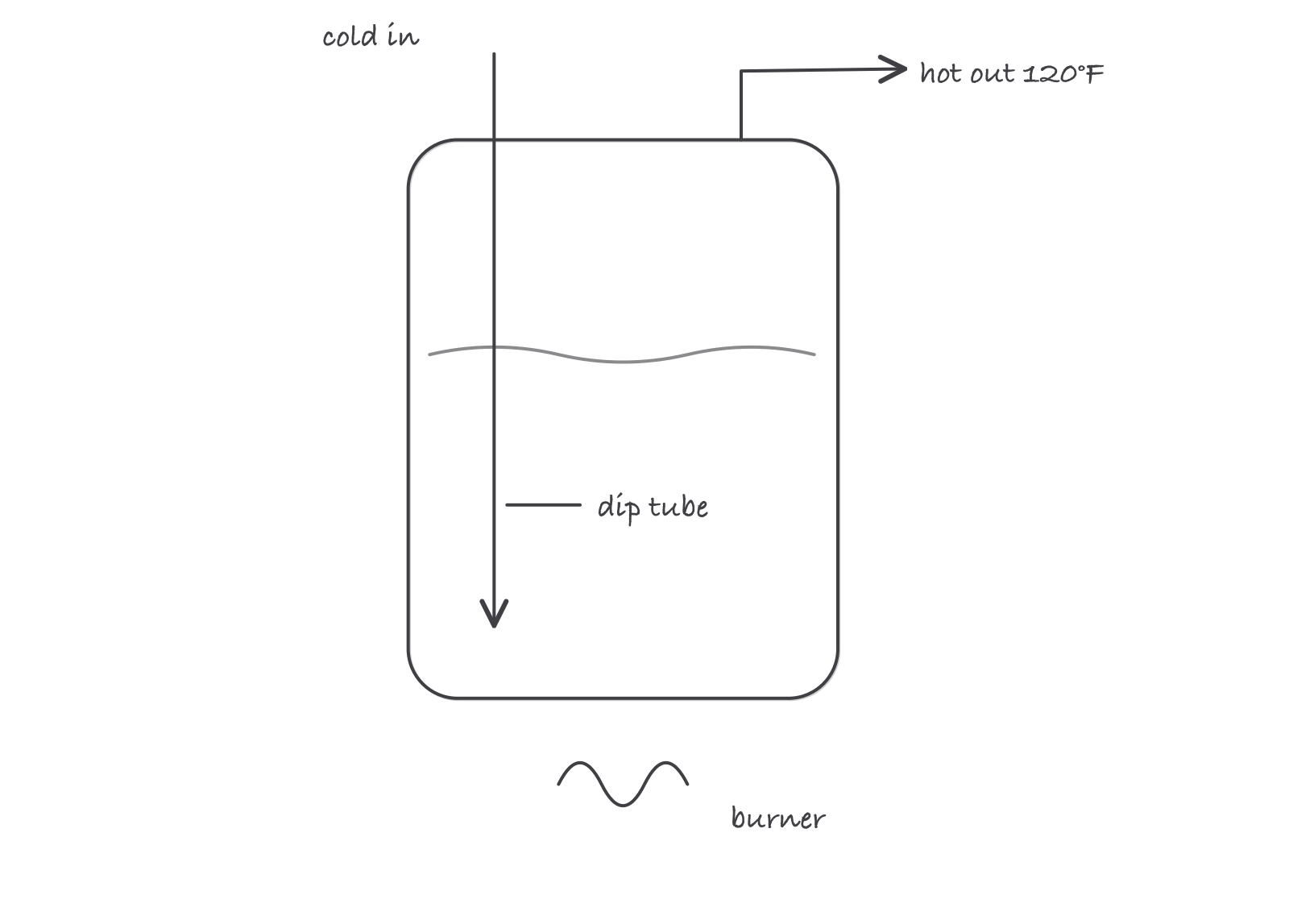
Cold enters low through the dip tube, heat rises, and the outlet skims the hottest water off the top
Where it bites
- Lukewarm water with a hot tank means dip tube first. A failed or broken dip tube lets inlet water short-circuit to the outlet. It mimics a failing element or burner and is far cheaper to fix.
- On electric units, elements take turns. The upper element heats its zone first, then hands off to the lower. A failed lower element leaves a short draw of hot then cold; a failed upper element means no hot at all. The symptom tells you which end to open.
- Sediment eats recovery from below. Scale on the tank bottom insulates gas burners from the water. Rumbling and popping is steam under the sediment blanket, and the recovery arithmetic above quietly stops being true.
- Tankless capacity is a winter number. Quote the flow at your real winter inlet temperature, not the brochure’s mild-inlet figure. A unit that gives 7 gpm at a 35°F rise gives far less at a 70°F rise.
Verified requirements
| Where | Expires | Renewal | Continuing education |
|---|---|---|---|
| Texas | Confirm with issuer | Confirm with issuer | Confirm with issuer |
| Texas | Confirm with issuer | Confirm with issuer | Confirm with issuer |
| Illinois | Confirm with issuer | Confirm with issuer | Confirm with issuer |
Information comes from issuing-authority sources. Confirm current rules, fees and eligibility with the authority before acting.