Learn · Plumbing
Service Diagnosis Method
Assumes you know: How Plumbing Vents Work, Water Pressure and Flow
Service diagnosis is a method, not a knack: verify the complaint, classify it by system, split the possibilities in half with a measurement, and repeat until the cause has nowhere left to hide. Plumbers who look like magicians on service calls are running this loop quickly; plumbers who replace three parts before finding the fault are skipping it.
Why it matters on the job
Service work is sold by the diagnosis. Parts-cannon plumbing, swap the faucet, then the stop, then blame the PRV, costs the customer money, costs you callbacks, and teaches you nothing. A measured diagnosis also protects you when the fault is not yours: “static 65 psi at the bib, 0.4 gpm at the aerator, restored to 1.7 gpm” is a finding you can put on an invoice.
The method
- Verify the complaint yourself. “No hot water upstairs” from a customer can mean slow, lukewarm, intermittent, or one fixture. Reproduce the symptom before reasoning about it.
- Classify by system. Everything you have learned sorts faults into families: supply problems (pressure, flow, temperature), drainage problems (slow, gurgling, smells, backups), and fixture-local problems. Supply faults ride the pressure logic of Water Pressure and Flow; drainage and gurgle complaints ride the air logic of How Plumbing Vents Work.
- Split the system in half. One question should eliminate half the candidates. Is it hot only, or hot and cold? One fixture, or many? Static pressure fine, but flowing pressure collapsing? Each answer prunes a branch of the house.
- Measure at the split point. A pressure gauge on a hose bib, a bucket-and-watch flow test, a gauge before and after the PRV: numbers move the split from opinion to fact.
- Fix the cause, then verify with the same measurement that showed the fault. The job is done when the number recovers, not when the part is replaced.
The discipline is refusing to open anything until the split logic points at it.
Worked example: weak kitchen faucet
Complaint: “barely any water at the kitchen sink.”
- Verify and measure. Bucket test at the kitchen faucet: 1 gallon in 150 seconds. Flow = 60 ÷ 150 = 0.4 GPM against a faucet rated 1.8 GPM. Real fault, quantified.
- Split: whole house or one fixture? Bathroom faucets run strong, and a gauge on the hose bib shows 65 psi static. The service, meter, and PRV are exonerated without touching them.
- Split: hot, cold, or both? At the kitchen sink, hot and cold are equally weak. That acquits the water heater and both individual supplies, pointing at what hot and cold share: the faucet body, the aerator, or paired stops feeding one fixture.
- Look where the logic points. The aerator unscrews half-clogged with mineral grit, and both stops under the sink turn out fully open. Clean the aerator, reassemble.
- Verify. Repeat the bucket test: 1 gallon in 35 seconds = 60 ÷ 35 = 1.7 GPM, matching the fixture’s rating within rounding. The number recovered; the diagnosis is closed.
Two splits and one cleaning replaced what a parts-cannon visit would have billed as a new faucet.
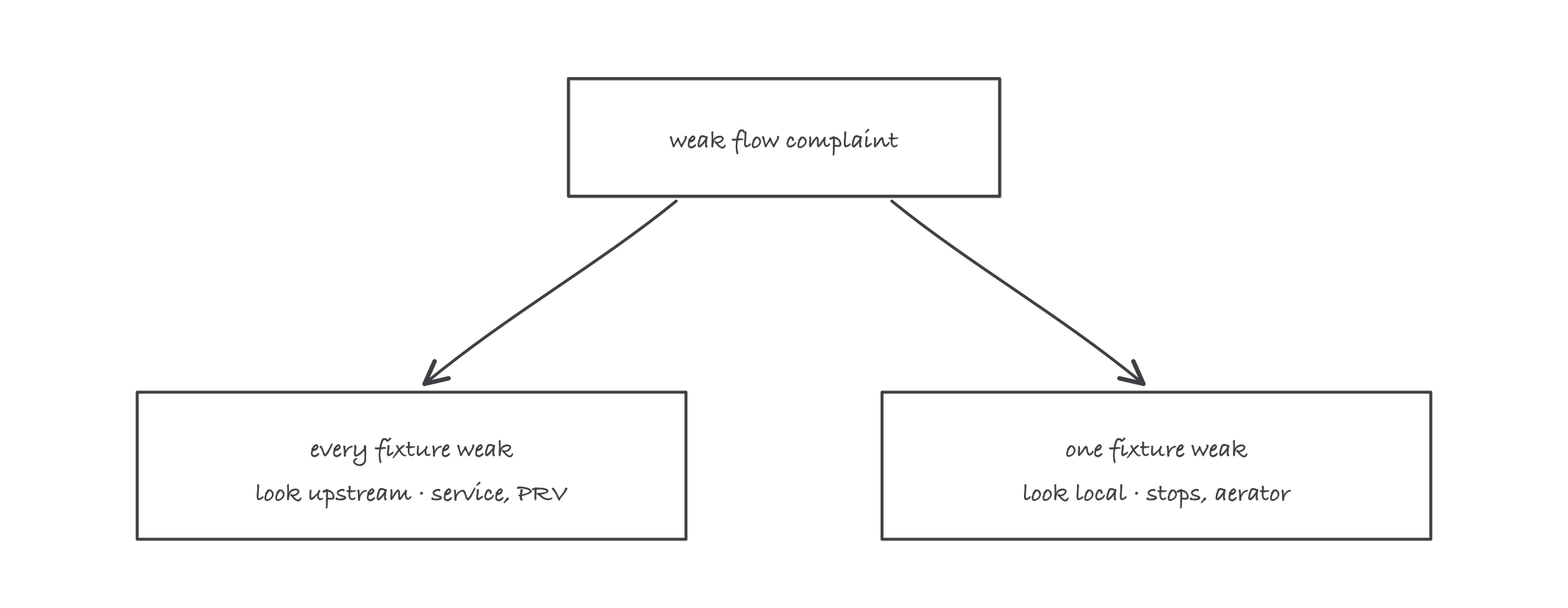
The first split does half the work: many fixtures means upstream, one fixture means local
Where it bites
- Static pressure lies about flow. A proud 65 psi static with everything closed coexists with a starving fixture; only flowing measurements expose restrictions. This is the sharpest lesson from Water Pressure and Flow, and service work retests you on it weekly.
- The complaint location is not the fault location. Drainage gurgles especially: a blocked vent or a partially blocked main announces itself at whichever trap is weakest, which may be two rooms from the blockage. Diagnose the network, not the fixture that spoke.
- Two faults happen. An aerator cleaned and a flow still low means the split continues, it does not mean the method failed. Old houses stack a half-closed stop on top of a fouled aerator on top of galvanized pipe closing in from the inside.
- Skipping verification invites callbacks. The clean aerator that “should fix it” and does not, discovered by the customer after you leave, costs more than the 35-second retest.
- Write the numbers down. Before, after, where measured. Today’s baseline is next year’s instant diagnosis at the same address.