Learn · Plumbing
Water Distribution Systems
Part of Journeyman Plumber Exam Prep · step 16 of 31 · next: Water Pipe Sizing
In learning paths: Journeyman Plumber Exam Prep
Assumes you know: Water Pressure and Flow
A water distribution system is the ordered chain of pipe that moves water from the utility main to every fixture in the building: service line, meter, controls, then a branching network that splits cold everywhere and routes hot from the water heater. Design is deciding the order of that chain and the shape of that network.
Why it matters on the job
Layout decisions get buried in walls and slabs, and a bad one is permanent. Put the pressure reducing valve in the wrong spot and half the house is unprotected. Route hot water the long way and the owner waits at every tap for the life of the building. You will pipe dozens of systems from someone else’s drawings before you design one, and reading the chain correctly is how you rough-in without rework.
The chain from street to fixture
Water leaves the utility main through a corporation stop, runs through the buried service line, and passes the curb stop at the property line. Inside, the order matters:
- Meter, so everything downstream is billed.
- Main shutoff valve, full-open type, where the owner can actually reach it.
- Pressure reducing valve where street pressure exceeds what code allows, which both model codes set at 80 psi static. Everything to be protected must sit downstream of it.
- Tee to the water heater, splitting the system into a cold main and a hot main that travel roughly in parallel from here on.
Two ways to shape the network
Trunk and branch runs a large main, commonly 3/4 in or 1 in in a house, past the fixture zones, and tees off smaller branches to each fixture group. Least pipe, fewest connections, one big shared artery. Its cost is shared behavior: the trunk holds a large volume of cooled-off hot water, and a fixture opening mid-shower steals from the same artery.
Manifold, or home-run, mounts a central manifold near the water heater and runs an individual small line, commonly 1/2 in or 3/8 in PEX, from the manifold to each fixture. More pipe but almost no fittings in walls, per-fixture shutoffs at the manifold, and small dedicated lines that purge fast.
Worked example
How long does a lavatory wait for hot water in each layout? Use round volumes: 3/4 in pipe holds about 0.025 gal per ft, 1/2 in about 0.012, 3/8 in about 0.005. The lav flows 1.5 gpm.
- Trunk and branch: 40 ft of 3/4 in trunk plus 10 ft of 1/2 in branch holds (40 × 0.025) + (10 × 0.012) = 1.0 + 0.12 = 1.12 gal of cooled water to purge.
- Wait: 1.12 gal ÷ 1.5 gpm = 0.75 min, about 45 seconds.
- Home-run: 50 ft of 3/8 in line holds 50 × 0.005 = 0.25 gal. Wait: 0.25 ÷ 1.5 = 0.17 min, about 10 seconds.
Same distance, same fixture. The layout alone decided whether the customer waits 45 seconds and dumps a gallon down the drain, or waits 10.
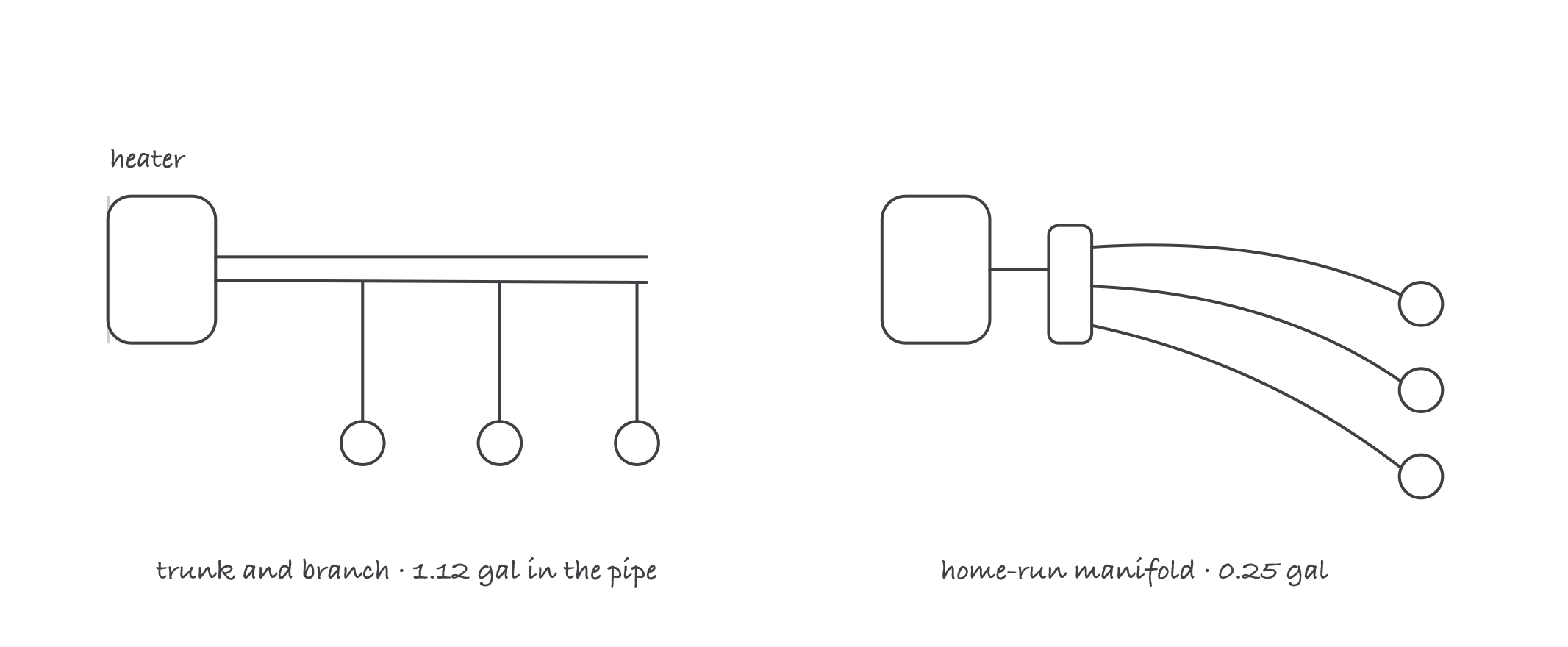
Two shapes for the same job: the water sitting between heater and tap is what you wait for
Where it bites
- A PRV usually closes the system. Most pressure reducing valves will not pass water backward, so heated water has nowhere to expand. Fit a thermal expansion tank when you fit a PRV; the water heater safety lesson runs those numbers.
- Dead ends breed complaints and worse. A capped future branch or an abandoned run holds stagnant water. Keep dead legs short; long ones are a water quality problem.
- Hot and cold are designed together, not separately. A long uninsulated hot main next to a cold main warms one and chills the other. Keep spacing, and insulate hot runs where your code requires it.
- Valves you cannot reach do not exist. A shutoff behind finished drywall serves nobody. Place isolation valves where a homeowner in a panic can find them, and label the main.
Verified requirements
| Where | Expires | Renewal | Continuing education |
|---|---|---|---|
| Texas | Confirm with issuer | Confirm with issuer | Confirm with issuer |
| Texas | Confirm with issuer | Confirm with issuer | Confirm with issuer |
| Illinois | Confirm with issuer | Confirm with issuer | Confirm with issuer |
Information comes from issuing-authority sources. Confirm current rules, fees and eligibility with the authority before acting.