Learn · Plumbing
Gas Pressure Testing
Part of Journeyman Plumber Exam Prep · step 22 of 31 · next: Gas Appliance Connections and Venting
In learning paths: Journeyman Plumber Exam Prep
Assumes you know: Gas Pipe Sizing
A gas pressure test is a controlled attempt to make new piping fail before fuel ever enters it. You cap every opening, pressurize the system with air or inert gas well above its working pressure, and watch a gauge for long enough that a leak has no place to hide. The logic behind each requirement matters more than the numbers, because the numbers are your code’s to set.
Why it matters on the job
Water piping announces its leaks. Gas piping conceals them until a space reaches a flammable mixture. The pressure test is the one moment in a gas system’s life when every joint is proven at once, witnessed, and signed off. Everything after that relies on nothing being disturbed. Inspectors treat gas tests with a formality that water tests never get, and they are right to.
The logic of the test
Test above working pressure. A system that will run at 7 in. w.c., about 0.25 psi, is typically tested at 3 psi or more, held for at least 10 minutes. Model codes frame this as a multiple of working pressure with a floor value; treat 3 psi and 10 minutes as code-typical and read your own code for the governing figures. The margin is the point: a joint that holds a test comfortably above operating conditions has demonstrated reserve, not bare adequacy.
Match the gauge to the test. A gauge can only reveal a pressure drop bigger than its own resolution. On a 0 to 300 psi gauge, a 3 psi test sits inside the width of the needle, and a leak that bleeds half a psi is invisible. Use a gauge whose full scale puts the test pressure in a readable part of the range and whose smallest increment is a small fraction of the drop you need to detect. Many codes state this as a required gauge sensitivity; the principle is that the instrument must be able to see the failure you are testing for.
Never test with the meter connected. The meter, the service regulator, and every connected appliance gas valve are working-pressure components rated for fractions of a psi. Test pressure destroys their diaphragms silently, and a regulator that fails after an overpressure event fails on somebody’s living room. Isolate the system: disconnect at the meter, cap the line, and disconnect or valve off and cap every appliance connection rated below the test pressure.
Prove the joints you opened afterward. The pressure test proves the piping. Reconnecting the meter and appliances creates new joints the test never saw, so those get leak-checked at working pressure with a soap solution or gauge, never with a flame.
Worked example
New piping for the house from the sizing lesson, working pressure 7 in. w.c.
- Convert the working pressure: 7 ÷ 27.7 = 0.25 psi. A code-typical 3 psi test is 3 ÷ 0.25 = 12 times working pressure.
- Set up: meter not yet installed, line capped at the meter location. All three appliance drops capped. Test tee with a 0 to 15 psi gauge reading in 1/10 psi increments, so the 3 psi test sits at one fifth of scale and a tenth-psi drop is visible.
- Pressurize to 3 psi with air, let the temperature settle, mark the needle, hold 10 minutes. The needle stays. Document, get the inspector’s eyes on it, then release.
- After the meter and appliances connect, soap-test every joint you just made at working pressure. Bubbles mean you are not done.
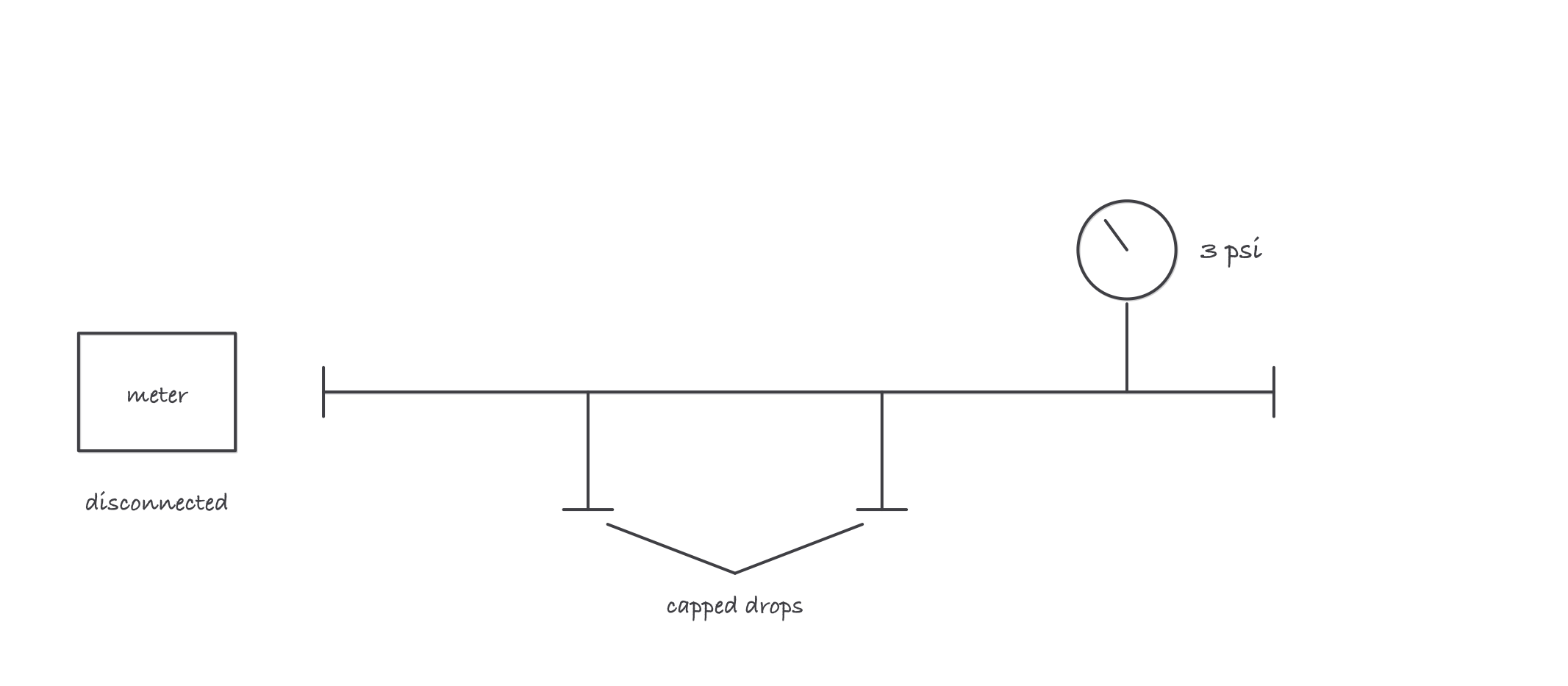
The test rig: everything capped, the gauge sized to the test, and the meter out of the line
Where it bites
- Temperature moves the needle. Air pressurized in the morning sun and read in the afternoon shade drops with no leak at all. Let the charge stabilize before marking, and think before condemning a system that lost a tenth over a cold night.
- A passed test can still leak at a reconnection. Most post-inspection gas odors trace to the joints made after the test: the meter swing, the appliance connectors. Soap them every time.
- Testing through an appliance valve is an expensive shortcut. Closed does not mean rated. If the component is not built for test pressure, it comes off the line or the cap goes ahead of it.
- Oxygen is never the test gas. Compressed air or inert gas only. Oxygen against oil residue in pipe is its own explosion hazard.
Exam relevance
Expect questions on the test medium, code-minimum pressure and duration for the code you are being examined on, gauge requirements, and what must be disconnected before testing. The scenario trap is always the meter or an appliance left connected during the test: know why that answer is wrong at the level of what a regulator diaphragm can survive.
Verified requirements
| Where | Expires | Renewal | Continuing education |
|---|---|---|---|
| Texas | Confirm with issuer | Confirm with issuer | Confirm with issuer |
| Texas | Confirm with issuer | Confirm with issuer | Confirm with issuer |
| Illinois | Confirm with issuer | Confirm with issuer | Confirm with issuer |
Information comes from issuing-authority sources. Confirm current rules, fees and eligibility with the authority before acting.