Learn · Plumbing
Slope and Grade
Part of Journeyman Plumber Exam Prep · step 12 of 31 · next: Cleanouts
In learning paths: Journeyman Plumber Exam Prep
Assumes you know: Drain Sizing and DFUs
Slope is the fall a horizontal drain makes over its run, and the number to carry in your head is a quarter inch per foot: the standard minimum for drains 2 1/2 in and smaller under both model codes. On the job you will hear it called grade, fall, or pitch. Same thing: controlled downhill.
Why it matters on the job
Gravity is the only pump a drain has, and slope is how you set its output. Slope decides whether solids ride the water out to the sewer or settle in the pipe and grow into a clog. It is set once, at rough-in, with a level in your hand, and it is nearly impossible to fix after the trench is backfilled or the slab is poured. Few numbers in the trade repay memorizing like this one.
The physics of self-cleaning pipe
A horizontal drain is designed to flow about half full, with water moving roughly 2 ft per second. That speed is the scouring velocity: fast enough that the stream keeps solids suspended and drags them along, wiping the pipe as it goes. Quarter inch per foot on small pipe reliably produces it.
Too flat and velocity drops, solids fall out of the stream, and the pipe silts shut from the bottom up. Larger pipes carry deeper streams, which is why codes permit 1/8 in per foot on bigger diameters; the sizes where that is allowed, and what approval it takes, differ between the UPC and IPC, so the adopted code governs. You will also hear the old warning that too much slope lets water outrun the solids. Codes set no maximum slope; past 45 degrees a drain is treated as vertical. Keep the warning as folklore and the minimums as law.
Worked example
A 2 in kitchen drain runs 40 ft from the stack to the far wall.
- Required fall: 40 ft × 1/4 in per ft = 10 in over the run.
- Check your ceiling space: the pipe leaves the stack 10 in higher than it arrives. If the joist bay only gives you 6 in, you reroute or shorten the run; you do not flatten the grade.
- Setting it with a 4 ft level: 1/4 in per foot means 1 in of fall per 4 ft of level, so shim the low end of the level 1 in and pipe to the bubble. A torpedo level with a grade line or a laser does the same arithmetic for you.
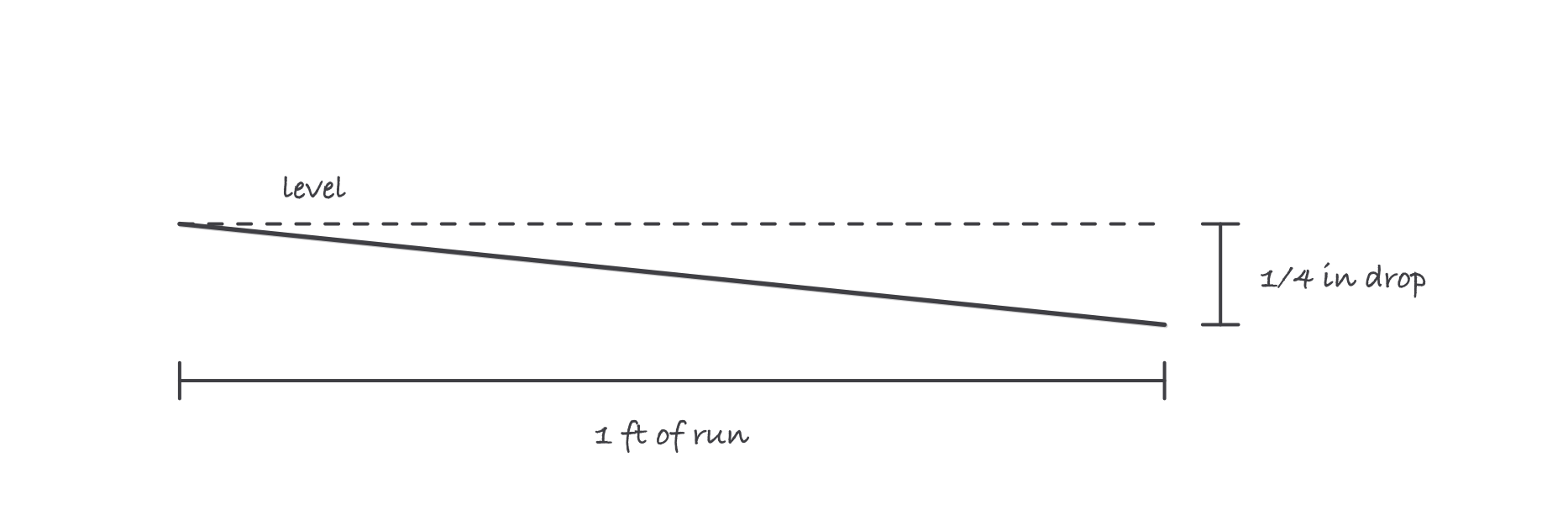
The number that runs the trade: for every foot of horizontal run, a quarter inch of fall
Where it bites
- A belly beats a perfect average. A pipe that falls 10 in overall but sags in the middle holds a standing pool that catches solids. Support the pipe to grade with hangers at the spacing your code and pipe material require, and sight down the run before it closes up.
- Measured at both ends is not measured. Grade is only real if it is continuous. Check intermediate hangers, not just the first and last fitting.
- Backfill un-grades buried pipe. A sewer laid on a shaped, compacted bed stays put. One laid on loose fill settles into bellies. Bedding is part of slope.
- Remember the trap arm limit. Extra slope on a trap arm eats the one-pipe-diameter fall budget from the venting lessons. Quarter inch per foot is usually the target there, not just the minimum.
Exam relevance
Slope questions are free points: compute total fall for a given run, know 1/4 in per foot as the small-pipe minimum, and know that flatter grades on larger pipe exist but are code-conditional. Practical exams and isometric questions expect the arithmetic both directions, fall from run and run from fall, so be able to do 1/4 in per foot in your head at trade speed.
Verified requirements
| Where | Expires | Renewal | Continuing education |
|---|---|---|---|
| Texas | Confirm with issuer | Confirm with issuer | Confirm with issuer |
| Texas | Confirm with issuer | Confirm with issuer | Confirm with issuer |
| Illinois | Confirm with issuer | Confirm with issuer | Confirm with issuer |
Information comes from issuing-authority sources. Confirm current rules, fees and eligibility with the authority before acting.