Learn · Plumbing
UPC vs IPC: The Two Model Codes
Part of Journeyman Plumber Exam Prep · step 24 of 31 · next: Which Code Applies Where
In learning paths: Journeyman Plumber Exam Prep
American plumbing runs on two competing model codes: the Uniform Plumbing Code, published by IAPMO, and the International Plumbing Code, published by the ICC. Neither is law by itself. Each is a template that states and cities adopt, amend, and enforce, and which one governs your work depends entirely on where you are standing.
Why it matters on the job
A journeyman who moves two states over can find that a layout that passed inspection for years is now a violation, and vice versa. The differences are not trivia: they change how many vents a bathroom group needs, which materials and devices are allowed, and how much design freedom an engineer gets. Knowing both codes exist, and where they characteristically disagree, is what separates “I know the code” from “I know my code.”
Two publishers, two cultures
The UPC comes from IAPMO, an organization with deep roots in the western United States and in the plumbing trade itself. Its code development runs through an ANSI-accredited consensus process in which installers and labor have a formal seat, and the resulting document tends toward the prescriptive: specific methods, specific limits, spelled out.
The IPC comes from the ICC, the body formed in the 1990s when the regional building code groups consolidated. It is one volume of the coordinated I-Code family alongside the IBC and IRC, which is a genuine advantage for jurisdictions that want one publisher for everything. Its culture tends toward performance: state the outcome required, allow more engineered and alternative paths to get there.
Neither philosophy is safer in itself. Prescriptive codes are easier to inspect and harder to misapply; performance codes flex to unusual buildings without variance paperwork. The debate is old, commercial, and unfinished.
Adoption patterns
As a broad pattern, the UPC dominates in the West, and the IPC covers most of the East and South. But adoption happens state by state and sometimes city by city, always with amendments, and several states maintain heavily customized codes that started from one model or blend both. The pattern tells you what to expect regionally; only the next lesson’s method tells you what actually governs a given address.
The classic divergences
Wet venting is the textbook split. Both codes let one pipe serve as drain for one fixture and vent for another, but the IPC permits horizontal wet venting of full bathroom groups broadly, so a single dry vent can protect an entire bathroom. The UPC has historically confined wet venting to narrower vertical arrangements with tighter limits, requiring more individual vent piping for the same room. Recent UPC editions have loosened, so the honest statement is: same fixtures, different vent count, check your edition.
Air admittance valves are the other headline: the IPC recognizes them as a venting termination in defined cases, while the UPC has traditionally not, keeping vents atmospheric. Materials, fixture unit values, and sizing tables also diverge in smaller ways throughout.
Worked example
Price the venting for one bathroom group: water closet, lavatory, and shower.
- Under a typical IPC wet-vent design, the lavatory’s drain serves as the wet vent for the water closet and shower. One dry vent, on the lavatory, protects all three fixtures: 1 vent penetration.
- Under a traditional strict UPC reading of the same room, the horizontal wet vent is not available, so the shower and water closet need conventional venting: 2 or more vent connections and the extra fittings and labor that follow.
- Same fixtures, same wall, materially different pipe count. Multiply by every bathroom in a tract project and you see why builders lobby over model code adoption.
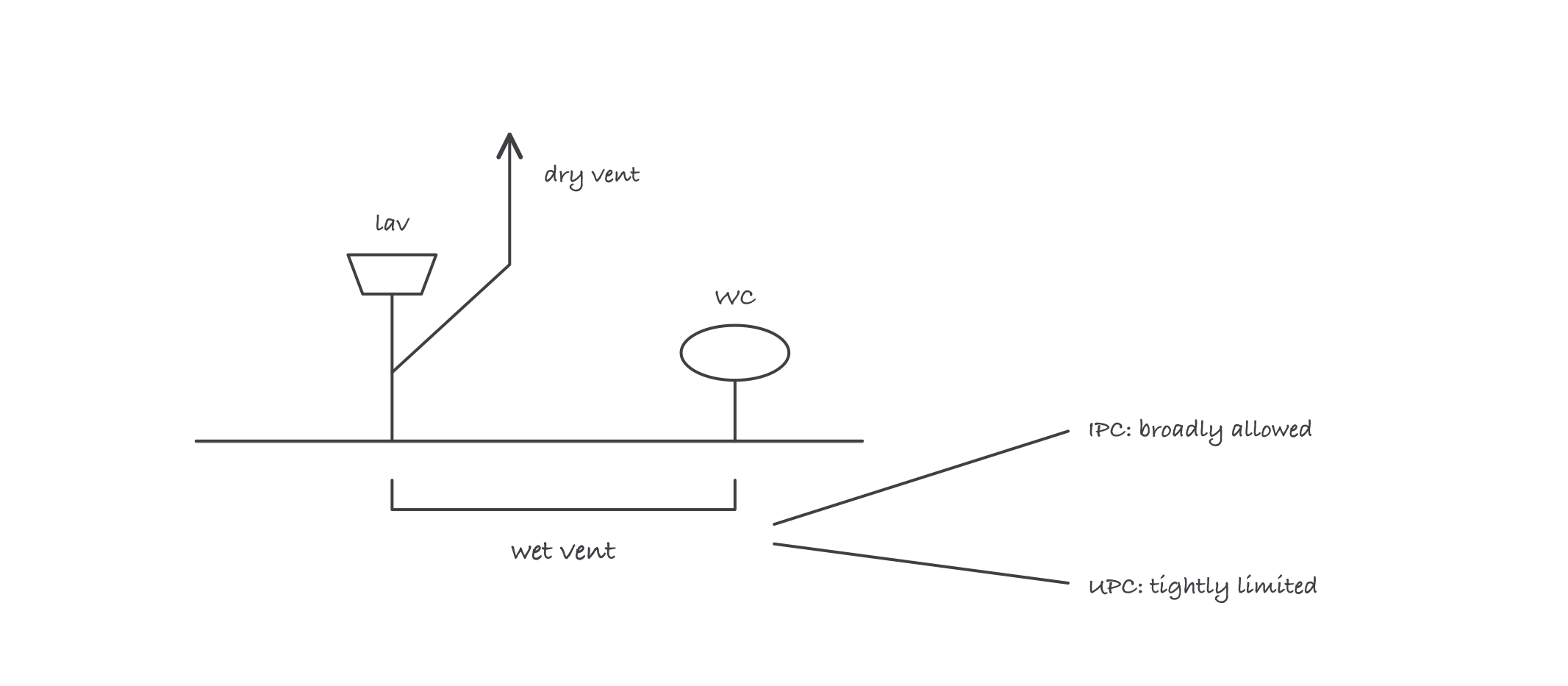
The same pipe, two rulings: wet venting is where the two model codes classically part ways
Where it bites
- Portable habits. The layout you memorized is your old code’s answer, not the trade’s answer. Moving between UPC and IPC territory means re-verifying your defaults, especially venting.
- Assuming the model code is the law. Every adoption carries amendments, and an amendment can reverse the model code’s position on exactly the item you looked up. The adopted, amended text governs.
- Arguing philosophy with an inspector. That an engineered design would pass under the other model code is not an argument. The path for alternatives is the alternative-methods provision in the code you are under, in writing.
- Old editions. Jurisdictions adopt specific editions and lag current ones. The current model code’s new allowance does not exist for you until your jurisdiction adopts it.
Exam relevance
Licensing exams are written against the specific code your jurisdiction adopts, so the first thing to know is which one that is. Exams in UPC territory test UPC vent limits and fixture unit tables; IPC-based exams do the same with IPC values. Comparative questions are rare, but wet venting and air admittance valves are exactly where cross-code confusion produces wrong answers, so learn your code’s position on both cold.
Verified requirements
| Where | Expires | Renewal | Continuing education |
|---|---|---|---|
| Texas | Confirm with issuer | Confirm with issuer | Confirm with issuer |
| Texas | Confirm with issuer | Confirm with issuer | Confirm with issuer |
| Illinois | Confirm with issuer | Confirm with issuer | Confirm with issuer |
Information comes from issuing-authority sources. Confirm current rules, fees and eligibility with the authority before acting.