Learn · Plumbing
Gas Appliance Connections and Venting
Part of Journeyman Plumber Exam Prep · step 23 of 31 · next: UPC vs IPC: The Two Model Codes
In learning paths: Journeyman Plumber Exam Prep
Assumes you know: Gas Pressure Testing
The last few feet of a gas system, from the branch line to the appliance, carry their own set of rules: a shutoff you can reach, a joint you can open, a trap for debris, and a connector the listing actually allows. Then the appliance has to breathe, because delivering fuel is only half of combustion.
Why it matters on the job
Appliance connections are where gas systems are opened most often, by the most people, with the least ceremony: appliance swaps, kitchen remodels, a range pulled out to paint. The code details at this joint exist so that the tenth person to touch it can do so safely. And the appliance end is where fuel meets air, so the connection lesson is also where combustion air and venting stop being someone else’s problem.
The anatomy of a connection
Work from the branch line toward the appliance.
Shutoff valve. An accessible manual valve serves each appliance, located per code in the same room and within a few feet of the appliance it controls. Its purpose is service isolation: the next tech kills gas here, not at the meter.
Union or connector. Downstream of the valve comes the joint that lets the appliance disconnect: a union in rigid pipe, or a listed flexible appliance connector. Connectors are listed components with length limits, typically in the 3 to 6 ft range by application. They do not pass through walls, floors, or partitions, they do not get concealed, and a connector that has been kinked or reused has lost its listing.
Drip leg, formally a sediment trap. At the appliance drop, gas turns horizontally into the appliance through a tee. The straight-down run of the tee continues into a capped nipple, code-typically at least 3 in long. Scale, thread chips, and moisture moving with the gas cannot make the turn: momentum carries them straight down into the capped pocket instead of into the appliance gas valve. It is a few dollars of fittings protecting the most sensitive component on the appliance.
No concealed unions. Any joint designed to be opened, unions, connector ends, valves, stays accessible. A union behind drywall is a future leak nobody can find, which is why codes confine concealed joints to threaded or welded fittings.
The appliance has to breathe
Burning 1 cubic foot of natural gas takes roughly 10 cubic feet of air, and real appliances draw more to keep combustion clean. An appliance closet that seals tight starves the flame: combustion goes rich, carbon monoxide climbs, and draft can reverse. Codes size combustion air openings for confined spaces by appliance input; know that the requirement exists and where your tables are.
Venting is the other half: flue gases must leave reliably. When you connect an appliance, you own a basic awareness check: the vent connector is intact, sloped, and sized for the appliance, and draft actually establishes. A draft hood spilling flue gas at the relief opening after a few minutes of operation is a red flag to escalate, not a note for the invoice.
Worked example
Reconnect a replacement 40,000 Btu/hr water heater in a garage alcove.
- Confirm the shutoff valve is in reach of the appliance and serves only it. Close it.
- Assemble the drop: tee at the connection height, capped 3 in nipple hanging below as the sediment trap, gas out the side of the tee through a union to the appliance gas valve.
- Open the valve, soap every joint you made at working pressure. No bubbles.
- Breathe check: the alcove has its two combustion air openings, high and low, unblocked. Fire the burner, let draft establish a few minutes, and check for spillage at the draft hood with a mirror or smoke source.
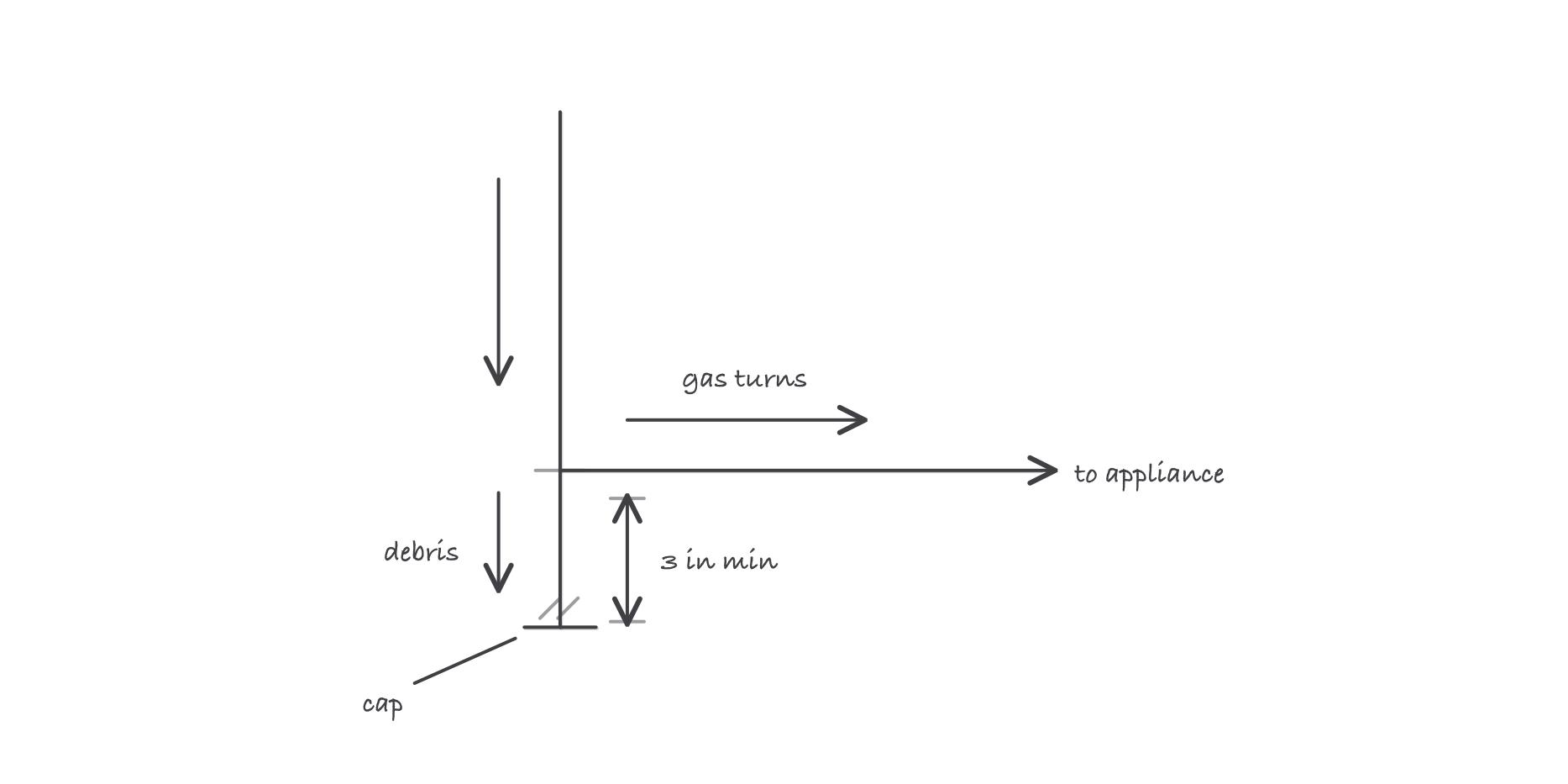
The sediment trap works by momentum: gas makes the turn, debris cannot
Where it bites
- A tee with no cap is not a sediment trap. The pocket below the tee is the trap. Piped straight through with no pocket, debris rides into the gas valve, and the “drip leg” is decoration.
- Connectors through cabinet walls. The range connector snaked through the cabinet side to reach an outlet in the next bay violates the listing and gets sawn edges against soft brass.
- Old connectors reused. A connector’s listing is for one installation. Certain decades-old brass connectors are recalled outright; replacement is cheap and automatic.
- The appliance works but the room is sealed. Weatherization projects that tighten a house can turn a passing appliance closet into a starved one. If the install changed the air, recheck the openings.
Exam relevance
Exams test the drop anatomy in order: valve location rules, connector listing limits, sediment trap placement and minimum dimensions, and the concealed-union prohibition. Combustion air questions hinge on recognizing a confined space and knowing openings are sized from appliance input. If a diagram shows a union behind a finished wall or a connector through a partition, that is the violation the question wants.
Verified requirements
| Where | Expires | Renewal | Continuing education |
|---|---|---|---|
| Texas | Confirm with issuer | Confirm with issuer | Confirm with issuer |
| Texas | Confirm with issuer | Confirm with issuer | Confirm with issuer |
| Illinois | Confirm with issuer | Confirm with issuer | Confirm with issuer |
Information comes from issuing-authority sources. Confirm current rules, fees and eligibility with the authority before acting.