Learn · Plumbing
Valves
Part of Journeyman Plumber Exam Prep · step 6 of 31 · next: How DWV Systems Work
In learning paths: Journeyman Plumber Exam Prep
Assumes you know: Pipe Materials and When to Use Them
A valve is deliberate control inserted into a supply system: stop the flow, throttle it, or forbid it from reversing. Four working principles cover nearly every valve you will touch, gate, ball, globe, and check, plus the regulating specialists like pressure reducing valves. Match the principle to the job and valve selection becomes automatic.
Why it matters on the job
Every service call begins with “where do I shut this off?” and every good installation answers it in advance: a main shutoff at the service, stops at every fixture, isolation around equipment. Choosing the wrong type costs too: a valve that throttles badly screams and erodes, a valve that obstructs flow starves fixtures downstream. Valves are also the moving parts of a plumbing system, which means they are where service work lives.
Full flow or nothing: gate and ball
Gate valves raise and lower a metal wedge across the flow path, many turns of a wheel handle. Fully open, the bore is clear and flow passes as if the valve were pipe. Their weakness is everything between open and closed: a partly open gate chatters and erodes, and old gates famously fail, stems snap and wedges jam, precisely on the day you finally operate them.
Ball valves rotate a drilled ball a quarter turn from full open to full closed. The handle is its own indicator, parallel to the pipe is open, across it is closed, and a full-port ball offers an unobstructed bore. Modern practice reaches for ball valves almost everywhere gates once went, especially as main and isolation shutoffs.
Both are stop valves: use them fully open or fully closed, never to regulate.
Regulating flow: globe and its relatives
Globe valves force flow through an S-shaped path over a seat, and a disc closes down onto that seat gradually. They are built to throttle: fine control, positive shutoff, at the cost of significant pressure drop even fully open. Flow direction matters, the body carries an arrow, install it pointing with the flow. Outdoor hose bibs and many fixture stops are globe-pattern internally.
Fixture stop valves, the little angle stops and straight stops under sinks and toilets, are the service plumber’s best friends: they let one fixture come apart without shutting down the house. Stop-and-waste valves add a small side drain port to empty the downstream line, the classic detail on lines that must winterize.
One direction only: check valves
Check valves permit flow one way and close against reversal, a swinging flap in a swing check, a spring-loaded disc in a spring check. They protect equipment from backspin and drained lines from refilling backward. What a plain check valve is not is backflow protection for the potable system: cross-connection control uses listed backflow assemblies, covered later in the water supply track. Do not promote a $12 check valve into a public-health device.
Regulating pressure: the PRV
A pressure reducing valve holds its downstream side at a set pressure regardless of a higher, fluctuating street pressure. Both model codes require pressure reduction where static supply pressure exceeds 80 psi, high pressure erodes fixtures, slams valves, and bursts connectors. The PRV goes at the service entrance, adjustable, typically with a strainer, and, because it creates a closed system downstream, it travels in company with thermal expansion control at the water heater, a connection Water Heaters and Water Heater Safety develops.
Worked example: taming a high-pressure street
A gauge on the hose bib reads 95 psi static. The code ceiling is 80 psi static, so this house needs a PRV.
- Install the PRV at the service entrance and set it to a working pressure, say 60 psi.
- Verify: gauge now reads 60 psi static at the bib. The street may swing between 90 and 100 psi; downstream holds at 60.
- Check the top-floor fixture 20 ft above the gauge: static pressure up there is 60 − (20 × 0.433) = 60 − 8.7 = 51.3 psi, comfortably above fixture minimums with friction still to spend.
- Because the PRV closes the system, confirm thermal expansion control exists at the water heater before you leave; without it, every heating cycle now spikes the trapped pressure.
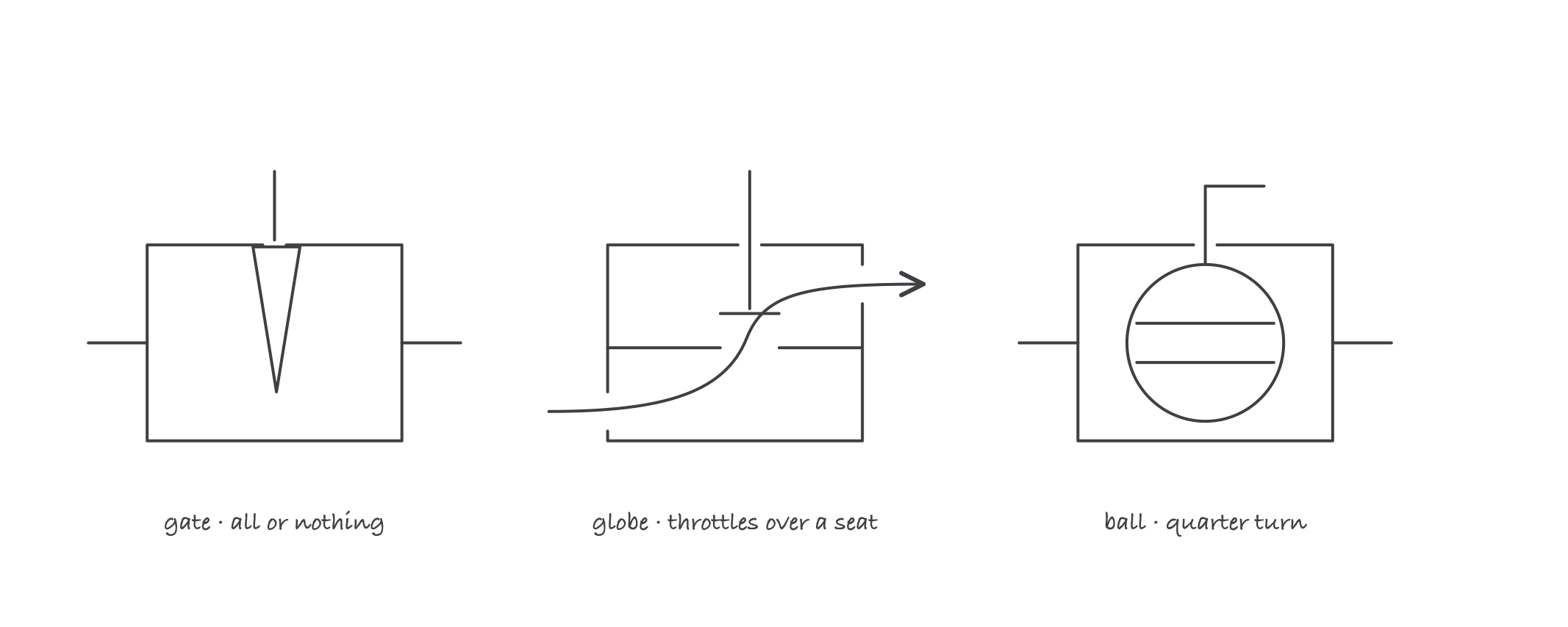
Three principles: the gate blocks the bore, the globe throttles over a seat, the ball turns its bore away
Where it bites
- A gate valve is not a faucet. Cracking one open “just a little” to regulate flow is how wedges erode and stems seize. Throttling is globe work.
- Valves that are never operated seize in place. The main shutoff that has not turned in 15 years will not turn tonight at 2 a.m. Exercise critical valves when you touch a system, and replace the ancient gate with a ball while the water is off anyway.
- Handle position lies on broken ball valves. A snapped stem can leave the handle saying closed over an open ball. Confirm shutoff by opening a downstream fixture, never by handle position alone.
- Direction arrows are load-bearing. Globe valves, check valves, and PRVs all have a flow direction; installed backward they choke, hammer, or hold the line shut. Find the arrow before soldering anything.
- A PRV without expansion control is a time bomb in slow motion. Closed system plus heating cycles equals pressure spikes that find the weakest fixture. The relief valve dripping at the water heater is the symptom; the missing expansion tank is the cause.