Learn · Plumbing
Joining Methods: Solder, Press, Solvent, Threaded
Part of Journeyman Plumber Exam Prep · step 4 of 31 · next: Reading Plumbing Drawings
In learning paths: Journeyman Plumber Exam Prep
Assumes you know: Pipe Materials and When to Use Them
Every pipe material has its own ways of becoming a system, and the joint, not the pipe, is where plumbing fails. Four families cover most of the trade: soldered joints on copper, press joints on copper, solvent-welded joints on plastics, and threaded joints on steel. Match the method to the material from Pipe Materials and When to Use Them, execute the joint’s ritual completely, and the connection outlives the building.
Why it matters on the job
Apprentices earn trust joint by joint. A blown solder joint floods a ceiling; a dry-fit solvent joint that never got cement holds during the test and lets go a month later; a cross-threaded fitting leaks gas. Every method has a failure mode that comes from skipping one step of its ritual, so the rituals are the lesson.
Soldering: the copper tradition
A soldered joint, the trade says sweated, bonds copper tube into a fitting socket with melted solder drawn into the gap by capillary action. The ritual: cut square, ream the burr, clean tube end and fitting socket to bright metal, flux both, assemble, heat the fitting, not the solder, and feed solder at the joint until a full ring appears. Potable water systems use lead-free solder, a legal requirement, not a preference.
Every step exists for a reason: unreamed burrs cause turbulence and erosion inside, unfluxed or dirty copper will not take solder, and heating the solder directly instead of the fitting makes a cold joint that looks finished and is not.
Press: the copper shortcut with a tool cost
Press fittings join copper with a factory-installed sealing element: slide the fitting on, squeeze it with a press tool, done. No flame, no flux, no burn permit, which is why press dominates service work and occupied buildings. The discipline is different but real: full insertion depth, marked before pressing, and no skipped crimps. An unpressed press fitting can hold at low pressure just long enough to pass a casual glance, then blow off.
Solvent welding: plastic chemistry
PVC, CPVC, and ABS join by solvent cement, which melts the mating surfaces so they fuse into one piece of plastic. It is welding, not gluing. The ritual: cut square, deburr, dry-fit check, then primer where required, PVC and CPVC use primer, ABS does not, then cement on both surfaces, insert with a quarter turn to spread the cement, and hold until it grabs. Each material takes its own cement; transition joints between ABS and PVC are restricted to listed transition methods.
Cure time is part of the joint. Cemented joints need their set time before pressure, and the cement can says how long at what temperature. The can is the spec sheet; read it.
Threading: steel and the wrench
Steel pipe, black for gas, galvanized where it survives in old work, joins by tapered pipe threads cut on the pipe end and sealed with thread sealant or PTFE tape rated for the service. The taper does the sealing: the joint tightens metal to metal as it advances, which is why a cross-started thread or an over-tightened brittle fitting cracks rather than seals. PEX runs on its own connector systems, crimp rings, expansion fittings, each requiring its listed tool, and push-fit connectors join several materials tool-free where the listing and your code allow them.
Worked example: cutting pipe to the math
Joining is where measuring meets the fittings, because pipe disappears into fitting sockets. The rule: cut length = face-to-face distance + engagement into each fitting.
Two 3/4 in copper 90s need to land 24 in apart, center to center. Your fitting chart lists this elbow at 5/8 in from center to socket face, and the socket depth at 3/4 in.
- Face-to-face distance between the fittings: 24 − (2 × 5/8) = 24 − 1 1/4 = 22 3/4 in.
- Add the engagement at both ends: 22 3/4 + (2 × 3/4) = 22 3/4 + 1 1/2 = 24 1/4 in cut length.
- Check the direction of each correction: subtracting the fitting bodies shortens, adding the socket engagement lengthens. If your answer came out under the center-to-center distance minus an inch, a sign went the wrong way.
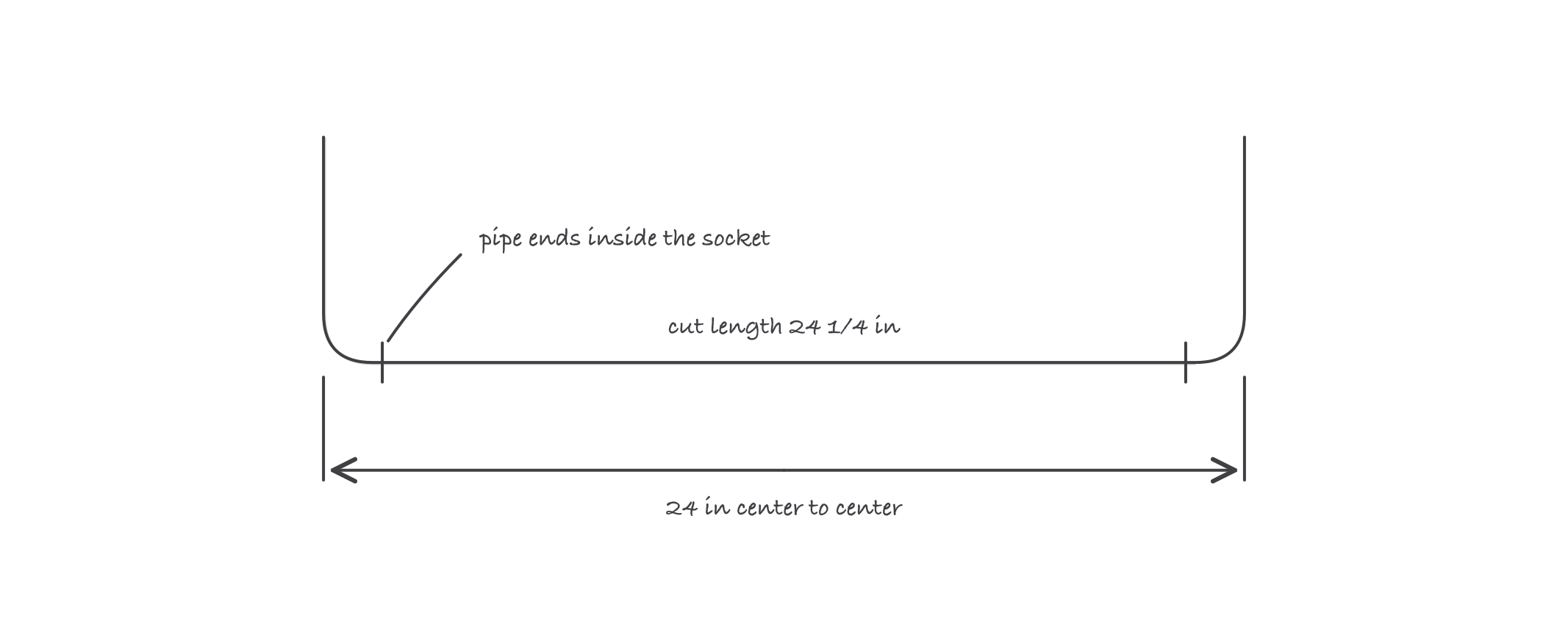
The pipe is longer than the gap it fills: sockets swallow 3/4 in at each end
Where it bites
- Capillary action works upside down, water beats it every time. Solder pulls into a joint in any orientation, but a drip of water in the line turns to steam and blows pinholes through cooling solder. Drain the line, stuff bread or use a plug on stubborn trickles, and never solder a wet joint.
- The dry-fit that never got cement is a real failure mode, plastic dry fits grip convincingly. Develop a marking habit: mark every joint as it is cemented or pressed, and walk the line before the test.
- Primer is not optional where the code and cement require it, and inspectors look for the purple stain on PVC and CPVC. Clear primer exists but reads as no primer at inspection in purple-primer jurisdictions.
- One material, one cement. ABS cement on PVC makes a joint that tests fine and creeps apart. The transition to a different plastic uses listed transition cement or a mechanical coupling, nothing else.
- Tape and dope belong on male threads only, wound with the thread direction, and kept out of the first thread on gas work so shreds do not migrate to valves and regulators.