Learn · Welding
Weld Defects and Discontinuities
Part of Your First Welding Cert · step 13 of 24 · next: Visual Inspection
In learning paths: Your First Welding Cert
Assumes you know: Choosing the Right Process
A discontinuity is any interruption in the structure of a weld. A defect is a discontinuity bad enough that the governing code rejects it. Every weld ever made contains discontinuities; whether yours contains defects depends on the acceptance criteria for the job. That distinction is the first thing inspectors learn, and it should be the first thing welders learn too.
Why it matters on the job
Defects are not random. Each family has specific causes, which means each has specific cures, and a welder who can read a defect can fix the process instead of endlessly grinding and rewelding the symptom. Repair time is the most expensive time in a fab shop: the weld gets cut out, rewelded, and reinspected, all on hours the job already spent once.
The four families, cause and cure
Porosity: gas trapped in solidifying metal. It shows as scattered spheres, clusters, or wormholes in the bead.
- Causes: contamination burning off in the arc (rust, mill scale, oil, paint, moisture), shielding failure (wind, low gas flow, spatter-clogged nozzle), or an arc held too long so shielding breaks down.
- Cures: grind to bright metal before welding, fix the gas coverage or block the wind, dry the rod and the joint, tighten the arc length.
Undercut: a groove melted into the base metal at the weld toe and left unfilled. It is a built-in notch running the length of the weld, and notches are where cracks start.
- Causes: too much amperage, travel too fast for the puddle to backfill, wrong work angle washing the arc against one plate, an oversized weave with no dwell at the edges.
- Cures: drop the heat, slow down, correct the angle, pause at the toes of a weave.
Lack of fusion: weld metal that never fused to the base metal or the previous pass. The joint looks filled but the metal is just parked there. Its cousin, incomplete penetration, is a root that was never reached.
- Causes: too little heat for the thickness (the classic cold lap from short-circuit MIG on thick plate), wrong gun or rod angle, welding over slag or mill scale, a joint prepped too narrow for the arc to reach the root.
- Cures: more amperage or a hotter process, correct angles that point the arc at the fusion faces, clean between passes, open up the joint prep.
Cracks: the family that is never acceptable. Hot cracks open as the weld solidifies, typically down the centerline of a deep narrow bead or in an unfilled crater. Cold cracks, the hydrogen kind, arrive hours or days later in weld or HAZ.
- Causes: bead shape and joint restraint for hot cracks; hydrogen plus hardness plus stress for cold cracks; stopping the arc abruptly for crater cracks.
- Cures: flatter bead profiles and filled craters, low-hydrogen rod discipline, preheat and interpass control on hardenable steel.
Worked example: reading a defect like a message
Mid-shift, your MIG welds outdoors start showing scattered surface porosity. Read it: porosity means contamination or lost shielding. The steel and wire have not changed since morning, so ask what did. The wind picked up, the gas bottle is near empty, or the nozzle has an hour of spatter in it. Check those three in that order, cheapest first. That habit, defect to cause list to what changed, is the whole diagnostic method.
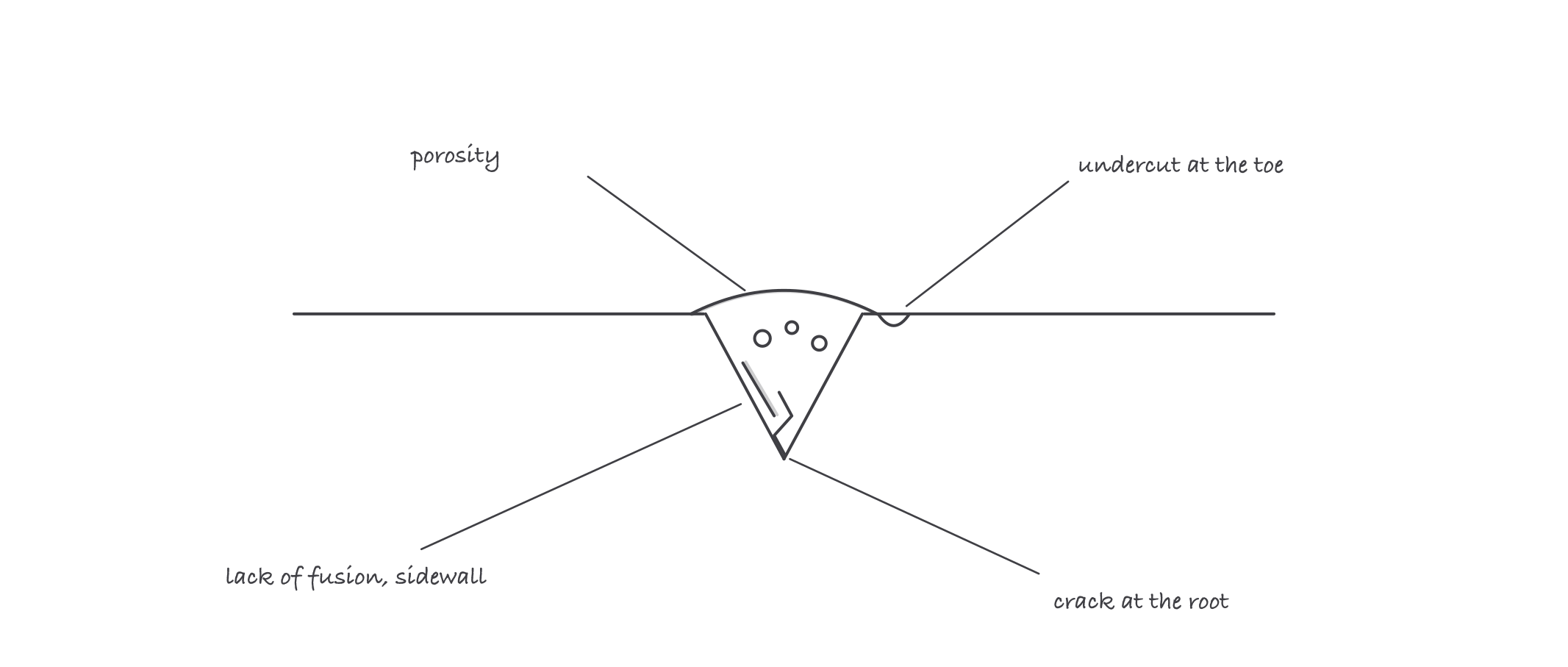
The four families in one unlucky weld: porosity, undercut, lack of fusion, crack
Where it bites
- A pretty cap can hide a cold weld. Lack of fusion is invisible from the surface, which is why the cheapest cure is technique and settings, not inspection. Cold-looking starts and a stacked, ropey bead are your early warnings.
- Cracks are never welded over. A crack must be completely removed, its ends found and excavated past, and the removal confirmed before rewelding. Capping a crack buries a growing flaw.
- Undercut is measured, not eyeballed. Codes allow small amounts of undercut, with limits that depend on the loading. What gets a weld rejected is depth beyond the limit, so know the number for your job before arguing with a shadow.
- Porosity at every start is a restrike problem. A used low-hydrogen rod restruck cold runs porous for the first half inch. Restrike ahead of the crater and sweep back, or every tack on the job carries the same flaw.