Learn · Welding
ASME Section IX Basics
Part of Your First Welding Cert · step 19 of 24 · next: Welder Qualification: How It Actually Works
In learning paths: Your First Welding Cert
Assumes you know: WPS and PQR: How Procedures Work
ASME Section IX is the qualification rulebook for pressure work. Boilers, pressure vessels, and power and process piping are built to their own construction codes, and when any of those codes needs a welding procedure or a welder qualified, they all point at the same book: Section IX. It does one job, qualification, and does it for an entire industry.
Why it matters on the job
Cross from structural work into a refinery, a power plant, or a vessel shop and the paperwork changes rulebooks. The WPS, PQR, and performance qualification logic you already know carries over, but the variables, the groupings, and the shortcuts are Section IX’s own. Welders who understand the book’s shape read their own qualification ranges correctly, and that is the difference between taking a weld you are covered for and taking one that gets cut out on paper grounds.
What Section IX is, and is not
Section IX does not tell anyone how to design a vessel, what pipe to use, or how much NDT a weld gets. Those belong to the construction codes: the boiler and pressure vessel sections and the piping codes that reference IX. Section IX answers exactly two questions: is this welding procedure proven, and is this person proven to run it? The construction code then decides when those proofs are required and can always add extra demands on top. Section IX is necessary, never sufficient.
The shape of the book
The welding half of Section IX is organized by function into articles covering general requirements, procedure qualification, performance qualification, and welding data, that last one holding the variable tables the first three lean on. As with D1.1, navigate by function: a question about proving a recipe goes to procedure qualification; a question about a welder’s coverage goes to performance qualification; every question eventually lands in a variables table in the data article.
The grouping numbers
Section IX’s signature move is grouping things so one test covers many materials:
- P-numbers group base metals with similar weldability. Common carbon steels sit together in one group, and qualifying a procedure on one P-number material generally covers others in the same group, subject to the variable tables.
- F-numbers group filler metals by usability characteristics, so a welder’s skill proven with one rod family carries to related ones.
- A-numbers classify the deposited weld metal’s chemistry for procedure purposes.
The point of all three is economy: without grouping, every new pipe spec would mean a new test coupon.
Variables: the engine of the system
Every procedure detail is classified per process:
- Essential variables define the qualification. Change one outside its range, a different P-number, a thickness beyond limits, and the procedure needs requalification by new test.
- Nonessential variables, things like groove detail or technique notes, can be changed by revising the WPS. No new test.
- Supplementary essential variables are dormant until the construction code requires impact toughness; then they wake up and act like essential ones.
Performance qualification has its own essential variables for the person: process, F-number, position, thickness, and backing among them, which is why your welder card reads as a list of ranges.
Worked example: same P-number, no new PQR
A shop’s WPS was qualified on a common carbon steel plate, a P-1 material. A new job arrives in A106 Grade B pipe, also P-1. Walk the logic: base metal is an essential variable by P-number, not by individual spec, so moving between two P-1 materials does not, by itself, demand a new PQR. The engineer still checks every other essential variable, thickness range first, against the data tables. Verdict: likely no new procedure test, and that lookup, grouping first, then the variable tables, is Section IX in miniature.
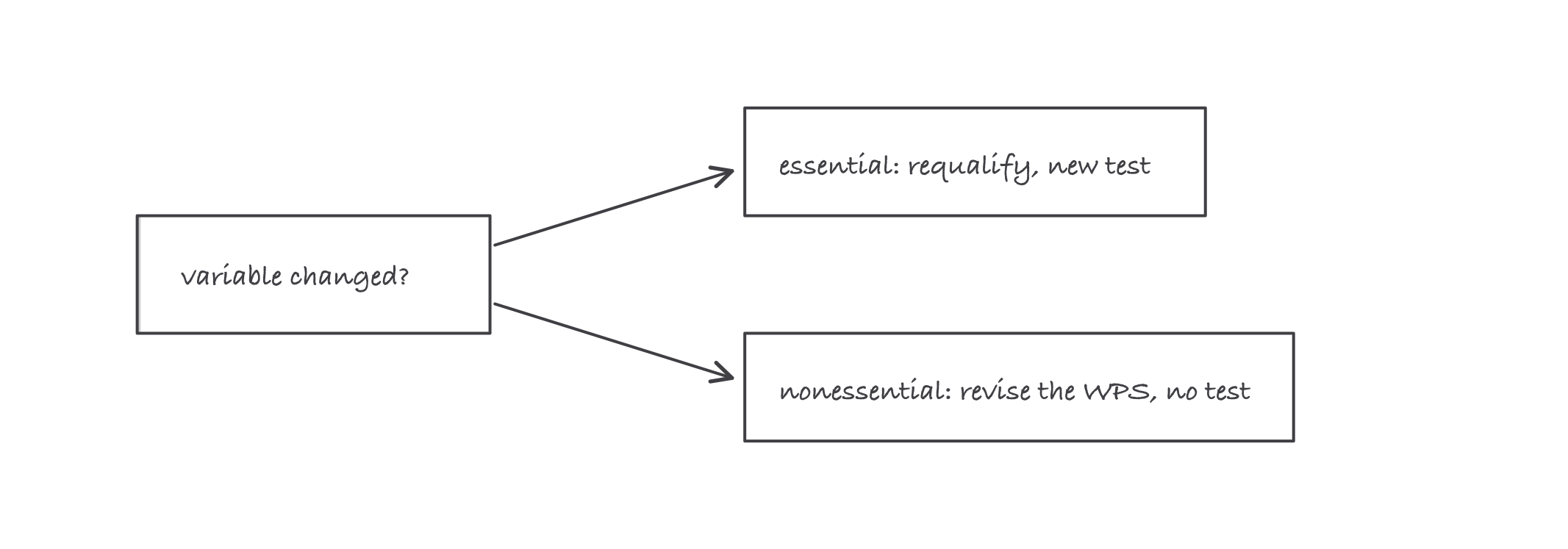
The whole book in one fork: essential means retest, nonessential means revise the paper
Where it bites
- D1.1 habits do not transfer. There are no prequalified procedures in Section IX: every WPS stands on a PQR. Assuming the structural shortcut exists here fails audits.
- Qualified is a range, not a status. A welder qualified on thin-wall pipe in one position is not covered for everything with the same process. The ranges on the record are the credential.
- Toughness flips the rules. The moment the construction code requires impact testing, supplementary essential variables activate, and a WPS that was fine yesterday may not qualify for the new service.
- The construction code always gets a vote. Piping and vessel codes add their own restrictions on top of IX. Meeting Section IX alone proves the weldment nothing; it proves the qualification.
Exam relevance
Section IX is one of the codebooks CWI candidates may elect for the open-book exam, and its navigation drill is the variables tables: given a change, classify it and state the consequence. For welders, every pressure-work qualification test runs under IX’s performance rules, so the coupon, position, and thickness you test with become the ranges on your continuity records.
Verified requirements
| Where | Expires | Renewal | Continuing education |
|---|---|---|---|
| United States (federal) | Yes | 9 years, with renewal applications required at years three and six after the initial activation date | 80 Professional Development Hours is one of four nine-year recertification routes; the others are retaking Part B Practical, passing an endorsement exam, or achieving Certified Radiographic Interpreter status |
| United States (federal) | Yes | Confirm with issuer | Confirm with issuer |
Information comes from issuing-authority sources. Confirm current rules, fees and eligibility with the authority before acting.