Learn · Welding
FCAW (Flux-Core)
Part of Your First Welding Cert · step 4 of 24 · next: GTAW (TIG)
In learning paths: Your First Welding Cert
Assumes you know: GMAW (MIG)
Flux-cored arc welding runs on the same wire-feed equipment as MIG, but the wire is different: a hollow steel tube filled with flux. The arc burns that core as the wire feeds, generating shielding gas and a slag layer from inside the wire itself. Think of it as a stick electrode turned inside out and made continuous.
Why it matters on the job
FCAW is the heavy-deposition process. On thick plate it lays more weld metal per hour than stick or solid-wire MIG, penetrates aggressively, and tolerates mill scale and light rust better than a bare solid wire. Structural steel erection, shipyards, and heavy fab run enormous amounts of it. One family of flux-core wires also solves MIG’s biggest weakness: it needs no gas cylinder at all, which makes it the wire process that works in the wind.
Two families: self-shielded and gas-shielded
The flux core changes everything, and it comes in two distinct designs.
Self-shielded FCAW (FCAW-S) wires carry a core that does the whole shielding job alone: it burns into gas and slag with no external cylinder. That makes FCAW-S the field wire process, at home on windy steel erection where MIG shielding would blow away. The arc is smoky and spattery, the slag is heavy, and many self-shielded wires run DCEN, the opposite of most wire processes. E71T-8 is a common structural example. Small 120 V “gasless MIG” home machines are actually running FCAW-S.
Gas-shielded FCAW (FCAW-G), often called dual shield, uses the core for slag and arc chemistry but adds external shielding gas, CO2 or 75% argon / 25% CO2, from the nozzle. The result is a smooth, deeply penetrating arc with high deposition and easy all-position control under a fast-freezing slag. Dual shield wires such as E71T-1 run DCEP and dominate shop structural work on thick sections. Being gas-shielded, FCAW-G inherits MIG’s wind limits.
The wire classification tells you which family and how to run it. In E71T-1: 7 for 70 ksi tensile, 1 for all positions, T for tubular, and the final digit for the usability group that defines shielding and polarity. Polarity and gas are dictated by the wire’s data sheet, not by preference; run a wire on the wrong polarity and you get a spattering arc and porous or brittle weld metal.
A concrete setup
Fillet weld on 1/2 in plate, flat position, dual shield: 0.045 in E71T-1 wire on DCEP, 75/25 gas at 35 to 40 cfh, roughly 26 V and 250 ipm wire feed, landing near 200 A. Use a drag angle like stick, hold about 3/4 in stickout, and chip the slag off every pass. The same machine loaded with 0.068 in E71T-8 self-shielded wire for a field job flips to DCEN, no gas, and a longer stickout per the wire’s sheet.
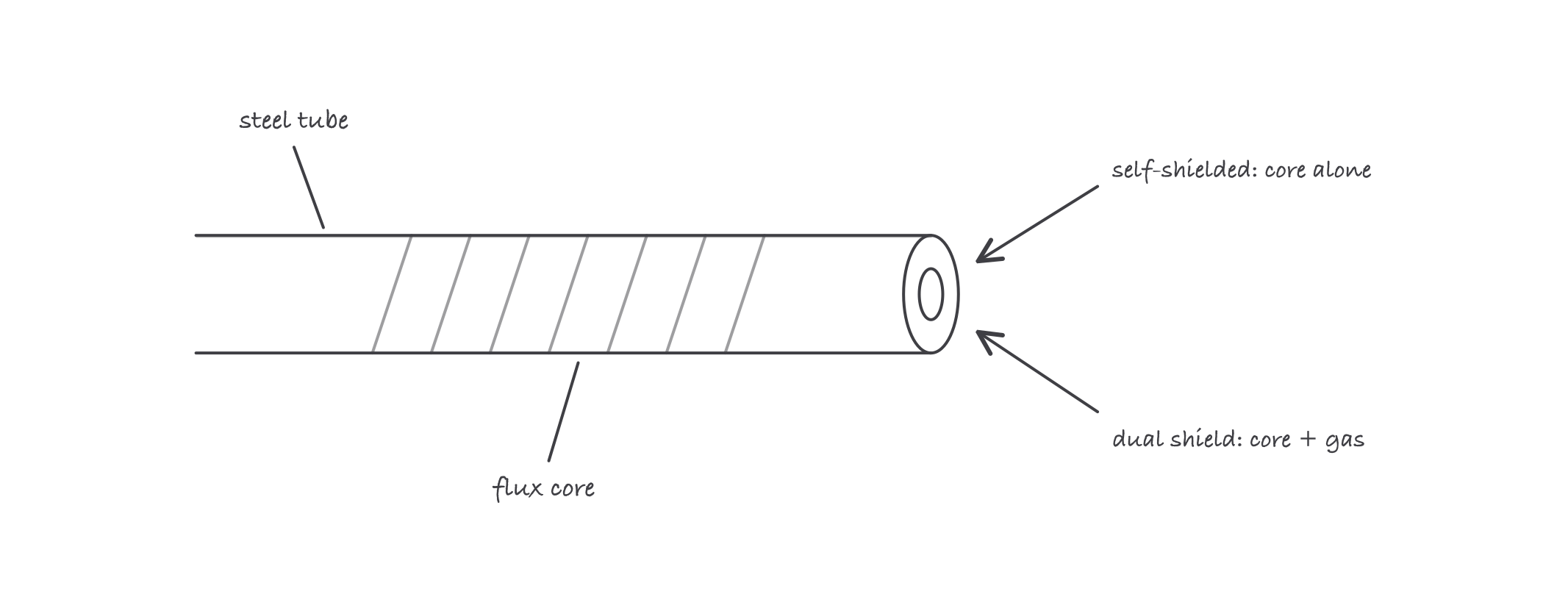
The flux rides inside the wire: self-shielded wires stop there, dual shield adds a gas from the nozzle
Where it bites
- Flux-core smoke is serious. FCAW generates far more fume than MIG. Indoors it needs real ventilation or fume extraction, and your head belongs out of the plume. This is a health rule, not a comfort rule.
- Slag rides on every pass. Like stick, trapped slag becomes an internal defect. Multi-pass flux-core lives and dies on interpass cleaning.
- Polarity mix-ups are routine and costly. Shops that swap between dual shield (DCEP) and self-shielded (DCEN) wire must flip the leads or the polarity switch every time. A wire on the wrong polarity can look almost right while depositing junk.
- Self-shielded wires are chemistry-sensitive. Some FCAW-S wires have limits on stacking multiple passes or on mixing with other processes over them, spelled out on the data sheet. Read it; the sheet is the law for that spool.
- Worm tracks mean gas trouble. Long surface grooves in the finished bead come from trapped gas under the slag, often wrong voltage or inadequate stickout on self-shielded wire. Tune to the sheet before blaming the spool.
Verified requirements
| Where | Expires | Renewal | Continuing education |
|---|---|---|---|
| United States (federal) | No | Confirm with issuer | Confirm with issuer |
Information comes from issuing-authority sources. Confirm current rules, fees and eligibility with the authority before acting.