Qualifications · Welding
Becoming a CWI
Part of Your First Welding Cert · step 23 of 24 · next: Welding Career Paths: Shop, Structural, Pipe, Inspection
In learning paths: Your First Welding Cert
Assumes you know: Welder Qualification: How It Actually Works
The Certified Welding Inspector credential moves you from making welds to judging them. It is the most valuable single certification in the welding trade: CWIs sign off structural work, run quality programs, and command salaries and independence most welders never reach with a hood down.
*Learn the Trades is a free study resource. We are not a licensing body, an authorized training provider, or an exam administrator. Reading this page does not award any card, license, or certification. Always verify requirements with the issuing authority linked in the sources.*What a CWI is
An AWS Certified Welding Inspector is qualified to inspect welds and welding activity against a governing code: verifying procedures, checking welder qualifications, examining joints before, during and after welding, and accepting or rejecting work. On code jobs, structural steel especially, a CWI’s signature is what makes the paperwork real.
The exam
The CWI examination is a three-part event:
- Part A, Fundamentals. Welding processes, heat and metallurgy, symbols, testing methods, safety.
- Part B, Practical. The hands-on section: measuring and evaluating weld replicas and specimens with inspection tools against a supplied specification.
- Part C, Code application. Open-book navigation of a code book you choose when applying, commonly AWS D1.1.
Candidates qualify with a combination of education and documented welding-related experience per AWS QC1, the specification governing the program. Expect the experience documentation to be checked properly.
Keeping it: the 9-year cycle
CWI certification renews on a long cycle with a hard stop every 9 years, satisfied by re-examination, an endorsement exam, or 80 hours of continuing education, per the current AWS recertification rules. Between those events, maintenance requirements keep the credential active. The 9-year options give working inspectors realistic routes; the point is that a CWI is never “done” credentialing.
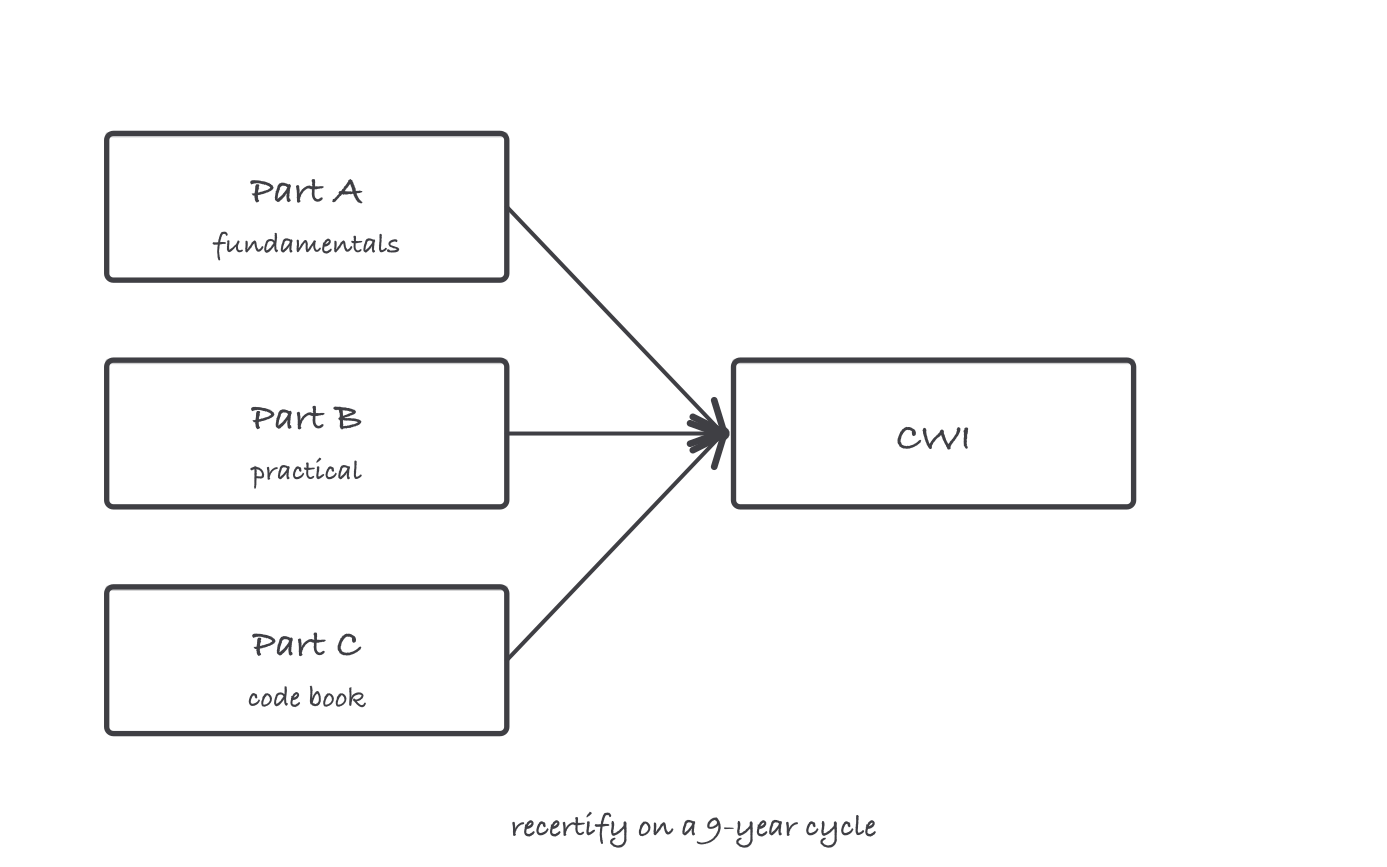
Three exams in one event; Part B fails the unprepared
Where it bites
- Part B fails prepared people. The practical section’s measuring discipline and its exam-specific specification book punish anyone who only studied theory. Practice with the actual tool kit.
- Experience thresholds are enforced. Count your qualifying years honestly against QC1 before paying fees.
- A CWI without code fluency is a contradiction. If Part C scares you, that is the study plan.
Verified requirements
| Where | Expires | Renewal | Continuing education |
|---|---|---|---|
| United States (federal) | Yes | 9 years, with renewal applications required at years three and six after the initial activation date | 80 Professional Development Hours is one of four nine-year recertification routes; the others are retaking Part B Practical, passing an endorsement exam, or achieving Certified Radiographic Interpreter status |
| United States (federal) | Confirm with issuer | Confirm with issuer | Confirm with issuer |
| United States (federal) | Confirm with issuer | Confirm with issuer | Confirm with issuer |
Information comes from issuing-authority sources. Confirm current rules, fees and eligibility with the authority before acting.