Learn · Welding
Compressed Gas Cylinders: Storage, Handling and the 15 psig Rule
A cylinder holds its entire contents behind one brass valve, and nearly everything OSHA says about handling cylinders comes back to protecting that valve or controlling what happens when the gas gets out. A cylinder that falls and snaps its valve off does not leak. It empties, all at once, through the hole where the valve used to be, with a steel bottle attached.
Why it matters on the job
Cylinder rules look like housekeeping and read like a list, so they get skimmed. They are not housekeeping. The 15 psig acetylene ceiling exists because of what the gas does above that pressure, the 20 ft separation exists because of what oxygen does to a fire, and the ban on lifting with a magnet exists because of what a dropped cylinder does to its own valve. Learn the reason attached to each rule and the list stops being a list.
The 15 psig acetylene ceiling
This one is exact, absolute, and free to read. 29 CFR 1910.253(a)(2):
“Under no condition shall acetylene be generated, piped (except in approved cylinder manifolds) or utilized at a pressure in excess of 15 psig (103 kPa gauge pressure).”
Read the verbs. Generated, piped, utilized. The ceiling is not a storage rule or a plumbing rule: it applies at the moment you are cutting, and the single carve-out in the sentence is for approved cylinder manifolds, not for a job that seems to want more pressure.
The reason is the gas itself. Acetylene becomes unstable above roughly that pressure: it can decompose and release energy without needing any oxygen to burn in. That is a different hazard from a fuel leak, and it does not care that your torch is off.
Keep the units straight, because this is where people talk past each other. A gauge reads pressure above the surrounding air, so 15 psig is about 15 + 14.7 = 29.7 psia in absolute terms, roughly twice atmospheric pressure. It is a low ceiling, and every acetylene regulator is built and marked with it in mind.
Storage: 20 feet or a barrier
29 CFR 1926.350(a)(10) sets the construction requirement:
“Oxygen cylinders in storage shall be separated from fuel-gas cylinders or combustible materials (especially oil or grease), a minimum distance of 20 feet (6.1 m) or by a noncombustible barrier at least 5 feet (1.5 m) high having a fire-resistance rating of at least one-half hour.”
Three things in that sentence are easy to miss. The separation is not only oxygen from fuel gas: it is oxygen from combustible materials as well, and the rule calls out oil and grease by name. The barrier is an alternative to the distance rather than an addition to it. And the barrier carries a specification (noncombustible, at least 5 ft high, at least a half-hour fire-resistance rating), which is why a sheet of plywood or a stack of pallets is not a barrier.
Oxygen and oil
29 CFR 1926.350(i) is one line: “Oxygen cylinders and fittings shall be kept away from oil or grease.”
Oxygen does not burn. It makes other things burn, hotter and faster than they manage in ordinary air, and hydrocarbon oils and greases are exactly the kind of fuel that responds to it. A greasy glove on an oxygen fitting, a regulator someone lubricated because it felt stiff, an oily rag left on top of a cylinder: each of those is fuel sitting in the one place the gas is pure. Nothing on an oxygen system gets oiled, ever, and if a regulator is stiff it goes back to the supplier.
Moving and securing cylinders
The handling rules protect the valve.
- Caps on. 1926.350(a)(1): “Valve protection caps shall be in place and secured.” Before a cylinder moves, 1910.253 also calls for regulators to be removed and valve caps fitted.
- Support it. 1926.350(a)(7): “A suitable cylinder truck, chain, or other steadying device shall be used.” A cylinder standing free is a cylinder waiting for someone to walk into it.
- Never lift by magnet or sling. 1910.253 states that “slings or electric magnets shall not be used” to lift cylinders. A sling slips off a smooth tapered shoulder and a magnet lets go when the power does, and either failure lands the cylinder on its valve.
Worked example: laying out a cylinder store
An indoor storage bay measures 14 ft wall to wall. Put the oxygen against one wall and the acetylene against the other, and the clear separation between them is 14 ft.
14 ft is 20 - 14 = 6 ft short of the distance the rule asks for. There are two honest ways out, and only two: find 6 more feet, or build the barrier (noncombustible, at least 5 ft high, at least a half-hour fire-resistance rating). In a 14 ft bay, the barrier is the answer.
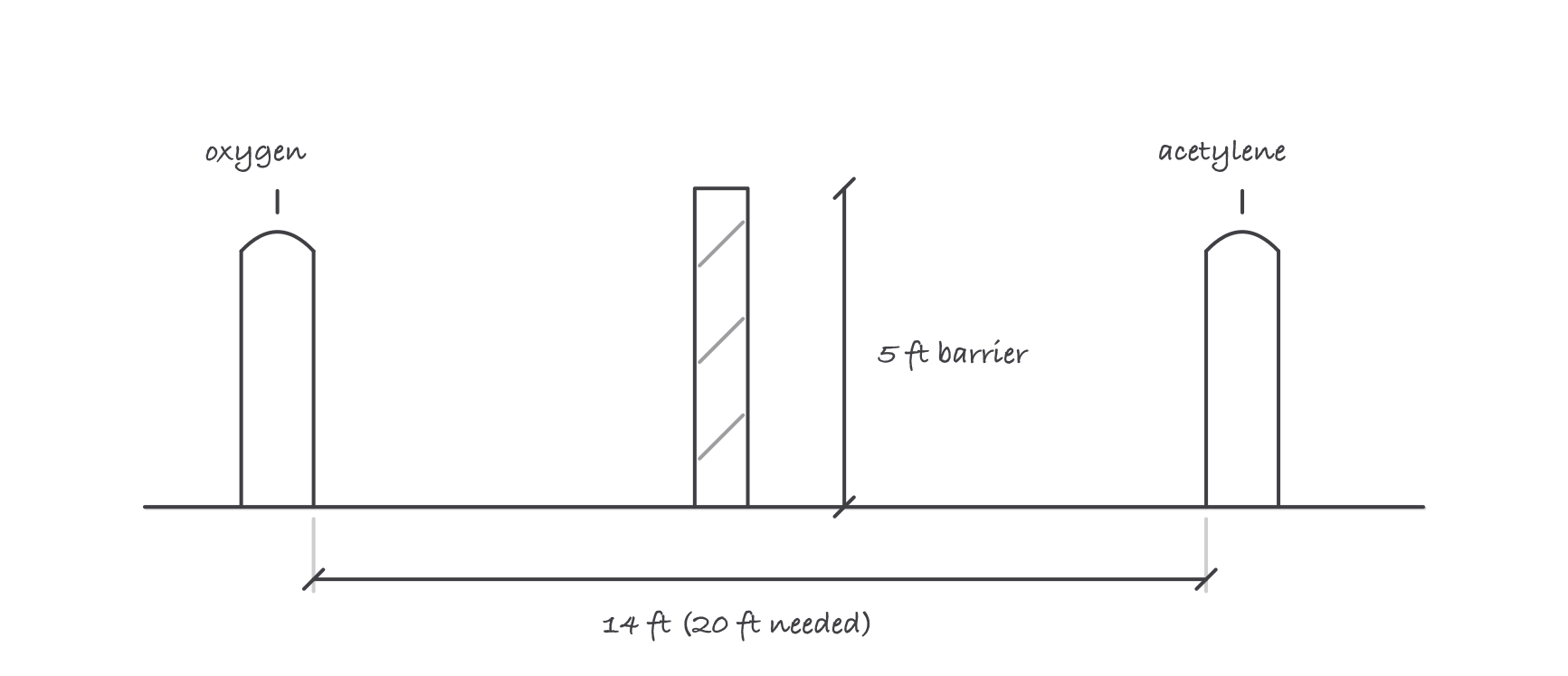
Below 20 ft of separation, the barrier is what makes the layout compliant, and the barrier has its own specification
Now take the same cylinders outside to a pad 30 ft long. Oxygen at one end, fuel gas at the other, and it looks like distance solves it with room to spare. Measure what the rule actually measures, though, which is the separation between the two, not the length of the pad. If each group of cylinders occupies about 4 ft of that run, the clear separation is 30 - 4 - 4 = 22 ft. That still clears 20 ft, by 2 ft. Add one more rack to either group and you are under.
Where it bites
- The ceiling applies while you are cutting. “Generated, piped or utilized” covers the working pressure at the torch, so winding the acetylene regulator past 15 psig to push a thick cut is precisely what the sentence prohibits. If the cut needs more, it needs a bigger tip, and the tip chart is the authority on that.
- A barrier is a specified object. Noncombustible, 5 ft, half-hour rating. Pallets, a stack of stock, a tarp on a frame or a rolling toolbox meet none of that, and putting one between the cylinders leaves you separated by whatever the tape measure says, which was the problem.
- Oxygen fittings are a no-oil zone. This includes your hands, the rag in your back pocket, and the thread lubricant that works fine on everything else in the shop.
- The cap protects the one part that cannot be repaired in the field. Caps in place and secured, regulators off before the cylinder moves, no slings and no magnets. Every one of those lines is about keeping the valve attached to the bottle.