Business · Welding
Welding Career Paths: Shop, Structural, Pipe, Inspection
Part of Your First Welding Cert · step 24 of 24
In learning paths: Your First Welding Cert
Welding careers fork early and pay very differently by branch. The credential ladder you climb depends on the branch you pick, so pick deliberately: the shop welder, the structural hand, the pipe welder and the inspector are four different economic lives built on the same base skill.
*Learn the Trades is a free study resource. We are not a licensing body, an authorized training provider, or an exam administrator. Reading this page does not award any card, license, or certification. Always verify requirements with the issuing authority linked in the sources.*The four main branches
- Production and shop welding. Steady, indoors, process-heavy (GMAW, FCAW). Quals are employer-held; advancement is speed, consistency, and moving toward lead or fitting roles.
- Structural field welding. Ironwork-adjacent, D1.1 country. The all-position plate package (3G, 4G) is the ticket; work follows construction cycles.
- Pipe welding. The premium door. 6G under ASME IX or API 1104 opens process pipe, power, and pipeline work, including travel-heavy turnaround seasons where the money concentrates.
- Inspection and quality. The CWI route: off the tools, onto the code books, into signatures and salaries. Senior CWI and specialist NDT credentials extend it.
Adjacent exits worth knowing: welding education, sales and applications for equipment makers, and robotic or automated welding programming, all of which pay for the same knowledge applied differently.
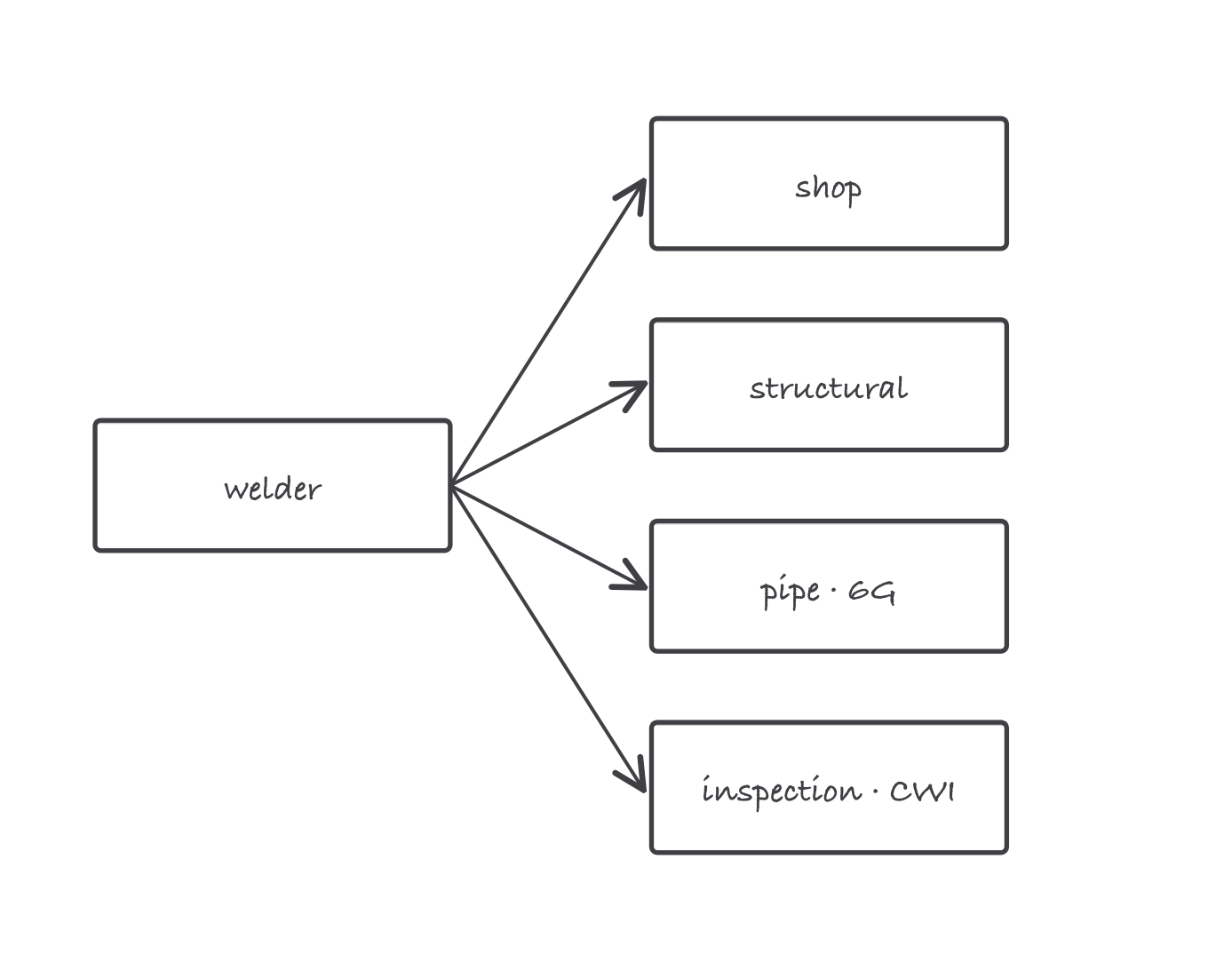
Four economic lives on one base skill; pick the branch deliberately
How credentials map to branches
- Shop: employer quals, maybe AWS Certified Welder for portability.
- Structural: D1.1 position quals, registry-backed.
- Pipe: 6G, plus whatever each project’s WPS demands; expect to re-test often, it is normal.
- Inspection: CWI, then endorsements and experience.
The move most welders mis-time
Going from tools to inspection too late. CWI requires documented experience, but the earning curve rewards starting the study years before your body asks you to. The welders who transition well treat code fluency as a parallel skill from mid-career, not a retirement plan.
Verified requirements
| Where | Expires | Renewal | Continuing education |
|---|---|---|---|
| United States (federal) | Yes | 9 years, with renewal applications required at years three and six after the initial activation date | 80 Professional Development Hours is one of four nine-year recertification routes; the others are retaking Part B Practical, passing an endorsement exam, or achieving Certified Radiographic Interpreter status |
| United States (federal) | No | Confirm with issuer | Confirm with issuer |
| United States (federal) | Yes | Confirm with issuer | Confirm with issuer |
Information comes from issuing-authority sources. Confirm current rules, fees and eligibility with the authority before acting.