Qualifications · Welding
Welder Qualification: How It Actually Works
Part of Your First Welding Cert · step 20 of 24 · next: The AWS Certified Welder Program
In learning paths: Your First Welding Cert
Welding has no journeyman license. What it has instead is qualification: documented, witnessed proof that you can make a sound weld with a specific process, on a specific material, in a specific position, to a specific code. Understand how qualification works and the whole credential landscape of the trade snaps into focus.
*Learn the Trades is a free study resource. We are not a licensing body, an authorized training provider, or an exam administrator. Reading this page does not award any card, license, or certification. Always verify requirements with the issuing authority linked in the sources.*Qualification vs certification vs license
Three words that get mixed up constantly on job sites:
- Qualification is the act: you weld a test coupon under witness, it gets tested (bend, break, or radiograph), and passing qualifies you to that procedure’s scope. Employers and codes call this a performance qualification.
- Certification is the paperwork layer: a body such as the American Welding Society maintaining a record that you passed, as in the AWS Certified Welder program.
- License is government permission to practice, and for welders it essentially does not exist in the US. A handful of cities run their own welder certificates, but there is no state welding license the way there is for electricians or plumbers.
The practical consequence: your employability is a stack of quals, and every qual has a scope and an expiry logic.
How a qualification is scoped
A performance qualification is defined by variables the governing code lists. The ones that matter most in practice:
- Process (SMAW, GMAW, FCAW, GTAW)
- Material and thickness range
- Position (1G through 6G for groove welds; the position lesson covers this)
- Filler metal and electrode class
- The governing code: structural work under AWS D1.1, pressure work under ASME Section IX, pipelines under API 1104. Qualifying under one code does not automatically qualify you under another.
Change a variable outside your qualified range and you are, formally, not qualified for that weld.
Staying qualified
Qualifications are kept alive by continuity: under the major codes, a welder who keeps using the process without an unacceptable break, with the employer documenting it, stays qualified. Let the process lapse long enough and you re-test. The exact continuity rules belong to the governing code and the employer’s quality system, which is why welders moving employers often re-test even with a wallet full of old papers.
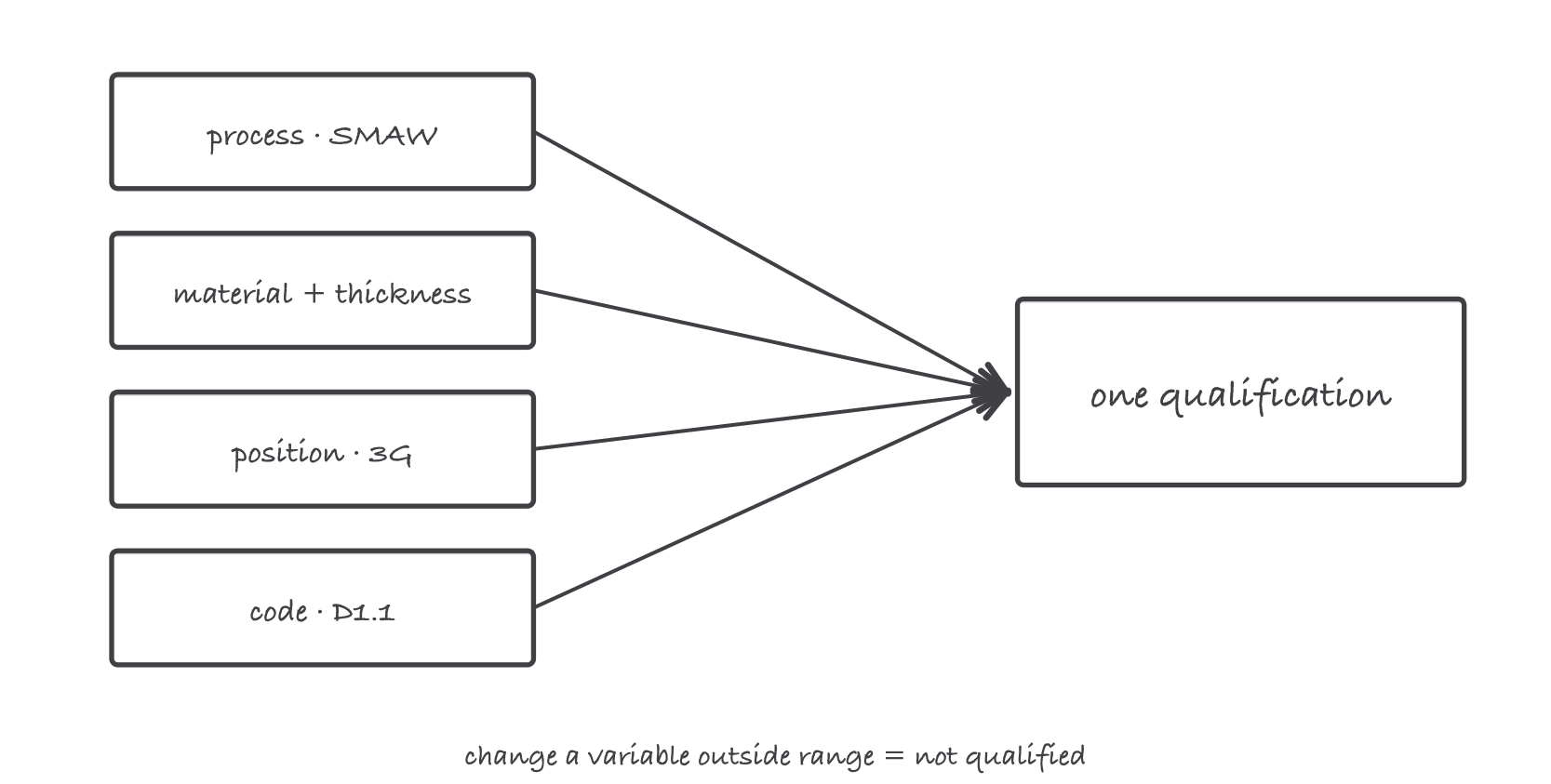
A qual is a scope, not a badge: four variables define it
Where it bites
- Quals are usually employer-held. A test you passed at one shop, under their WPS, may not transfer. The AWS Certified Welder program exists partly to make quals portable through a national registry.
- The code governs, not the certificate. Inspectors verify you are qualified to the WPS in use on this job today.
- “Certified welder” on a resume means nothing without scope. Certified to what code, process, position, thickness? That sentence is your actual credential.
Verified requirements
| Where | Expires | Renewal | Continuing education |
|---|---|---|---|
| United States (federal) | No | Confirm with issuer | Confirm with issuer |
| United States (federal) | Yes | Confirm with issuer | Confirm with issuer |
Information comes from issuing-authority sources. Confirm current rules, fees and eligibility with the authority before acting.