Learn · Welding
Hot Work, Fire Watch and the Hollow Container Rule
A cutting torch throws sparks and molten slag well past arm’s reach, and they keep burning after they land. That gap is what hot work rules exist for: the ignition happens where you are looking, and the fire happens somewhere else, often after you have packed up and gone. Hot work is welding, cutting, burning and heating, and OSHA uses exactly that list when it defines a hot work permit at 1910.146.
Why it matters on the job
Nothing about the fire risk is visible from behind the hood. You have a lens over your eyes, a hot arc filling your field of view, and both hands committed. Somebody else has to be watching the floor below, the wall cavity behind, and the pallet of cardboard nobody moved, and that somebody has to keep watching after the arc goes out.
Which rulebook you are under
Welding sits in two different parts of 29 CFR, and which one applies depends on the work, not on the equipment in your hands.
- Construction: 29 CFR 1926 Subpart J. 1926.350 covers gas welding and cutting, 1926.352 covers fire prevention, 1926.353 covers ventilation and protection.
- General industry: 29 CFR 1910 Subpart Q. 1910.252 is the general requirements section, 1910.253 covers oxygen-fuel gas welding and cutting.
The same welder, the same machine and the same joint can fall under either one. Fabricate a stair stringer in the shop and you are in 1910. Install it in a building under construction that afternoon and you are in 1926. Working welders cross that line constantly, sometimes inside a single week, and the two rulebooks do not say identical things.
Fire watch duration shows the split plainly. General industry, at 1910.252(a)(2)(iii)(B), requires that “a fire watch shall be maintained for at least a half hour after completion of welding or cutting operations.” Construction, at 1926.352(e), says instead that “additional personnel shall be assigned to guard against fire … for a sufficient period of time after completion of the work.” No number.
The construction rule is not the looser rule. It is the less specific one, and the difference matters in the opposite direction from how people read it: on a construction site you own the judgment about how long is sufficient, with no published figure to hide behind.
What a fire watch actually is
The trigger, at 1910.252(a)(2)(iii)(A): “Fire watchers shall be required whenever welding or cutting is performed in locations where other than a minor fire might develop.” The test is what could develop, not how long the job takes. A two-minute cut over a loading dock full of stock trips it, and a two-hour job in an empty concrete pit may not.
The staffing, in the construction wording at 1926.352(e): “additional personnel.” A fire watch is another person, assigned to that and watching, not the welder glancing around between passes and not a helper who is also fetching rod.
The hollow container rule
Never put heat into a closed container until you know what it held and it has been cleaned, vented or inerted. Drums, tanks, pipe, buoyancy chambers, anything with an inside you cannot see.
The reason is worth understanding rather than memorizing. A residue you cannot smell keeps evaporating into the space above it, and the vapor concentration in that space climbs as the container warms. Heat from your torch is what pushes a headspace that was too rich or too lean into the range where it will burn. The container then supplies the last ingredient, which is confinement, so combustion that would be a flash in open air becomes pressure with steel around it. “It has been empty for years” describes the liquid, not the vapor, and the vapor is the part that ignites.
The paperwork hook for this is the hot work permit, and OSHA’s definition of one, at 1910.146, is broad on purpose: it covers “riveting, welding, cutting, burning, and heating.” Note the scope limit on that standard, though. 1910.146 “does not apply to agriculture, construction, or shipyard employment.” Construction’s confined space requirements are in 1926 Subpart AA instead.
Worked example: what the half-hour clock costs a shift
A general industry job: cutting and tacking on a mezzanine above a packaging area, three separate bursts of work in one morning.
- Cut 1: 9:10 to 9:35 (25 minutes)
- Cut 2: 10:00 to 10:40 (40 minutes)
- Cut 3: 11:20 to 11:52 (32 minutes)
Torch and arc time totals 25 + 40 + 32 = 97 minutes, which is 1 hour 37 minutes.
Now run the half-hour rule. The clock starts each time the work stops and it restarts each time you strike up again.
- Cut 1 ends 9:35, so the watch runs to at least 10:05. Cut 2 starts at 10:00, before that expires, so the watch never stands down.
- Cut 2 ends 10:40, so the watch runs to at least 11:10. Cut 3 does not start until 11:20, so there is a genuine ten-minute break in coverage, and the watch has to be re-established before the torch lights again.
- Cut 3 ends 11:52, so the watch runs to at least 12:22.
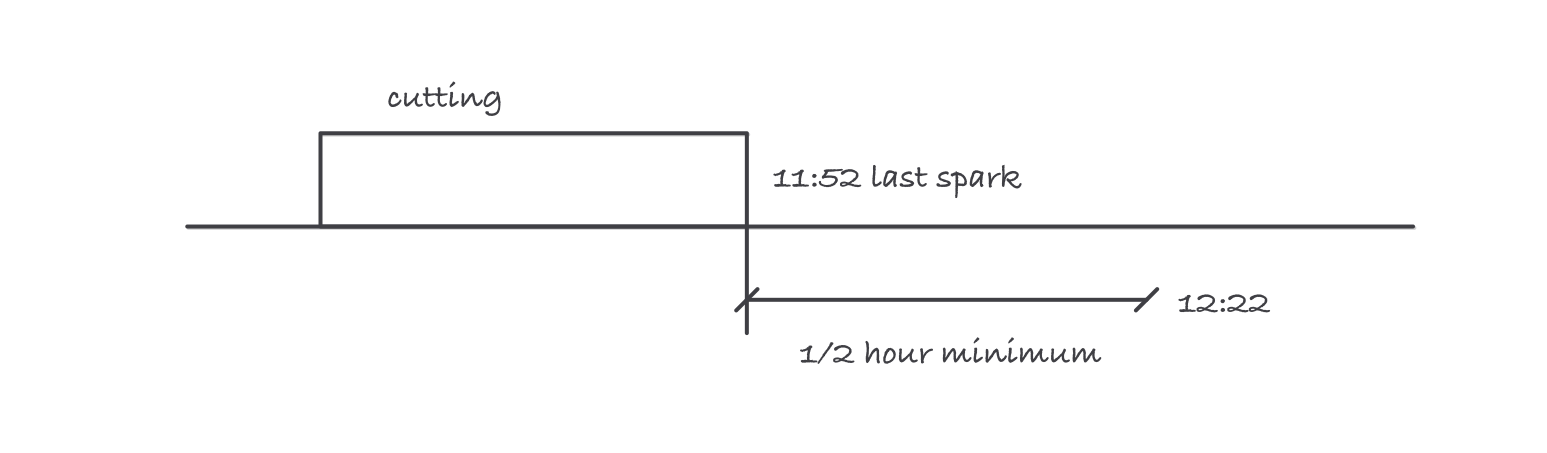
The half hour is measured from the last spark, and every restrike resets it
Watch coverage adds up to 9:10 through 11:10 (120 minutes) plus 11:20 through 12:22 (62 minutes), which is 182 minutes, or 3 hours 2 minutes. That is 182 / 97 = 1.9 times the torch time.
Scheduling the three cuts back to back would have cost one half-hour tail instead of two. And a foreman who staffs the watch for the cutting only, then sends that person to lunch at 11:52, has stopped complying at the exact point the rule was written for.
Where it bites
- A missing number is not permission. Construction’s “sufficient period of time” gives you no line to stand behind, and it is a judgment you have to defend afterward. The general industry half hour is the nearest published figure, and it sets a floor rather than a target.
- The permit rule you trained on may not be your rule. 1910.146 is where many people first meet hot work permits, and it excludes construction outright. On a site, work to 1926 Subpart AA and to your employer’s permit system.
- Sparks land where you are not looking. Slag falls through floor openings, rolls under equipment, and lodges in insulation and packaging where it smolders quietly for a long time. Position the watch where the sparks are going rather than beside the welder.
- Empty means empty of liquid. The hollow container rule has no version that starts with “but this one is obviously fine.” If you cannot confirm what the vessel held and that it has been cleaned, vented or inerted, the torch does not light.