Learn · Welding
Welding Metallurgy Basics
Part of Your First Welding Cert · step 9 of 24 · next: Heat Input and Distortion Control
In learning paths: Your First Welding Cert
Assumes you know: Welding Fundamentals: Heat, Arc and the Weld Pool
An arc weld is a casting poured into forged metal. The puddle solidifies like a tiny ingot, and the solid steel beside it gets heat treated whether you wanted that or not. Welding metallurgy is the study of what your arc does to the metal it touches, and every parameter you set either controls that or ignores it.
Why it matters on the job
Preheat tables, rod ovens, heat input limits, interpass temperatures: every one of those rules exists because of metallurgy. Welders who know why the rules exist follow them when nobody is watching, and they can diagnose a cracked weld instead of just grinding it out and hoping. This lesson is the spine that the next three hang on.
Three zones in every weld
Cut any weld in cross section and you find three different metals where there used to be one:
- Weld metal is the fusion zone: filler and melted base metal mixed in the puddle, now solidified with a cast structure.
- The heat-affected zone (HAZ) never melted, but the arc heated it far enough to change its internal structure. Closest to the fusion line the grains grow coarse; farther out the steel may harden, soften, or lose toughness depending on the alloy.
- Base metal beyond the HAZ never got hot enough to change. It is the only part of the joint the mill certificate still describes.
The boundary between weld metal and HAZ is the fusion line. Most cracking problems in steel live in the HAZ, not in the weld metal, because the HAZ got a heat treatment nobody designed.
Cooling rate is the control knob
Heat carbon steel until it glows and let it cool slowly, and you get a soft, ductile structure. Cool the same steel fast, and it transforms into martensite: very hard, very brittle. A weld on a thick, cold plate is a quench, because the surrounding mass sucks heat out of the joint in seconds.
Three levers set the cooling rate of a weld:
- Thickness. More surrounding steel means a bigger heat sink and faster cooling.
- Starting temperature. A preheated joint cools slower. So does one kept warm between passes.
- Heat input. A hotter, slower weld pass leaves more energy behind, and the joint cools slower.
Fast cooling plus a hardenable steel plus hydrogen equals delayed cracking. Every hydrogen and preheat rule in the trade is aimed at breaking that chain.
Worked example: reading hardenability from a mill cert
How hardenable a steel is rises with carbon and alloy content. The common way to score it is the carbon equivalent (CE) formula:
CE = %C + %Mn/6 + (%Cr + %Mo + %V)/5 + (%Ni + %Cu)/15
A mill certificate for a structural plate lists carbon 0.20% and manganese 1.00%, with only trace amounts of the other elements. Then:
- CE = 0.20 + 1.00/6
- CE = 0.20 + 0.17
- CE = 0.37
As a widely used rule of thumb, steels with CE around 0.40 and below weld without special precautions at moderate thickness. As CE climbs past that, the HAZ hardens more readily, and preheat plus strict low-hydrogen practice stop being optional. The number is not the whole story, but it turns a mill cert into a warning system you can read in ten seconds.
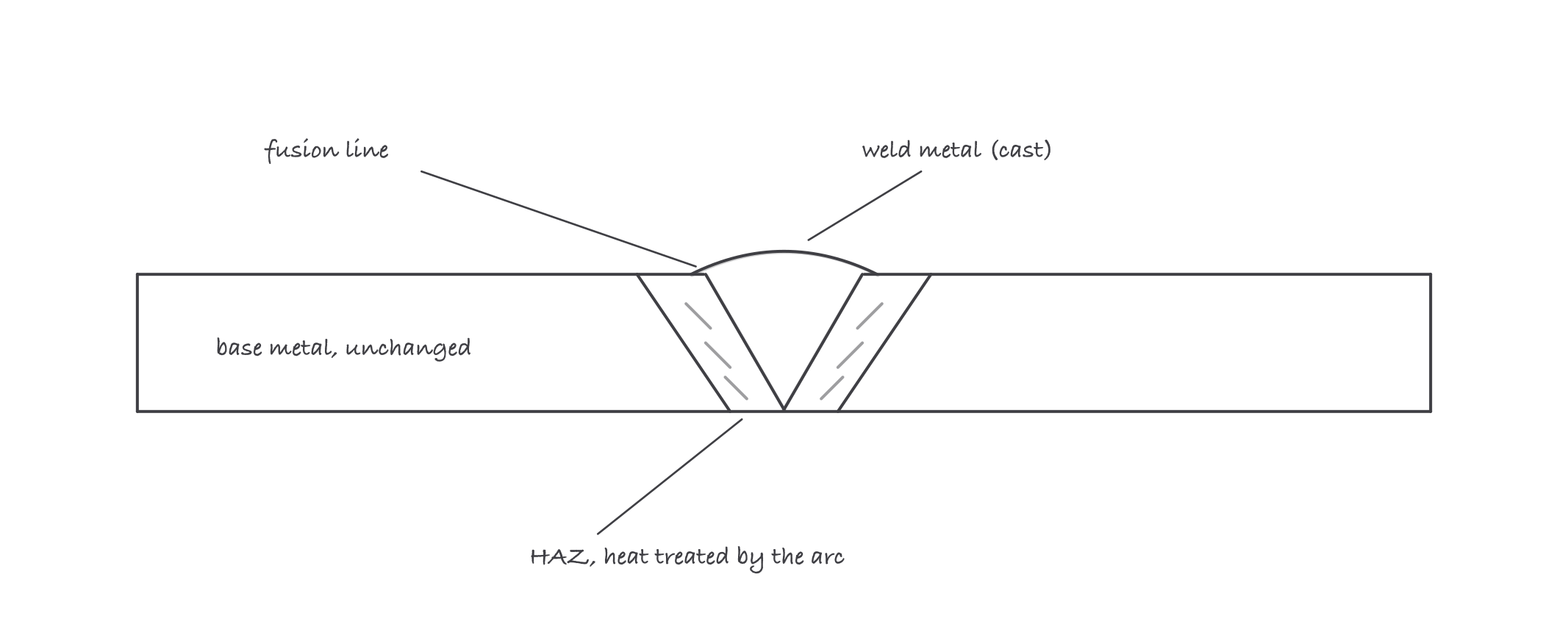
Three metals after one pass: cast weld metal, a heat treated HAZ, untouched base metal
Where it bites
- HAZ cracks hide beside the weld, not in it. The hardest, most brittle metal in the joint is often a thin band just off the fusion line. A crack there can run under a good-looking bead.
- Grinding does not undo metallurgy. A hardened or cracked HAZ stays hardened under a smooth surface. Fixes go through procedure changes, not the grinder.
- Hotter is not automatically safer. High heat input slows cooling, which helps against hardening, but it also grows coarse grains and can wreck the properties of quenched and tempered steels. That is why some procedures list a maximum heat input, not just a minimum preheat.
- Same rod, different steel, different result. A technique that works on mild steel can crack a higher-carbon or alloy plate. Ask what the material is before you strike an arc on it.