Learn · Welding
Plasma Cutting
Part of Your First Welding Cert · step 8 of 24 · next: Welding Metallurgy Basics
In learning paths: Your First Welding Cert
Assumes you know: Oxy-Fuel Cutting
Plasma cutting is a melting process. The machine forces an electric arc through a tiny nozzle orifice along with compressed gas, usually shop air. Squeezed through that opening, the gas ionizes into plasma, a conducting jet in the tens of thousands of degrees, far hotter than any flame. The jet melts a narrow channel through the metal and its own velocity blows the molten metal out the bottom. No combustion chemistry, just concentrated electric heat, which is exactly why plasma cuts what oxy-fuel cannot.
Why it matters on the job
Where oxy-fuel is limited by chemistry to carbon steel, plasma cuts anything that conducts electricity: carbon steel, stainless, aluminum, copper, brass, cast iron. It starts instantly with no preheat, cuts thin material far faster and cleaner than a flame, and leaves a narrow kerf with a small heat-affected zone. Fab shops use it for sheet and plate work, mechanics for exhaust and body metal, and CNC tables are built around it. Its limits are the flip side: it needs electricity and clean compressed air, and handheld machines top out around an inch of steel where big oxy-fuel torches are just warming up.
How the arc becomes a blade
A plasma torch is an arc welding circuit with a bottleneck. The electrode sits inside the torch behind a copper nozzle with an orifice smaller than a pencil lead. Gas swirls through that gap, the arc ionizes it, and the orifice constricts the whole discharge into a stiff, fast jet. Constriction is the entire trick: the same arc that would sprawl softly in a welding torch comes out as a cutting blade because it is forced through a small, cooled opening.
Because the metal only has to melt, not burn, the material no longer matters chemically. It only has to conduct, since the cutting arc runs from the electrode, through the jet, into the workpiece, and back through the work clamp. Most torches first strike a small pilot arc inside the torch so the jet can reach out and transfer to the work; that pilot also lets you start a cut mid-plate or on expanded metal where the arc breaks and re-establishes constantly.
A concrete setup
Cutting 3/8 in mild steel with a typical 45 A handheld machine: clean, dry air at the pressure the machine specifies, usually around 70 to 90 psig inlet, the work clamp on bare metal, and a fresh tip and electrode in the torch. With a drag shield fitted you rest the torch lightly on the plate; otherwise hold a standoff of about 1/8 in. Start at the plate edge, hold the torch square, and travel so the spray of sparks exits nearly straight underneath, angling back slightly. Sparks blasting back up at you means too fast or underpowered; a wide, slow-blown kerf means too slow. Amperage buys thickness: that same 45 A class machine drags along near its severance limit around 5/8 to 3/4 in, where cut quality is gone even though the plate eventually parts.
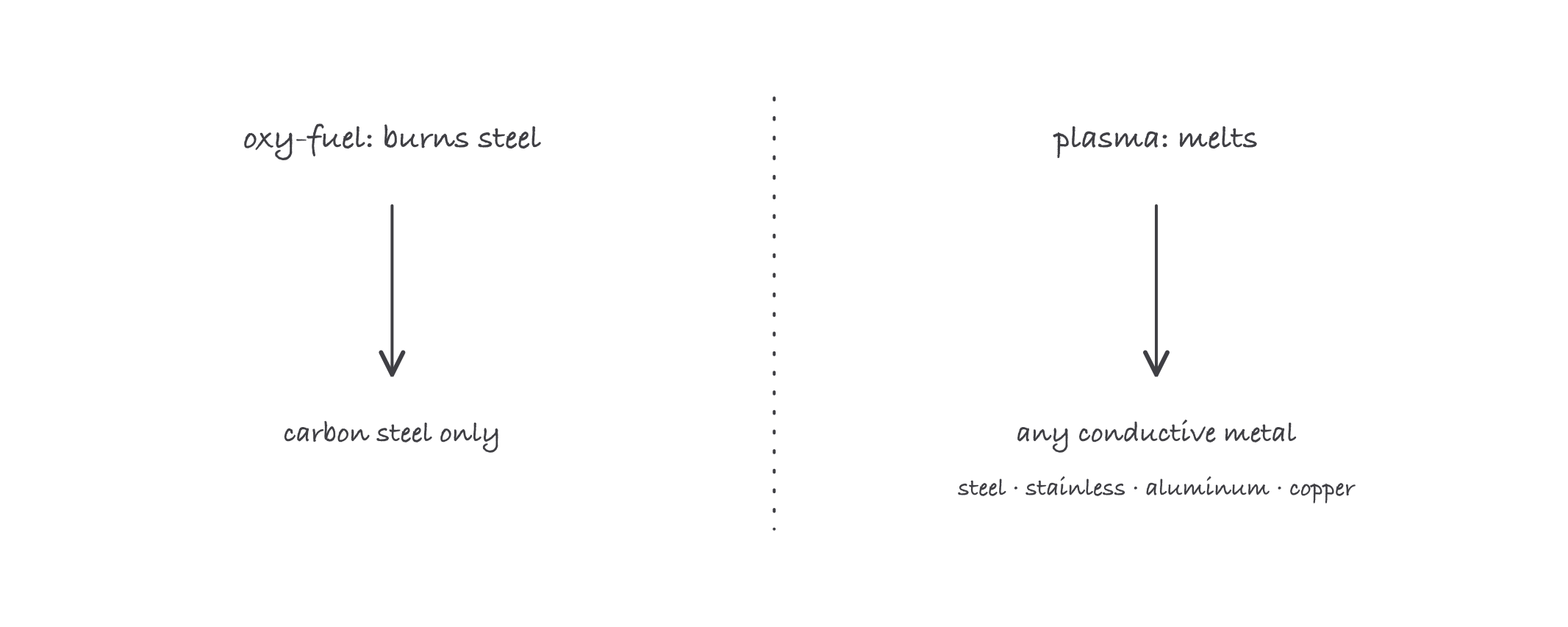
The dividing line between the two cutting processes: combustion needs steel, melting only needs a conductor
Where it bites
- Wet air kills consumables and cuts. Compressor moisture spits and pops in the arc, chews up electrodes and tips, and leaves ragged edges. A dryer or good filtration on the air line is part of the machine, not an accessory.
- The work clamp is still a real connection. Plasma is an arc process; a clamp on paint or rust gives hard starts and wandering cuts. On coated or hinged work, grind a clamp spot first.
- Higher open-circuit voltage means real shock risk. Plasma machines run much higher voltage than welding arcs. Do not bypass the torch safety interlocks, and never change consumables with the machine energized.
- The hollow-container rule applies to plasma too. No preheat flame does not mean no ignition source; the jet and its sparks light flammable vapor exactly as well as a torch. Closed vessels get cleaned, vented or inerted first, same as with oxy-fuel.
- It is still an arc. The jet emits UV like a welding arc: shaded eye protection per the machine’s chart, covered skin, and awareness of people around you. The noise and fine fume of plasma also call for hearing protection and ventilation, especially on stainless.
Verified requirements
| Where | Expires | Renewal | Continuing education |
|---|---|---|---|
| United States (federal) | No | Confirm with issuer | Confirm with issuer |
Information comes from issuing-authority sources. Confirm current rules, fees and eligibility with the authority before acting.